BioLNG and bioCNGGuide
LNG and L-CNG stations for bioLNG: construction, components and operation
An LNG station consists of a cryogenic tank, pump, dispenser and safety systems; an L-CNG station additionally vaporises gas into compressed form. We describe the components, refuelling, safety and operation.
Other language versions: polski.
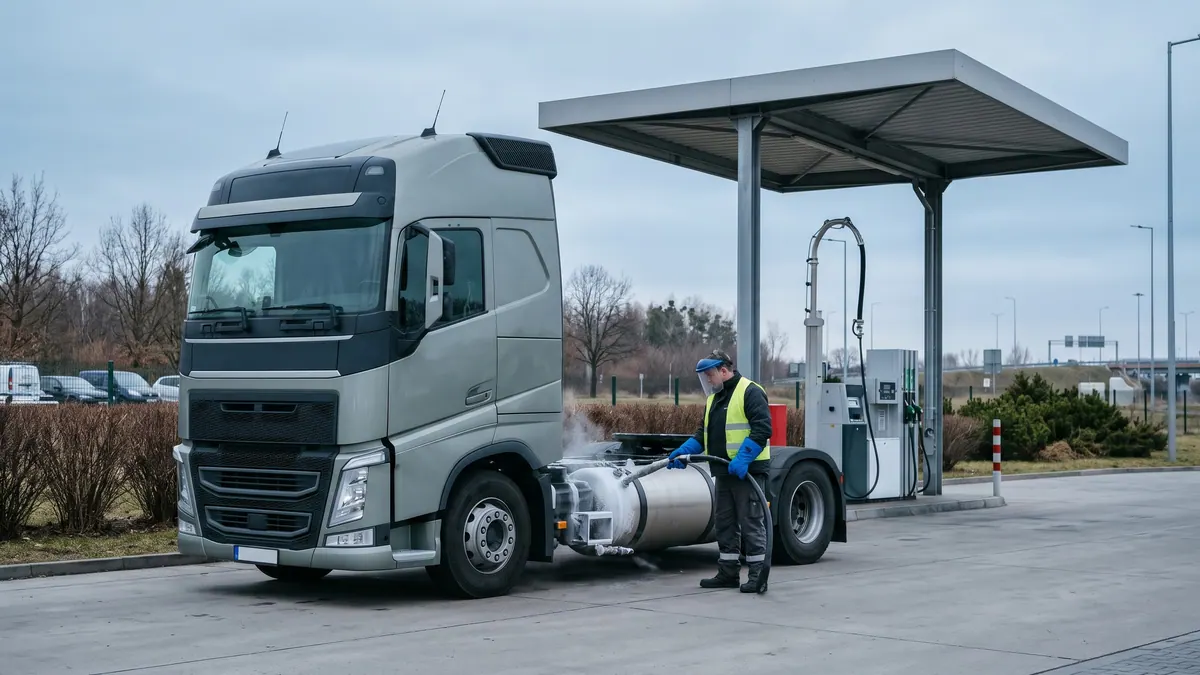
An LNG station is an installation for refuelling vehicles with liquefied gas, based on a vacuum tank holding cryogenic liquid (about −162°C), a cryogenic pump, a dispenser, and safety and boil-off gas recovery systems. An L-CNG station additionally includes a high-pressure pump and a vaporiser, which convert LNG into compressed gas at high pressure, so that it can also refuel CNG vehicles. If the supplier provides bioLNG with certified origin, the fuel can be sold as renewable, which requires documentation along the entire delivery route.
Station components
- Cryogenic tank – a vacuum-insulated tank, usually in a vertical or horizontal arrangement, with a capacity from over a dozen to several dozen cubic metres or more; equipped with safety valves, level indicators and a pressure control system.
- Tanker unloading – cryogenic hoses, valves, earthing and pressure control.
- Cryogenic pump – delivers LNG to the dispenser; submerged pumps are used to limit evaporation.
- Dispenser – with a mass (Coriolis) metering system, a filling hose and a gas return hose, and a coupling with a handle that prevents leaks.
- Boil-off recovery system – collection of the evaporated gas and its use (e.g. compression to CNG, supply to a local consumer, discharge to a flare).
- L-CNG: a high-pressure pump, a vaporiser (heater) and CNG buffers, a CNG dispenser.
- Safety: gas and flame detection, shut-off valves, emergency buttons, lighting and signage, explosion hazard zones (ATEX).
- Measurement systems and monitoring: level, pressure, temperature, flow.
Refuelling a truck
An LNG vehicle has a cryogenic fuel tank (usually one or two), and refuelling takes place by connecting the filling hose and the return hose. After connection, the pump delivers LNG, and gas from the vehicle returns through the return hose to equalise pressure. The whole process takes several to a dozen or so minutes, depending on the dispenser and temperatures. The vehicle operator wears protective equipment (gloves, face shield) because of contact with the cryogenic liquid.
Range and consumption
An LNG truck consumes roughly several dozen kg of LNG per 100 km (depending on weight, route and engine). For example: consumption of 28 kg LNG/100 km means that a tank containing 400 kg of fuel lasts for about 1430 km. Range depends on conditions and may vary. The energy in 400 kg of LNG is about 5.6 MWh (400 × 13.9 kWh/kg).
Example: station scale
Assumptions: the station serves 20 trucks per day at 250 kg of LNG each, i.e. 5 t per day. Deliveries by a tanker with a capacity of 18 t take place every 3–4 days. A tank with a capacity of 60 m³ (about 26 t, at a density of 0.43 t/m³) holds a stock for about 5 days. The station must have a buffer that covers delivery delays and boil-off losses, and the annual volume is about 1800 t of LNG ≈ 25 GWh. The figures are illustrative.
Boil-off and losses
A cryogenic tank evaporates, especially when only slightly filled and in hot weather. This gas has to be managed in order to avoid methane emissions. The solutions are re-liquefaction (costly), compression and sale as CNG (L-CNG), supply to local consumers or burning in a flare. The station design should provide for such a solution from the start.
Regulations and supervision
Pressure vessels and gas installations are subject to regulations on technical equipment and technical supervision, and stations to fire, building and Ex-zone regulations. Inspections are carried out, among others, by the Office of Technical Inspection (Urząd Dozoru Technicznego). ADR regulations apply to the carriage of LNG. Detailed requirements depend on the size of the station and the classification of the establishment with regard to the risk of major accidents.
Operation and training
Station staff must undergo training in occupational safety when working with cryogenic liquids, rescue and emergency procedures. The procedures include tanker unloading, a leak check after every delivery, periodic inspections of safety valves and tests of gas sensors. Drivers of fleets using the station should know the refuelling rules, and the operator should have instructions for customers. Good practice is an incident register, which makes it possible to analyse failures and prevent their recurrence.
Summary
An LNG or L-CNG station is an investment that combines cryogenic engineering with logistics. Profitability depends on steady demand for the fuel, the availability of deliveries and the management of boil-off gas, and the status of bioLNG on documentation of origin.
Sources
Related articles