BiogasExplainer
Malaysia: palm oil mill effluent (POME) as a source of biogas and methane. A requirement for new mills
Palm oil mills produce POME effluent with a high organic matter content. Since 2014 new and expanded mills in Malaysia have had to have biogas capture or methane avoidance systems.
Other language versions: polski.
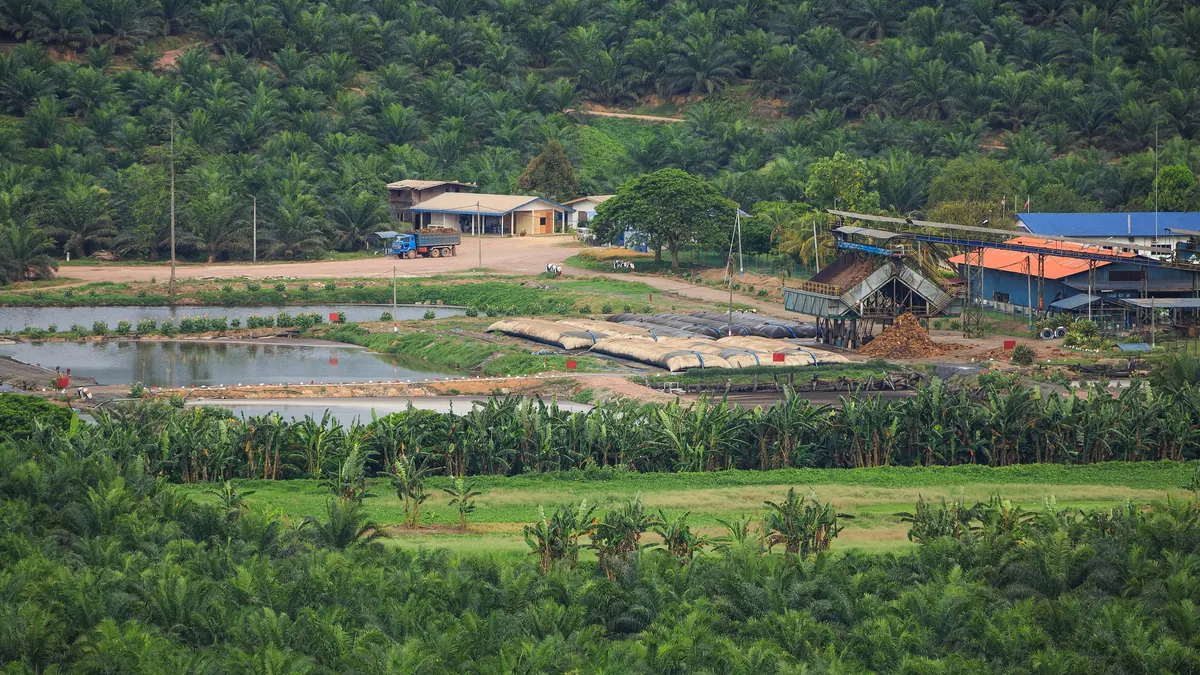

Palm oil mills in Malaysia generate huge quantities of process effluent — POME (palm oil mill effluent) — which, after anaerobic digestion, yields biogas with a high methane content. In open lagoons this gas escapes into the atmosphere, which makes POME an important point source of methane in the country's agri-food sector. According to information from 2014, the Malaysian Palm Oil Board (MPOB) requires new mills to capture biogas or avoid methane, but implementation has sometimes been difficult.
Scale of the problem
According to a paper published on 31 December 2020 by MPOB, the palm oil sector can generate about 65 million t of POME per year, with a ratio of POME mass to fresh fruit bunches of 0.67:1. In 2019, 452 mills processed 98.28 million t of fresh bunches, yielding 19.86 million t of crude palm oil (roughly one fifth of the bunch mass). Biogas produced in POME digestion contains, according to this paper, about 65% methane. If the gas is captured, it becomes a renewable energy source; in open lagoons it is lost. Check calculation: 98.28 million t of bunches multiplied by 0.67 gives about 65.8 million t of POME, a value consistent with the paper's estimate of about 65 million t per year. This means that for every tonne of bunches processed there is about 0.67 t of effluent requiring treatment.
Where POME comes from
The effluent arises during bunch processing, including fruit sterilisation and oil clarification. It contains organic matter with a high load, which is why it is a good substrate for methanogenic bacteria. This is the reason why traditional anaerobic lagoons generate methane, and covered lagoons or reactors allow it to be collected.
The regulatory requirement
According to Eco-Business's report of 6 November 2014, MPOB requires the "mandatory installation of biogas capture or methane avoidance facilities" when building new mills and when increasing throughput at existing mills. The Sarawak palm oil producers' association (SOPPOA) estimated at the time that 67 mills in that state would have to incur outlays exceeding RM 600 million in total, with no clear possibility of recovering them. It also pointed to the lack of an electricity grid that could take energy from the mills, and to difficulties in setting a purchase tariff, given the low cost of power generation by the operator in Sarawak. SOPPOA asked for implementation of the requirement in Sarawak to be deferred to 2025, following an earlier request for a further five years.
What happens to the gas after capture
Biogas from POME can be flared, used in boilers, in engines to generate electricity at the mill, or sold to the grid. Profitability depends on the availability of a grid connection and on the purchase tariff. The 2014 example from Sarawak shows that distance from the grid and low energy prices can determine the feasibility of environmental regulations.
Climate significance
Methane capture from lagoons is one of the options for reducing emissions in the palm oil sector, because the source is a point source and well defined. The benefit, however, depends on whether the gas is flared or used, rather than merely collected and released. For importers and regulators who assess the emissions of palm oil in the supply chain, what matters is therefore not the mere declaration of capture but its documentation.
How to read the numbers
Data on the number of mills and capture installations differ depending on the source and the year. MPOB gave a figure of 452 mills for 2019. Statistics on biogas capture come from different publications and relate to different years (later data are in the update note), so they should not be treated as a uniform data series. In comparisons it is necessary to pay attention to whether the figure refers to the number of mills with a capture system, to installed capacity, or to gas actually used.
What this means for Poland and Europe
The Malaysian experience shows two things that are also important for biogas policy in the EU: that an obligation to capture methane from industrial waste can be feasible only when accompanied by an opportunity to sell energy or gas, and that data on the degree of implementation must be taken from primary publications rather than from trade reports. For importers of fuels and raw materials from Asia this means the need to verify methane capture declarations in certification schemes.
Sources
- MPOB — The future of biogas in the Malaysian palm oil industry: why need methane capture? (31.12.2020)
- Eco-Business — Palm oil mills' biogas capture implementation in Sarawak a major challenge: SOPPOA (6.11.2014)
- Journal of Oil Palm Research — Renewable energy and greenhouse gases emission reduction potential of biogas from POME (2024)
- The Edge Malaysia — How Malaysia's palm oil industry is cultivating a greener tomorrow (treść brandowana, 2025)
Related articles