Waste-to-energyExplainer
R1 or D10: the energy efficiency indicator of incineration plants — formula, thresholds and example
A municipal waste incineration plant is a recovery installation (R1) if its energy efficiency exceeds 0.60 or 0.65; otherwise it is disposal (D10). We give the formula and a worked example.
Other language versions: polski.
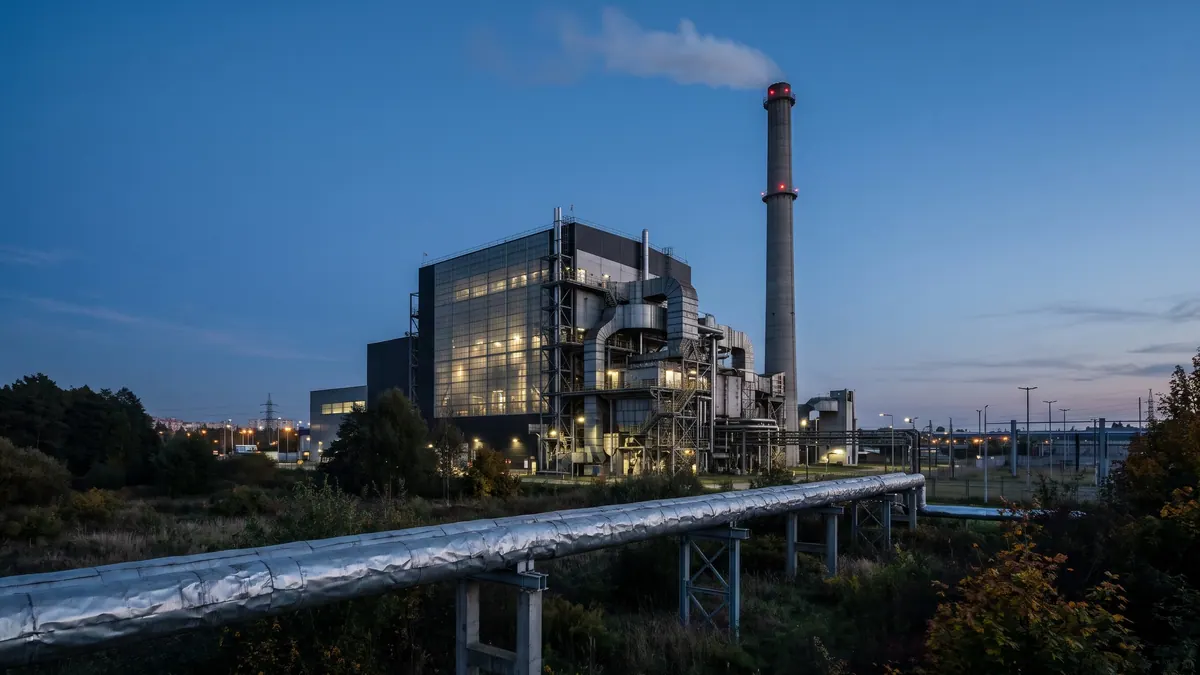
A municipal waste incineration plant may be classified as a recovery (R1 — use principally as a fuel or other means to generate energy) installation or as a disposal (D10 — incineration on land) installation. This is decided by the energy efficiency indicator from Annex II to Directive 2008/98/EC: it must be at least 0.60 for installations in operation and permitted before 1 January 2009 and at least 0.65 for the others.
The formula
The indicator is calculated with reference to a year:
R1 = (Ep − (Ef + Ei)) / (0.97 × (Ew + Ef))
where:
- Ep — annual energy produced as heat or electricity; electricity is multiplied by 2.6, and heat produced for commercial use by 1.1 (GJ/year),
- Ef — annual energy input to the system from fuels contributing to the production of steam (GJ/year),
- Ew — annual energy contained in the treated waste, calculated using the net calorific value (GJ/year),
- Ei — annual energy imported, excluding Ew and Ef (GJ/year),
- 0.97 — a factor accounting for energy losses due to bottom ash and radiation.
Since Annex II was amended by Commission Directive (EU) 2015/1127, the result of the formula is additionally multiplied by a climate correction factor (CCF), which depends on the number of heating degree days (HDD) at the location of the installation: for HDD ≥ 3350 CCF = 1, and for warmer locations it is greater than 1. The example below omits the CCF (CCF = 1 is assumed).
The factors 2.6 and 1.1 reflect the higher value of electricity compared with heat. The mechanism therefore rewards the generation of electricity, but it also allows a heat-only installation to meet the threshold.
Worked example (illustrative)
Let us take an incineration plant in which: Ew = 1000, Ef = 20, Ei = 40 (energy units, e.g. TJ per year). Denominator: 0.97 × (1000 + 20) ≈ 989.
| Variant | Output | Ep | Ep − (Ef + Ei) | R1 |
|---|---|---|---|---|
| Electricity only | 200 | 200 × 2.6 = 520 | 460 | approx. 0.47 |
| Electricity only | 300 | 300 × 2.6 = 780 | 720 | approx. 0.73 |
| Cogeneration | 150 electricity + 350 heat | 390 + 385 = 775 | 715 | approx. 0.72 |
| Heat only | 700 | 700 × 1.1 = 770 | 710 | approx. 0.72 |
These figures illustrate the mechanism, not the parameters of a specific installation. It can be seen that an incineration plant operating solely in condensing mode and delivering to the grid only a small part of the energy contained in the waste will not reach the 0.65 threshold; in this example, only electricity generation at a level of approx. 27% of the energy in the waste, or heat offtake, changes the classification. That is why the location of the installation relative to a district heating network or customers of process steam is so important.
Which installations the formula applies to
A footnote in the Directive limits the formula to installations dedicated to the processing of solid municipal waste only. For incineration plants for industrial or hazardous waste there is no uniform indicator, and classification is determined individually on the basis of the documentation and the permit conditions.
Why classification matters
- The waste hierarchy. Recovery ranks higher than disposal.
- Shipments of waste. In the rules on the shipment of waste, e.g. in the transboundary transport of municipal waste, the procedures and grounds for objection are different for recovery than for disposal.
- Statistics and reporting. Energy recovery is counted as recovery, although it is not recycling and does not count towards recycling levels.
- Image and financing. R1 status may matter when a project is assessed by financing institutions or in tender documents.
- Justification of the project. The indicator shows whether the project actually uses the energy from waste or merely reduces its volume.
How it is applied in practice
The operator calculates the indicator for a full year of operation on the basis of metered quantities: the quantity and calorific value of the waste (from the fuel balance), the electricity and heat delivered to customers, the consumption of auxiliary fuels and imported energy. The classification of the installation as R1 is entered in the administrative documents of the installation, and the authority may require the calculations to be documented. It should also be remembered that the calorific value of waste changes with the season and the composition of the collection, so the indicator may change from year to year.
Typical errors
- Using the gross calorific value instead of the net one.
- Counting heat delivered to coolers and condensers instead of heat sold for use.
- Omitting imported energy during outages.
- Adopting the design indicator rather than the result from actual operation.
- Failing to take into account that the 0.60 threshold applies to installations in operation and permitted before 1 January 2009, and for the others it is 0.65.
What to do first
Draw up an energy balance at annual level, verify the metering, and then calculate the indicator in several scenarios (with and without heat offtake). If the result is close to the threshold, check whether it can be improved: by delivering more heat, reducing energy imports, or optimising the steam parameters. When designing a new installation, the decision to locate it near heat customers usually yields more than fine-tuning the turbine.
Changes in waste composition and the indicator
The calorific value of municipal waste rises with the share of plastics and paper and falls with higher moisture and a higher share of biowaste. The introduction of separate collection of biowaste therefore reduces the moisture of residual waste and increases its calorific value, but at the same time reduces its quantity. When designing an incineration plant, the forecast composition of the waste over the entire operating period should be taken into account, not just the current one. Excessive capacity of the installation relative to the waste stream lowers efficiency and makes it harder to reach the R1 threshold.
This text is for information purposes only and does not constitute legal advice; before an investment or formal decision, check the current wording of the legislation and consult a lawyer or the competent authority.
Sources
Questions and answers
Does the R1 indicator apply to every incinerator?
The formula applies to installations intended for processing municipal (solid) waste. For other incinerators, e.g. for hazardous waste, a different classification applies.
What changes when an incinerator has R1 status instead of D10?
The installation is treated as recovery rather than disposal. This matters in statistics, in waste classification and in the rules on waste shipments, where recovery and disposal are treated differently.
Related articles