Waste-to-energyExplainer
Waste pyrolysis: the state of the technology, products, limitations and a realistic assessment
Pyrolysis is the thermal decomposition of waste without oxygen into gas, oil and char. We show the types of process, the product balance, the barriers to scaling up and what to realistically expect from the technology.
Other language versions: polski.
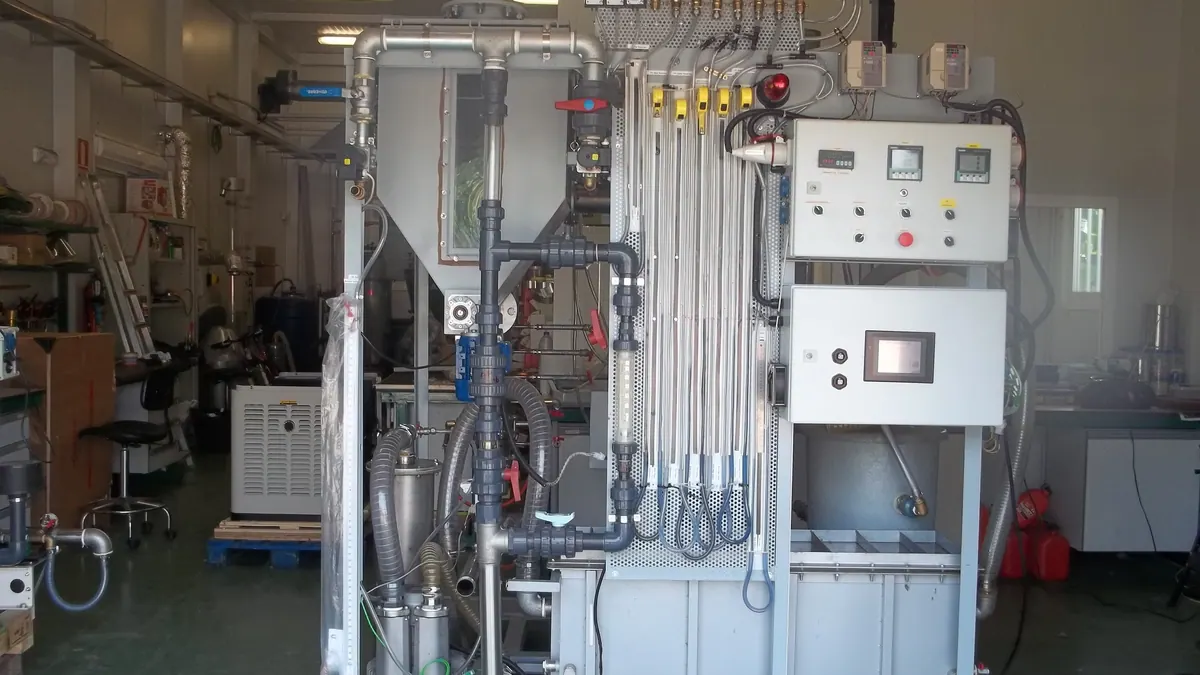

Pyrolysis is the thermal decomposition of organic material in an oxygen-free atmosphere, usually at a temperature of about 400 to 800 °C. Instead of flue gas, three streams are produced: combustible gas, a liquid (pyrolysis oil) and solid char. In practice it is not a “miracle” way of dealing with waste, but one of the technologies suited to narrow, well-prepared feedstock streams.
How the process runs and what the products depend on
The heated material breaks down into volatile fragments, which on cooling partly condense into oil and partly remain gas; the remainder forms char. The fractions’ shares depend on temperature, heating rate and the vapour residence time in the reactor:
| Variant | Temperature and rate | Dominant product |
|---|---|---|
| Slow pyrolysis | lower temperature, minutes to hours | char (biochar) |
| Fast pyrolysis | moderate temperature, very short vapour time | liquid (oil) |
| High-temperature pyrolysis | higher temperature | gas |
Rotary, fluidised-bed, screw and batch reactors are used. Heat is supplied from outside (most often by burning part of the gas produced), because there is no oxygen inside the reactor.
For which waste it makes sense
Best regarded is the pyrolysis of biomass (wood waste, sludges, agricultural residues), whose main product tends to be biochar, and of used tyres, where a homogeneous feedstock and valuable char (carbon black) give a more stable calculation. For plastics, pyrolysis is attractive for polyolefins (PE, PP), whereas PVC and PET are troublesome: PVC releases chlorine, which forms hydrogen chloride and corrodes the installation, and PET contains a lot of oxygen, which worsens the quality of the oil.
Troublesome, by contrast, are mixed municipal waste and contaminated fractions: variable moisture, the presence of glass and metals, chlorine and nitrogen compounds, and the need for preliminary preparation of the feedstock limit efficiency and reliability. That is why plants based on pyrolysis usually require prior sorting and removal of contaminants.
What to do with the products
- Pyrolysis gas has a calorific value that allows it to power the process itself, and the surplus an engine or boiler. It does, however, contain tars and impurities, which requires cleaning.
- Pyrolysis oil is a mixture with a high content of oxygenated compounds (in the case of biomass) or hydrocarbons (in the case of polyolefins). It usually requires upgrading — filtration, hydrotreating or dilution — before it goes to a refinery, cracker or boiler.
- Char can be a solid fuel, a soil additive (biochar) or a sorbent material, but only if it meets the requirements for heavy metals and organic compounds. Otherwise it remains waste.
Barriers to scaling up
European experience shows several recurring problems:
- Feedstock quality and continuity — installations are designed for a specific composition; variability causes downtime.
- Energy balance — the more moisture and inerts, the more heat must be put into the process.
- Maintenance — tarry deposits, corrosion and clogging of the gas cleaning systems.
- Sales of products — no steady recipient for the oil and char, and unclarity whether the product can cease to be waste.
- Scale and cost — many projects declared high capacities but achieved much lower utilisation.
In assessing the maturity of the technology one must distinguish biomass and tyres (advanced deployments) from mixed plastic waste (mainly pilots and first commercial installations). It is not worth basing an investment decision on individual declarations by technology suppliers; instead one can ask for references from installations operating on similar feedstock and data from over a dozen months of operation.
Legal decisions that must be taken early
The status of the installation and of the products decides the whole project. Among other things, one must determine whether the installation will be treated as an incinerator (if the substances produced are then burned) or as a waste processing installation (recovery), and whether the oil or char can cease to be waste. We discuss this in detail in a separate article on the legal status of pyrolysis and gasification.
A realistic assessment
Pyrolysis makes sense where there is a stable, homogeneous waste stream, a reasonable route to market for the products and a well-developed gas cleaning technology. It does not replace separate collection, mechanical recycling or incinerators for residual waste. The most valuable applications are those in which it increases the amount of raw material returned to circulation, and does not merely change the form of the fuel. Before investing it is worth carrying out a mass and energy balance on the real feedstock, not on laboratory material.
Energy and emissions of the process itself
Pyrolysis is an endothermic process: to decompose the feedstock, heat must be supplied, and the amount rises with moisture. The raw material is therefore often dried, and heat for own needs is covered from part of the gas produced. If the gas is burned in a boiler or flare, one must reckon with emissions to air (nitrogen oxides, CO, dust, and with chlorine in the feedstock also HCl and dioxins), which require flue gas cleaning. In addition, condensate wastewater and residues arise, which are classified as waste. The argument that “without oxygen there are no dioxins” is not proof: contaminants can form in the gas combustion and cooling systems.
Questions worth asking the technology supplier
- On what feedstock has the reference installation worked for at least a dozen months, and how many hours a year has it operated?
- What is the mass and energy balance from measurements, not from the design?
- How are the gas and flue gas cleaned, and what happens to the condensate?
- Who takes the oil and char, and on what quality terms?
- What are the costs of maintenance, replacement of reactor components and downtime?
This text is for information only and does not constitute legal advice; before an investment or formal decision, check the current wording of the regulations and consult a lawyer or the competent authority.
Sources
Questions and answers
How do pyrolysis and gasification differ from waste incineration?
Incineration oxidises waste in excess oxygen and usually yields heat directly, while pyrolysis (without oxygen) and gasification (with limited oxygen) break it down into gas, oil or synthesis gas, which are then used.
Is pyrolysis recycling?
It depends on what is produced and how it is used. When a raw material for making new materials is recovered from plastics, this is called chemical recycling; when the products are used as fuel, it is energy recovery.
Related articles