Safety and ATEXExplainer
bioLNG and bioCNG: cryogenic hazards, rollover, fuelling stations and safety zones
Liquefied and compressed biomethane pose different hazards than biogas: cryogenic burns, rollover, hoses at 200–250 bar, and zones around fuelling stations.
Other language versions: Polski, Deutsch, Español, Français, Italiano, Nederlands.
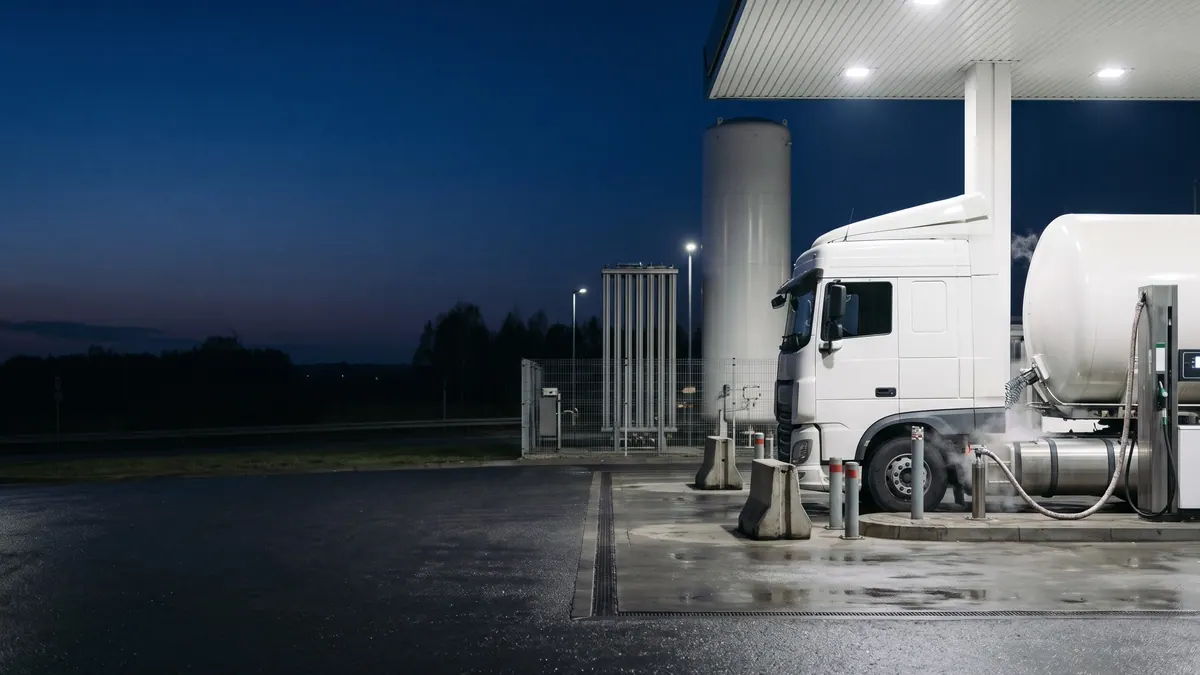
BioLNG and bioCNG are the same methane as in biogas but in a different state, which changes the nature of the hazards: instead of a free release of gas at low pressure we have a liquid at a temperature of −162 °C or gas at a pressure of several hundred atmospheres. The procedures known from the agricultural biogas plant are still needed, but they are not enough.
What liquefied biomethane is
LNG (liquefied natural gas) is produced by cooling cleaned gas to a temperature of about −162 °C at a pressure close to atmospheric. The density of the liquid is about 0.42–0.45 kg/l, and after evaporation and warming to normal conditions 1 litre of liquid gives about 600 litres of gas. This explains both the attractiveness for transport and the biggest hazard: even a small leak of liquid in an enclosed space can quickly produce a large cloud of gas.
Liquefied biomethane is colourless and odourless; after liquefaction no odorant is present, so there is no smell signal of a leak. Cold vapour is initially heavier than air (until it warms up), and then rises, because methane at ambient temperature is lighter than air.
Cryogenic hazards
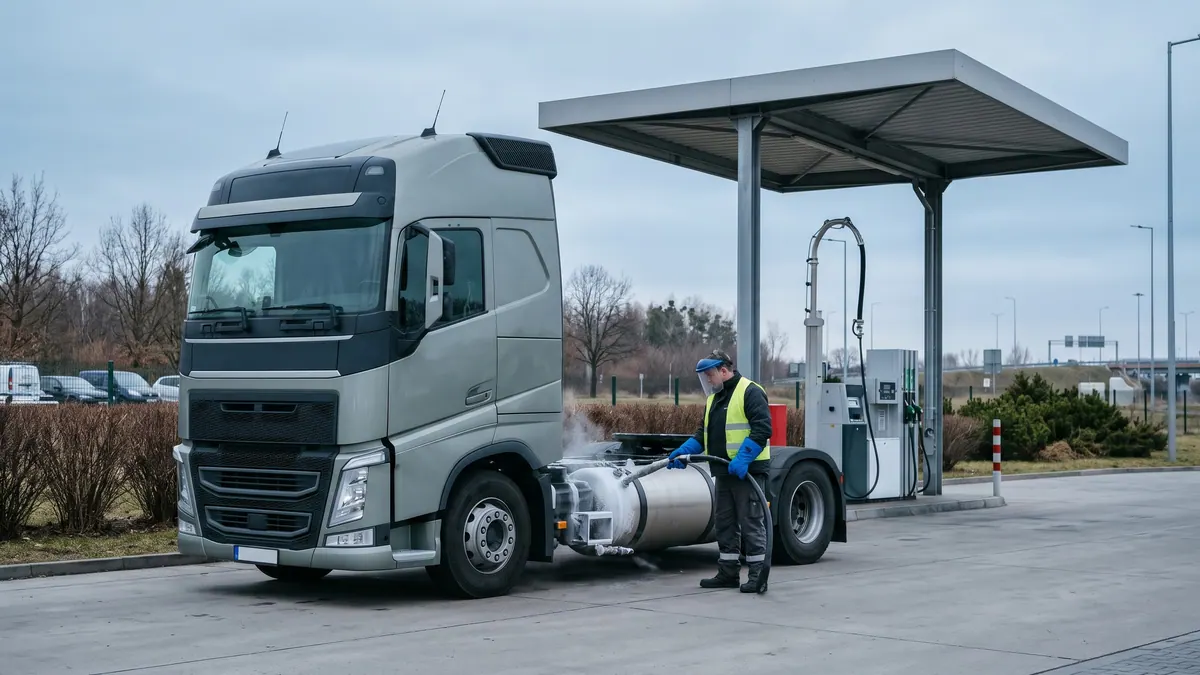
- Cryogenic burns. Skin contact with the liquid or with uninsulated fittings causes damage similar to thermal burns. Gloves and face shields designed for work with cryogenic gases are required, as well as clothing without places where liquid can collect.
- Brittleness of materials. Ordinary carbon steel, plastics and seals become brittle at low temperature; austenitic steels, aluminium and dedicated seals are used. Moving a single unsuitable component into a cryogenic system is a dangerous mistake.
- Trapped sections. Liquid trapped between valves evaporates on warming and raises the pressure very quickly, so every such section requires a safety valve.
- Gas cloud and fire. After a leak a cloud of cold vapour forms; ignition can lead to a pool fire or a cloud fire. Asphyxiating vapours collecting in depressions and ducts are also a hazard.
- Boil-off. A tank, even a well-insulated one, slowly warms and part of the liquid evaporates. Excess gas is discharged by a valve or a recovery system; a tank left idle for a long time reaches the valve opening pressure, which must be taken into account when parking tankers and planning downtime.
Rollover
In an LNG tank, layers of liquid of different density can form, e.g. after filling a fresh cargo onto an old one or with different composition (biomethane with a different nitrogen or ethane content). The layers can persist, and heat passing through the walls warms the lower layer. When the densities equalise, sudden mixing (rollover) follows, releasing the accumulated heat and causing rapid evaporation, which produces a step increase in pressure. This is prevented by filling from the top or from the bottom depending on the densities of the cargoes, mixing the liquid, monitoring temperature and density at different heights, and careful start-up according to the tank instruction. The phenomenon more often concerns large tanks than small bioLNG installations, but it is worth knowing the mechanism, because it affects filling procedures.
BioCNG: high pressure
Compressed biomethane is stored in cylinders and cylinder banks at pressures of the order of 200–250 bar. The hazards:
- Rupture of a hose or connector, causing a jet impact and reaction force and rapid gas release;
- damage to cylinders (corrosion, impacts, an exceeded examination period), and also overheating, e.g. in a fire, when the thermal safety valve is supposed to operate;
- a fuelling error (filling too fast, a leaking connection);
- the high energy stored in compressed gas in the event of mechanical destruction of the vessel.
Cylinders and pressure vessels are subject to the regulations on technical supervision and periodic examinations, and the equipment of vehicles is governed by type-approval regulations.
Rules for fuelling stations
A bioLNG or bioCNG station requires a design compliant with the current regulations and approvals: hazard zones around dispensers, tanks and vent points, distances from buildings, roads and the plot boundary, as well as safe access routes. Typical safeguards: an ESD emergency shutdown system with buttons at the dispenser and in the operator's room, breakaway couplings on the hose, a vehicle drive-off interlock during fuelling, gas and flame sensors, earthing of the tanker and vehicle, lighting and marking, and the ability to isolate the station from the power supply.
Training
Drivers and operators should be trained in the properties of the gas, the procedure for connecting and disconnecting hoses, using the ESD, and responding to a leak and a burn. Practice with a check of the response to a simulated leak is worth more than a written instruction. The instruction at the station should be short, illustrated and available at the fuelling point.
Differences compared with biogas in a pipeline
Biogas in an agricultural installation has low pressure (of the order of several tens of millibars), contains hydrogen sulphide and CO₂, and the typical event is a leak of low energy. In bioLNG and bioCNG the gas is cleaned, but the amount of energy in one tank is many times greater and the consequence of a failure increases. For this reason stations and liquefaction installations require a risk analysis and often discussions with the authorities before construction starts.
Sources
Related articles