Safety and ATEXGuide
Flame arresters in biogas installations: deflagration, detonation, selection and maintenance
A flame arrester stops a flame in a pipeline. We explain the difference between deflagration and detonation, types of arrester, installation points and maintenance.
Other language versions: Polski, Deutsch, Español, Français, Italiano, Nederlands.
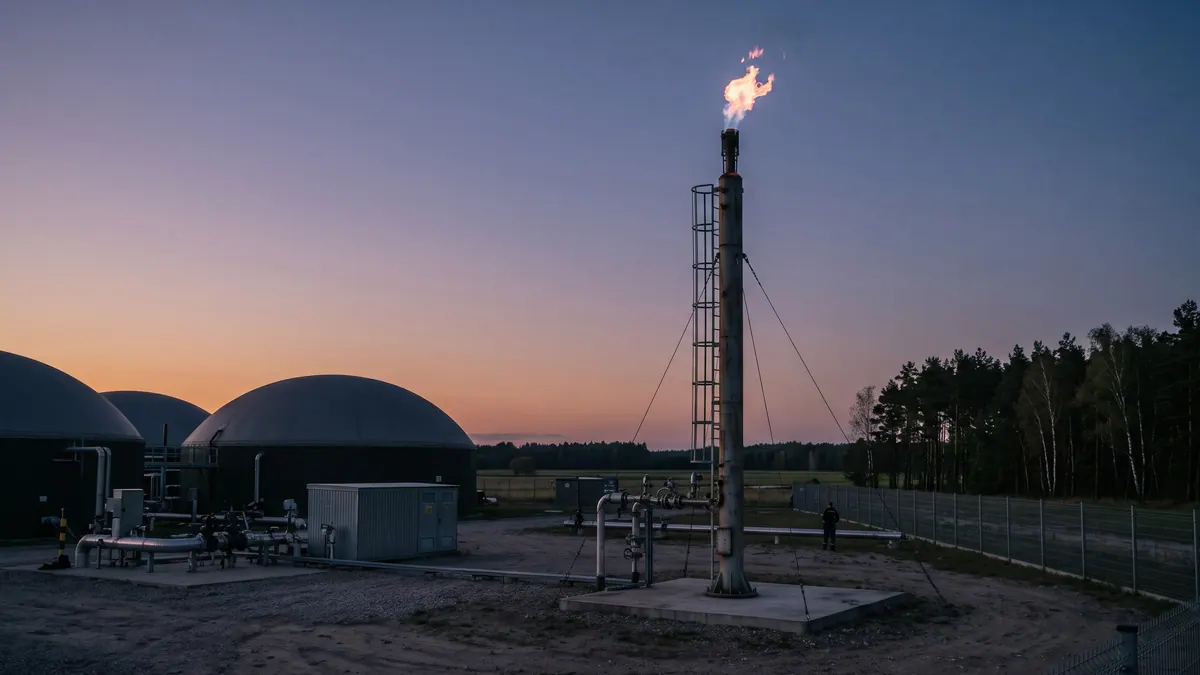
If a mixture with air forms in a biogas pipeline and ignites, the flame can travel to a tank, blower or engine. A flame arrester is a passive device intended to stop that flame; it works only if it is properly selected, installed in the right place and regularly cleaned. Below we discuss the principle of operation, the types, and installation and maintenance practice.
Principle of operation
The arrester element consists of narrow channels or gaps, usually made of metal with high thermal conductivity. A flame entering such a gap loses heat to the walls and is extinguished if the gap is narrower than the limiting width for the given gas (the so-called MESG). For methane the limiting gap is larger than for hydrogen, so designs for group IIA may have different parameters than for IIB or IIC.
An arrester does not stop combustion that continues on its source side, nor does it protect against a flame being held continuously on the element unless it is designed for this. Flares or burners therefore have arresters together with equipment that prevents a stable flame from burning at the pipe outlet.
Deflagration and detonation
Deflagration is combustion propagating at subsonic speed, of the order of several dozen centimetres to several hundred metres per second. Detonation is combustion propagating at supersonic speed, with a shock wave, in which the peak pressure is many times higher. In a long pipeline a deflagration can turn into a detonation, and the longer the run, the greater the risk.
This determines the choice of arrester:
- Deflagration arrester: used where the run from the potential ignition source is short and transition to detonation is excluded.
- Stable detonation arrester: stops the flame of a stable detonation in the pipeline.
- Unstable detonation arrester: for detonation in the transitional phase, in which the wave is most violent.
Manufacturers specify the maximum permissible distance from the ignition source at which the arrester is applicable. Exceeding this distance, for example by adding a section of pipeline, means the arrester is no longer appropriate.
Types and installation points
In-line arresters are installed in the pipeline and must withstand a flame from both sides or from one side, depending on the design. End-of-line arresters are installed at the outlet, for example on a vent line, and additionally protect against the heat of a stationary flame if they have been tested for it.
At a biogas plant, arresters are found:
- on the line before the flare,
- before the blower or compressor,
- on the supply line to the cogeneration engine,
- on the vent lines of tanks and pressure relief valves, if the explosion protection document so provides.
The choice of locations results from hazard analysis, not from the belief that "the more, the better". Every arrester increases pressure drop and requires servicing.
Requirements and markings
The requirements for testing and marking arresters are set by the standard EN ISO 16852. The device has a type-examination certificate and markings stating the type of gas (group), permissible pressure, direction of flow and application parameters. An arrester intended for an installation at risk of explosion is subject to the ATEX directive, so conformity documentation also applies.
Effect of contaminants, condensate and ice
Biogas is moist and contains siloxanes, sulphur and particles. In the arrester they settle on the element and form deposits. Moisture condenses, especially in winter, and ice can block the flow. The effects are:
- an increase in pressure drop and poorer blower operation,
- local negative or positive pressure, which may trigger safety devices,
- reduced effectiveness of flame quenching if the gaps become distorted,
- corrosion of the element and housing.
For this reason drying, drainage and heating of the line are usually applied before the arrester, and the housing is fitted with connections for measuring pressure drop.
Inspection and maintenance
- Measure the pressure difference before and after the arrester and compare it with the baseline value; a growing difference indicates fouling.
- Check the element at the intervals recommended by the manufacturer, and more often with contaminated gas or in winter.
- Clean the element only by a method permitted in the instructions: inappropriate brushing or use of sharp tools deforms the gaps.
- After each opening, pay attention to the gaskets and the tightening of connections; a leak is a new source of mixture.
- Keep a log of inspections and replacements.
Typical installation mistakes
The biggest mistake is installing the arrester too far from the ignition source relative to its approvals, wrong orientation relative to the direction of flow, blanking of measuring connections and using an arrester intended for a different gas or pressure. Common faults also include the lack of drainage, as a result of which the arrester floods with condensate. After every change to the pipeline it is worth checking that the approval parameters are still met.
Sources
Related articles