InnovationAnalysis
Biomethane tractor: can a farmer refuel with gas from their own biogas plant
CNG tractors are available as production models, but refuelling with your own biomethane requires a station and a fleet that justifies it. We analyse the technology, range and profitability.
Other language versions: Polski, Deutsch, Español, Français, Italiano, Nederlands.
A farmer can run a tractor on biomethane from their own biogas plant, but this only makes practical sense with a large fleet or a shared station in a cluster, because the infrastructure cost is fixed and the range of the machine is lower than on diesel. Below is an analysis of the technology, the station and the profitability.
Technology: a CNG engine in a tractor
For several years, production tractors with an internal combustion engine fuelled by compressed natural gas (CNG) have been offered, and this can also be biomethane. This is a market phenomenon that shows the technology is available, not a recommendation of a specific manufacturer. Gas engines use spark ignition and have a power output similar to a diesel, but lower torque at low revs, which manufacturers compensate for with turbocharging. Noise and particulate emissions are lower, and for biomethane the CO₂ balance is more favourable than for diesel (its size depends on the calculation method and the feedstock).
Range and tanks
Gas stored at a pressure of about 200 bar contains several times less energy per litre of tank volume than diesel; in an indicative calculation, a litre of CNG at 200 bar is about 7–8 MJ versus about 36 MJ in a litre of diesel. In addition, cylinders are heavy and cannot take any shape. As a result, a tractor with cylinders usually carries enough energy for work that is several tens of percent shorter than the diesel equivalent, and manufacturers compensate with more cylinders or shorter refuelling cycles. On a farm with a base next to the field this is acceptable; for dispersed work and long journeys, less so.
A local bioCNG station
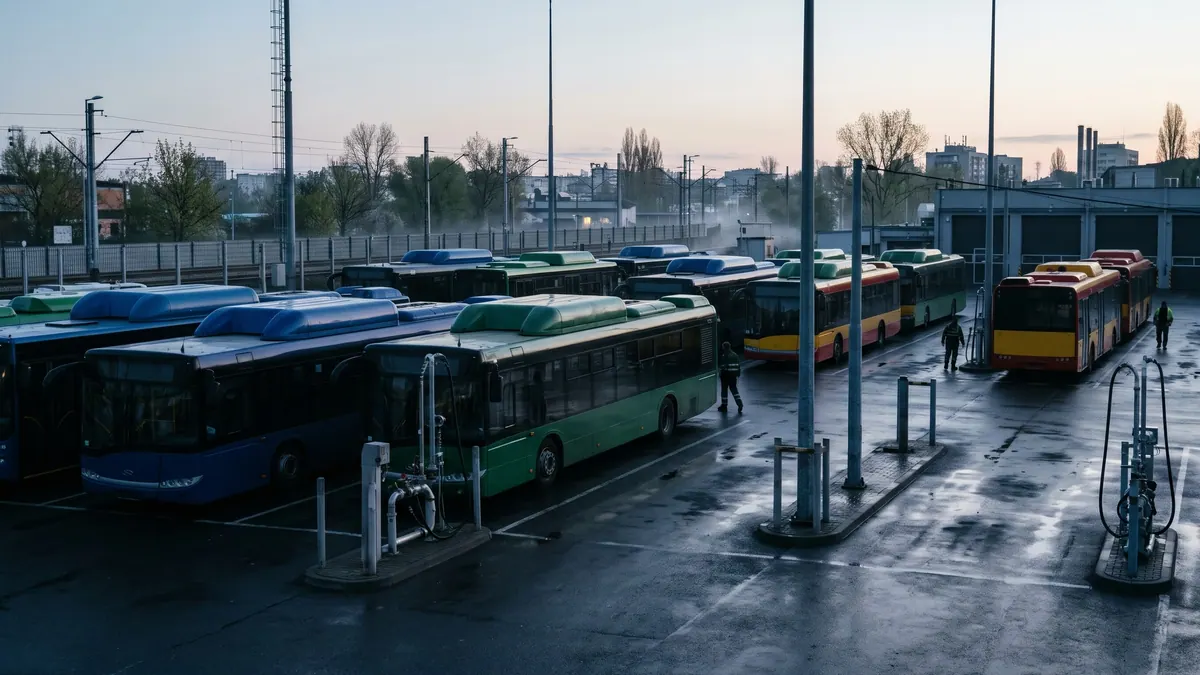
The station layout comprises several elements:
- biomethane supply: from the line after upgrading (before injection into the grid, or on a farm without a connection);
- drying and filtration: moisture and oils from the compressor must be removed;
- compressor: usually reciprocating, several stages, 200–250 bar;
- high-pressure buffer vessel: a buffer allowing several machines to be refuelled in a row;
- dispenser with a metering system and safety devices.
The gas must meet the requirements of EN 16723-2, the standard for biomethane as an automotive fuel, which includes limits on sulphur, water, oxygen and dew point. For an agricultural tractor the same requirements apply as for a car, because the engine and cylinders do not distinguish the source of the gas. The station is designed according to the regulations on pressure equipment and explosion protection (ATEX zones), and its acceptance requires documentation and qualifications.
Illustrative calculation
Assumptions, for the example only: a tractor uses 4000 l of diesel per year, which corresponds to an energy of about 144 GJ, or about 4000 m³ of biomethane at a calorific value of about 36 MJ/m³ (about 144,000 MJ / 36 MJ). Forty machines would use 160,000 m³ of gas per year. A station for such a fleet often costs from several hundred thousand to several million zlotys, depending on capacity and buffer vessel. For a single machine, an annual consumption of 4000 m³ is small relative to the cost of the station; even if the gas were free, the capital calculation would not close. With a fleet of a dozen or so machines and shared use of the station by neighbours, the calculation starts to become plausible.
The assessment should also include the purchase prices of the tractors (usually higher than for diesel), servicing, the cost of hours lost during refuelling and the value of the biomethane, which could instead go into the grid.
Accounting as a renewable fuel
The RED III Directive (2023/2413) introduces targets for the share of renewable energy in transport, which Member States implement nationally, including through the National Indicative Target (NCW, the Polish obligation for fuel suppliers). In practice, the farmer should check: whether biomethane used in agricultural machinery off the public road is taken into account in the accounting at all, what documents (proof of sustainability, guarantees of origin) are required, and whether on-farm consumption is covered by any excise relief for agricultural fuels. We do not give rates and details, because they have changed in recent years and depend on the national rules adopted; contact with an adviser and the authority is appropriate. The quality requirements for biomethane as a fuel are discussed in the post on the EN 16723 standard.
Conclusions
- Technically the solution works, and the range is a compromise.
- Economically it requires a large fleet or a shared station in a cluster; for a single tractor the station cost dominates.
- Biomethane must be available locally; if it requires transport, the sense diminishes.
- It is worth comparing this option with injection into the grid, full upgrading or electrification of machinery. Refuelling technology and cylinders are described in the article on bioCNG as a fuel.
Sources
Related articles