

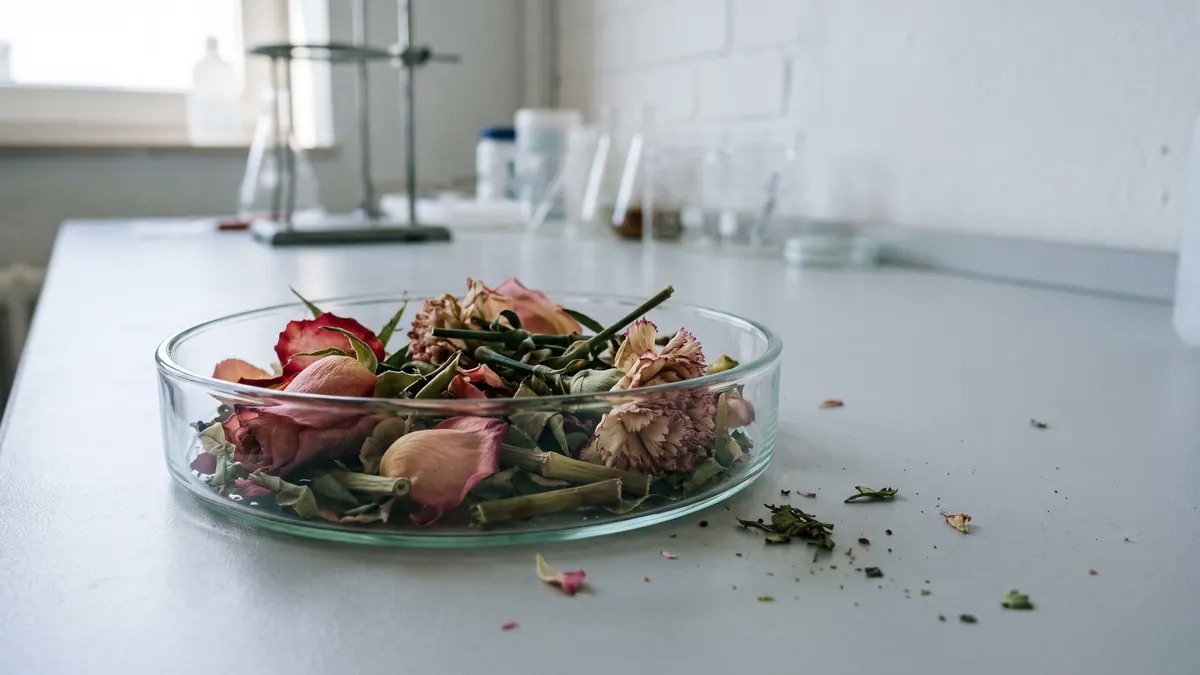
BMP testingMunicipal and green waste, paper and textiles
Flower wastes (cut flowers, flower pomace) — BMP: 2 studies, weighted mean 322 m³ CH₄/t VS
Flower waste means pressed flower residues and cutting waste, e.g. gerbera; records from different studies show how varied this stream is.
rating: goodCH₄ ≈ 54 % (estimate)
Illustration: FeedstockData (AI, Google Gemini)
- Weighted mean
- 322m³ CH₄/t VS
- Range
- 281–362m³ CH₄/t VS
- Records
- 2studies
- Publications
- 2sources
- Temperatures
- 38 °Cof the test
Methane in biogas
Medium methane content · ≈ 5.4 kWh/m³ of biogas
estimate from the substrate type The collected studies contain no measurement. The interval follows from the approximate composition (protein from total nitrogen (N 2.2 % DM × 6.25)) and the yields of compound groups according to FNR.
Rating for biogas plants
good — editorial rating for biogas plantsStable, usually accepted without a fee
Potential per tonne of fresh matter: very high (127 m³ CH₄/t); process risk: inhibitors. Handling costs: physical contaminants (packaging, plastics).
Why? Rating factors
Potential per tonne +3
- +3potential 127 m³ CH₄/t fresh matter (BMP 322 × DM 47.1 % × VS 84 %)
Process stability −1
- −1inhibitors: natural or residues (e.g. limonene, polyphenols, antibiotics, metals)
Handling and costs −1
- −1physical contaminants (packaging, plastics) — depackaging and separation
Total points: 1 · thresholds: ≥ 2.5 very good, ≥ 1 good, below — neutral; negative with cumulative process risk.
Add to the co-digestion calculator CSV data
BMP curves from 2 studies
Weighted mean Individual records
Dashed lines are a model curve (first-order kinetics, B(t) = B₀·(1 − e−kt)); the end point comes from the publication. All curves are model curves.
Cumulative methane production over the test [m³ CH₄/t VS]. The thick line is the weighted mean of all records (322); dots mark the end values given in the publications. Point at the chart to read values; click a legend item to hide or show a record.
Records and sources
Download CSV| Source | BMP m³ CH₄/t VS | Temperature | Sample | Curve |
|---|---|---|---|---|
| Lallement et al. (2023) DOI | 281 | 38 °C · mesophilic | flower residue pomace | end point (model curve) |
| Nogueira et al. (2026) DOI | 362 | — | Gerbera flower residues (FR), mono-digestion | end point (model curve) |
| Weighted mean | 322 | arithmetic mean 322, SD 58 | ||
Typical composition
- Dry matter (DM)
- 47.1% (range 47.1–47.1)
- Volatile solids (VS)
- 84 % DM (range 84–84)
- Nitrogen
- 2.2 % DM
- C/N ratio
- 17.4
Median and range of the determinations reported in the publications behind this substrate's BMP records (read from: MY-D); dry matter: 1 determination, volatile solids: 1 determination. C/N was calculated as the ratio of C and N content (% DM) from the same source. DM from a single determination – indicative value.
Sources: Lallement et al. (2023).
The composition of the raw material varies between batches — for plant calculations use an analysis of your own sample. The calculator inserts typical values automatically.
Process properties
Low confidence: the description is based on general characteristics of the substrate group, not on studies of this material. Treat it as a hint to be verified.
Advantages
- Methane potential in the Substraty.pl BMP dataset: weighted mean 321.8 m³ CH₄/t VS (SD 57.6; 2 records, 2 sources).
- Petals and green parts are readily degradable (Weiland 2010).
Drawbacks and risks
- Secondary compounds (essential oils, dyes) and plant protection products may inhibit (Chen et al. 2008).
- Admixtures of foil, wire and floral foam.
Co-digestion — what to combine it with, what to watch out for
- combines well
substrates: high alkalinity (buffer) — e.g. Cattle manure, Pig slurry, Cattle slurry, Duck slurry, Rumen and digestive tract content
Dosing
No source threshold.
Introduce gradually, starting with a small dose and monitoring the process (e.g. FOS/TAC, pH, gas composition).
Practical requirements
- Remove foreign contaminants before dosing: material from biowaste may contain interfering substances, and the co-substrate should be free of them (FNR 2010, Ch. 3).
Sources of the process data
- Hagos et al. (2017). Anaerobic co-digestion process for biogas production: progress, challenges and perspectives. Renew. Sustain. Energy Rev.
- Weiland (2010). Biogas production: current state and perspectives. Appl. Microbiol. Biotechnol.
- Chen, Cheng, Creamer (2008). Inhibition of anaerobic digestion process: A review. Bioresour. Technol.
- FNR (2010). Guía sobre el Biogás – Desde la producción hasta el uso (hiszp. wydanie „Leitfaden Biogas”, GIZ 2013)
The co-digestion calculator will assess a specific mixture containing this substrate.
What it is and where it comes from
Flower waste arises in florists' shops, wholesale markets, cut-flower plantations and in industry using flowers (e.g. pressed residues after extraction). The dataset includes pressed flower residues and gerbera cutting waste. It is a dispersed and seasonal stream, with peaks around holidays.
Properties relevant to digestion
Petals and green parts are rich in water and readily degradable carbohydrates, whereas stems and woody fragments contain lignin. Flowers also contain secondary compounds (essential oils, pigments), which at large doses can inhibit microorganisms. Residues of pesticides and preservatives used in trade are often present, and the waste is sometimes mixed with film, wire or floral foam, which requires sorting.
How to read the spread of results
The records concern two completely different materials, so the dataset does not describe a single characteristic of "flower waste". The flower species, the share of stems, the degree of comminution, industrial processing (e.g. pressing) and test conditions all have an effect. One result comes from a review paper, the other from a study on mono-digestion of gerbera waste.
In biogas plant practice
Flower waste, where available, is used as an addition to a mix with slurry or biowaste. It is necessary to clean it of packaging and inorganic elements and to shred the stems. Because of the variable composition of batches, it is worth carrying out BMP tests periodically. Waste from trade is waste within the meaning of the Waste Act, so the installation must have a permit to accept it.
It should also be taken into account that flower waste is available irregularly, with distinct seasonal peaks, so it is hard to plan a steady share in the feed with it. Its value lies rather in managing a waste that would otherwise go to a composting plant than in supplying a significant part of the installation's energy. With the first deliveries it is good to carry out a BMP test and assess the content of contaminants.
Methodology in brief
BMP is the amount of methane obtained from volatile solids (VS) in a batch test, given in m³ CH₄ per tonne of VS (numerically the same as NmL CH₄/g VS in the publications) and converted to normal conditions (0 °C, 101.325 kPa). The weighted mean gives each publication a total weight of 1, split equally between its results for the substrate — a paper testing twenty varieties does not outweigh a paper with a single sample. In inter-laboratory programmes the unit is the laboratory (total weight 1), and within it the weight of a test grows with the number of bottles (replicates). Results after pretreatment (e.g. thermal, chemical, enzymatic) are shown separately and are not included in the mean.
Solid lines are curves measured in the tests. Where a publication gives only the final result, we draw a first-order kinetic model, B(t) = B₀·(1 − e−kt): only the end point comes from the publication, and the shape of the curve serves purely as visualisation — do not read the production on a particular day from it. For this substrate k = 0.110 d−1 was assumed (median of rate constants k reported in the sources and/or fitted to the mean measured curves).
The statistics describe the spread of published results — a descriptive compilation, not a meta-analysis or a guarantee of plant yield.
Bibliography
- Lallement, A.; Peyrelasse, C.; Lagnet, C.; Barakat, A.; Schraauwers, B.; Maunas, S.; Monlau, F. (2023). A Detailed Database of the Chemical Properties and Methane Potential of Biomasses Covering a Large Range of Common Agricultural Biogas Plant Feedstocks. Waste 1(1), 195–227. DOI: 10.3390/waste1010014 DOI
- Nogueira, M.; Popich, M.R.; Sousa, C.C.; Fragoso, R. (2026). Anaerobic Co-Digestion of Gerbera Flower Residues, Non-Marketable Apples and Pig Slurry: Biochemical Methane Potential, Synergistic Effects and Kinetic Modelling. Energies 19(17), 3946. DOI: 10.3390/en19173946 DOI
All sources of the site: bibliography.
Other substrates in the group “Municipal and green waste, paper and textiles”
Organic fraction of municipal solid waste — BMP: 13 studies, weighted mean 187 m³ CH₄/t VS
187 m³ CH₄/t VS weighted mean from 13 studies
neutral — editorial rating for biogas plants≈58 %
Plant-fibre and viscose textile wastes (flax, hemp, ramie, sisal, abaca, kapok, rayon) — BMP: 7 studies, mean 303 m³ CH₄/t VS
303 m³ CH₄/t VS weighted mean from 7 studies
≈51 %
Cardboard and paperboard — BMP: 14 studies, weighted mean 278 m³ CH₄/t VS
278 m³ CH₄/t VS weighted mean from 14 studies
good — editorial rating for biogas plants≈51 %
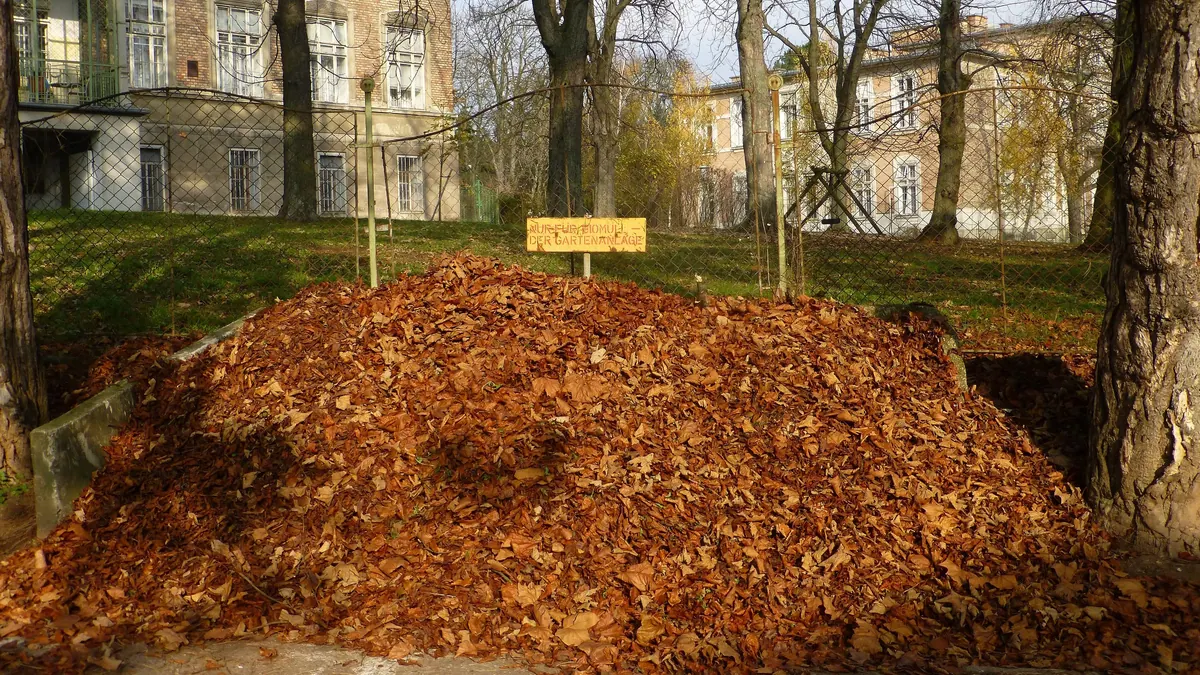
Tree leaves (leaf litter) — BMP: 7 studies, weighted mean 202 m³ CH₄/t VS
202 m³ CH₄/t VS weighted mean from 7 studies
≈52 %