

BMP testingFats, oils and animal by-productssingle study (3 samples)
Raw sheep wool — BMP: 3 studies, weighted mean 37 m³ CH₄/t VS
Raw sheep wool is a poorly degradable protein material (keratin) with a slow rate of hydrolysis. The compilation is based on a single study comparing three sheep breeds.
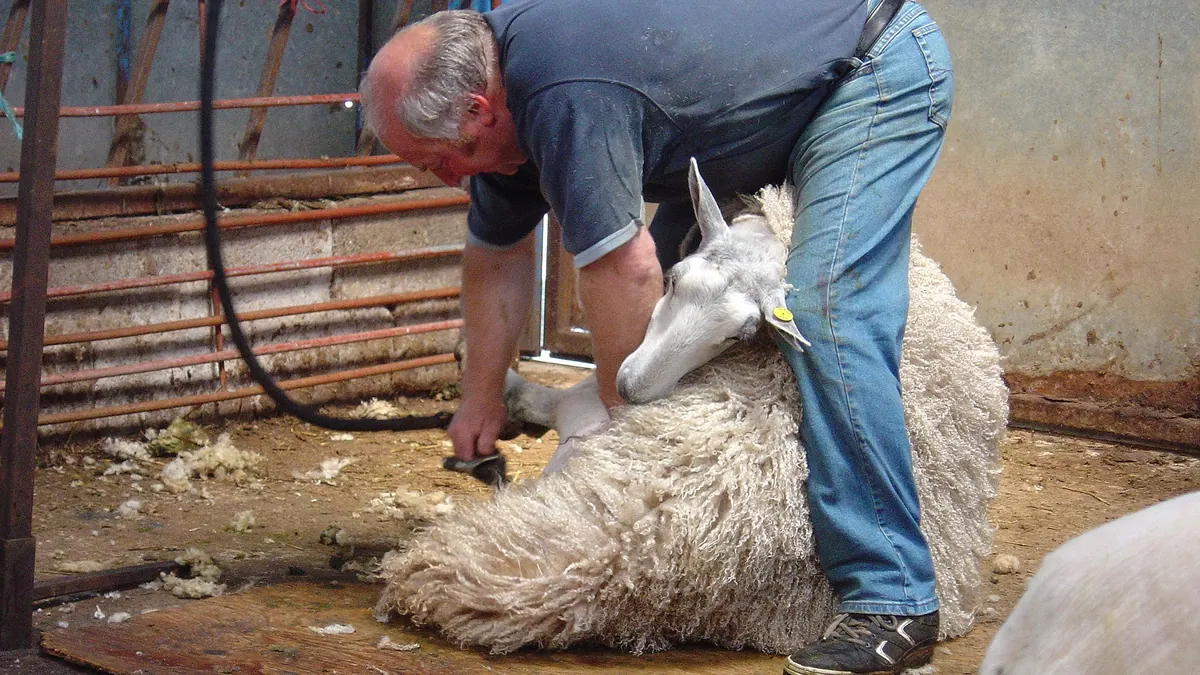
Photo Paul / Wikimedia Commons, licence CC BY 2.0, source file; changes: cropping

- Weighted mean
- 37m³ CH₄/t VS
- Range
- 34–41m³ CH₄/t VS
- Records
- 3single study (3 samples)
- Publications
- 1source
- Temperatures
- —of the test
Methane in biogas
Medium methane content · ≈ 5.8 kWh/m³ of biogas
estimate from the substrate type The collected studies contain no measurement. The interval follows from the approximate composition (protein-rich (process classification)) and the yields of compound groups according to FNR.
Rating for biogas plants
not rated — editorial rating for biogas plants
Not rated: no dry matter or volatile solids in the data. We calculate the rating when the dry matter and volatile solids of the material are known.
Add to the co-digestion calculator CSV data
BMP curves from 3 studies
Weighted mean Individual records
Dashed lines are a model curve (first-order kinetics, B(t) = B₀·(1 − e−kt)); the end point comes from the publication. All curves are model curves.
Cumulative methane production over the test [m³ CH₄/t VS]. The thick line is the weighted mean of all records (37); dots mark the end values given in the publications. Point at the chart to read values; click a legend item to hide or show a record.
Records and sources
Download CSV| Source | BMP m³ CH₄/t VS | Temperature | Sample | Curve |
|---|---|---|---|---|
| Kuzmanova et al. (2018) · 1 DOI | 34 | — | Texel wool (raw) | end point (model curve) |
| Kuzmanova et al. (2018) · 2 DOI | 35 | — | Scotch mule wool (raw) | end point (model curve) |
| Kuzmanova et al. (2018) · 3 DOI | 41 | — | Blackface handcleaned wool (raw) | end point (model curve) |
| Weighted mean | 37 | arithmetic mean 37, SD 4 | ||
Process properties
Low confidence: the description is based on general characteristics of the substrate group, not on studies of this material. Treat it as a hint to be verified.
Advantages
- Methane potential in the Substraty.pl BMP dataset: weighted mean 36.6 m³ CH₄/t VS (SD 4.1; 3 records, 1 source).
- Keratin and lanolin supply carbon and nitrogen, but only after the structure has been broken down (Salminen and Rintala 2002).
Drawbacks and risks
- Degradation releases ammonia and sulphur compounds (Chen et al. 2008).
Co-digestion — what to combine it with, what to watch out for
- combines well
substrates: high alkalinity (buffer) — e.g. Cattle manure, Pig slurry, Cattle slurry, Duck slurry, Rumen and digestive tract content
Slurry as a base stabilises the keratin mix (by analogy with feathers).[1]
Dosing
No source-based threshold. Use only at a low share and after pretreatment.
Introduce gradually, starting with a small dose and monitoring the process (e.g. FOS/TAC, pH, gas composition).
Practical requirements
- ABP cat. 3 (Art. 10 of Reg. 1069/2009; admitted to biogas plants by Art. 14): hygienisation before the digester in a mandatory unit: shredding to a maximum of 12 mm, temperature throughout the mass of at least 70 °C for at least 60 min without interruption (Reg. 142/2011, Annex V Ch. I Section 1 and Ch. III Section 1); the installation requires approval by the competent authority (Art. 24(1)(g) of Reg. 1069/2009).
- Do not feed hygienised substrate into the digester hot (FNR 2010, Ch. 3: hygienisation).
- Shred: shredding increases the surface available for degradation and speeds it up, but does not necessarily raise the final gas yield (FNR 2010, Ch. 3 “Triturado”).
Sources of the process data
- Schommer et al. (2020). Anaerobic co-digestion of swine manure and chicken feathers: effects of manure maturation and microbial pretreatment of feathers on methane production. Renew. Energy
- Salminen, Rintala (2002). Anaerobic digestion of organic solid poultry slaughterhouse waste - a review. Bioresour. Technol.
- Chen, Cheng, Creamer (2008). Inhibition of anaerobic digestion process: A review. Bioresour. Technol.
- Rozporządzenie (WE) nr 1069/2009 określające przepisy sanitarne dotyczące produktów ubocznych pochodzenia zwierzęcego (art. 9, 10, 12–14, 24)
- Rozporządzenie Komisji (UE) nr 142/2011 wykonujące rozporządzenie (WE) nr 1069/2009 (zał. IV rozdz. III, zał. V rozdz. I i III)
- FNR (2010). Guía sobre el Biogás – Desde la producción hasta el uso (hiszp. wydanie „Leitfaden Biogas”, GIZ 2013)
The co-digestion calculator will assess a specific mixture containing this substrate.
What it is and where it comes from
Sheep wool is a product of shearing. Good-quality fleece goes to the textile industry, but poorer, contaminated wool or wool from coarse-haired breeds is sometimes hard to sell and becomes a troublesome waste, especially in sheep-farming regions. The compilation includes records from a single study, relating to raw wool of the Texel, Scotch mule and Blackface breeds.
Properties relevant to digestion
Wool is predominantly keratin, a protein with a large number of disulphide bridges, highly resistant to enzymatic hydrolysis. Raw wool also contains lanolin (wool grease), mineral impurities, suint and residues of excrement. In the digester, the breakdown of keratin is very slow, and its microbial degradation releases ammonia and sulphur compounds, including hydrogen sulphide. Wool is therefore usually combined with other substrates and various pretreatments are applied to improve availability. The material is fibrous, can become tangled around agitators and block pipelines.
How to read the spread of results
All the records come from a single publication, so the differences between them result mainly from the sheep breed and not from a different method. The breeds have wool with different fibre thickness, lanolin content and impurities. In actual batches, further factors are the degree of cleaning (raw, washed, degreased), the method of shredding and the moisture. The absence of a stated temperature in the description of the records makes comparison with other substrates difficult. Owing to the slow kinetics, the test length is of particular importance.
In biogas plant practice
Wool is not a typical biogas plant substrate. Its practical use is limited by technical difficulties (fibres on agitators), slow degradation and emissions of sulphur and nitrogen compounds. If it is considered, then in a small share, after shredding and in a mixture with a liquid substrate. Wool is an animal by-product, so regulations on the classification and handling of such material apply; the details should be checked for one's own installation. Before planning doses, the result should be confirmed with one's own BMP test. If wool were considered as a permanent component of the ration, one should first check how it behaves in the mixing system on a small scale, because mechanical problems are sometimes more important than the gas potential itself, and the cost of downtime exceeds the gain from the additional biogas.
Methodology in brief
BMP is the amount of methane obtained from volatile solids (VS) in a batch test, given in m³ CH₄ per tonne of VS (numerically the same as NmL CH₄/g VS in the publications) and converted to normal conditions (0 °C, 101.325 kPa). The weighted mean gives each publication a total weight of 1, split equally between its results for the substrate — a paper testing twenty varieties does not outweigh a paper with a single sample. In inter-laboratory programmes the unit is the laboratory (total weight 1), and within it the weight of a test grows with the number of bottles (replicates). Results after pretreatment (e.g. thermal, chemical, enzymatic) are shown separately and are not included in the mean.
Solid lines are curves measured in the tests. Where a publication gives only the final result, we draw a first-order kinetic model, B(t) = B₀·(1 − e−kt): only the end point comes from the publication, and the shape of the curve serves purely as visualisation — do not read the production on a particular day from it. For this substrate k = 0.091 d−1 was assumed (no kinetic data for the group – the median of all available rate constants k (93 values) was used).
The statistics describe the spread of published results — a descriptive compilation, not a meta-analysis or a guarantee of plant yield.
Bibliography
- Kuzmanova, E.; Zhelev, N.; Akunna, J.C. (2018). Effect of liquid nitrogen pre-treatment on various types of wool waste fibres for biogas production. Heliyon 4(5), e00619. DOI: 10.1016/j.heliyon.2018.e00619 DOI
All sources of the site: bibliography.
Other substrates in the group “Fats, oils and animal by-products”
Meat and meat waste — BMP: 2 studies, weighted mean 295 m³ CH₄/t VS
295 m³ CH₄/t VS weighted mean from 2 studies
neutral — editorial rating for biogas plants≈66 %

Fish waste — BMP: 3 studies, weighted mean 319 m³ CH₄/t VS
319 m³ CH₄/t VS weighted mean from 3 studies
neutral — editorial rating for biogas plants≈66 %
Fats, oils and grease (FOG) — BMP: 5 studies, weighted mean 488 m³ CH₄/t VS
488 m³ CH₄/t VS weighted mean from 5 studies
≈63 %
Animal fats — BMP: 3 studies, weighted mean 690 m³ CH₄/t VS
690 m³ CH₄/t VS weighted mean from 3 studies
neutral — editorial rating for biogas plants≈63 %