

BMP testingBy-products of the agri-food industry
Sweet corn processing residues — BMP: 8 studies, weighted mean 323 m³ CH₄/t VS
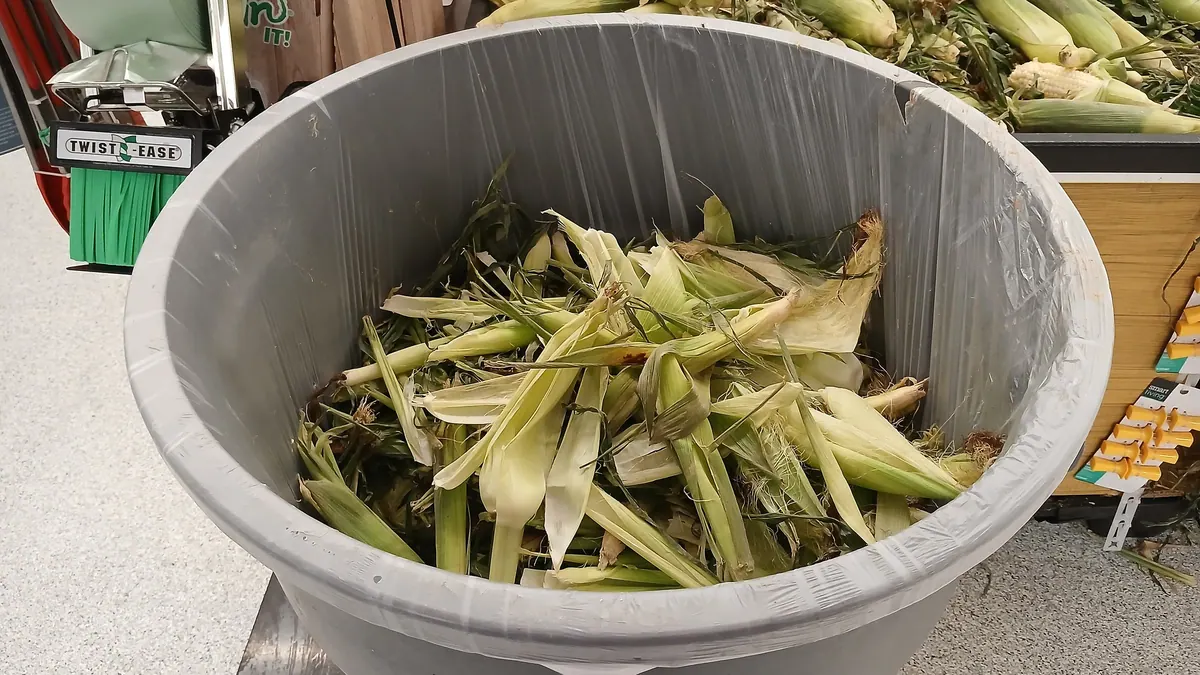
Waste from sweet corn processing (cobs, husk leaves, grain residues) is a well-digesting, seasonal stream from canning and freezing plants.
rating: goodCH₄ ≈ 52 % (estimate)
Photo Ser Amantio di Nicolao / Wikimedia Commons, licence CC BY-SA 4.0, source file; changes: cropping

- Weighted mean
- 323m³ CH₄/t VS
- Range
- 263–345m³ CH₄/t VS
- Records
- 8studies
- Publications
- 2sources
- Temperatures
- 38 °Cof the test
Methane in biogas
Low methane content · ≈ 5.2 kWh/m³ of biogas
estimate from the substrate type The collected studies contain no measurement. The interval follows from the approximate composition (protein from total nitrogen (N 0.9 % DM × 6.25)) and the yields of compound groups according to FNR.
Rating for biogas plants
good — editorial rating for biogas plantsStable, usually accepted without a fee
Potential per tonne of fresh matter: high (77 m³ CH₄/t); process risk: acidification. Handling costs: fibres, floating layer.
Why? Rating factors
Potential per tonne +2
- +2potential 77 m³ CH₄/t fresh matter (BMP 323 × DM 24.2 % × VS 98 %)
Process stability −0.5
- −0.5acidification: rapid degradation / acidic pH, risk of VFA accumulation, needs buffering
Handling and costs −0.5
- −0.5fibres, floating layer — shredding and intensive mixing
Total points: 1 · thresholds: ≥ 2.5 very good, ≥ 1 good, below — neutral; negative with cumulative process risk.
Add to the co-digestion calculator CSV data
BMP curves from 8 studies
Weighted mean Individual records
Dashed lines are a model curve (first-order kinetics, B(t) = B₀·(1 − e−kt)); the end point comes from the publication. All curves are model curves.
Cumulative methane production over the test [m³ CH₄/t VS]. The thick line is the weighted mean of all records (323); dots mark the end values given in the publications. Point at the chart to read values; click a legend item to hide or show a record.
Records and sources
Download CSV| Source | BMP m³ CH₄/t VS | Temperature | Sample | Curve |
|---|---|---|---|---|
| Lallement et al. (2023) · 1 DOI | 263 | 38 °C · mesophilic | fresh residue from sweet corn | end point (model curve) |
| Lallement et al. (2023) · 2 DOI | 264 | 38 °C · mesophilic | fresh residue from sweet corn | end point (model curve) |
| Lallement et al. (2023) · 3 DOI | 306 | 38 °C · mesophilic | fresh residue from sweet corn | end point (model curve) |
| Lallement et al. (2023) · 4 DOI | 307 | 38 °C · mesophilic | fresh residue from sweet corn | end point (model curve) |
| Lallement et al. (2023) · 5 DOI | 312 | 38 °C · mesophilic | fresh residue from sweet corn | end point (model curve) |
| Lallement et al. (2023) · 6 DOI | 314 | 38 °C · mesophilic | fresh residue from sweet corn | end point (model curve) |
| Lallement et al. (2023) · 7 DOI | 336 | 38 °C · mesophilic | fresh residue from sweet corn | end point (model curve) |
| Chevalier et al. (2023) DOI | 345 | — | Sweetcorn by-products (SB), milled control (CM) | end point (model curve) |
| Weighted mean | 323 | arithmetic mean 306, SD 30 | ||
Typical composition
- Dry matter (DM)
- 24.2% (range 21.9–26.7)
- Volatile solids (VS)
- 98 % DM (range 97–99)
- Nitrogen
- 0.9 % DM
- C/N ratio
- 49.6
Median and range of the determinations reported in the publications behind this substrate's BMP records (read from: MY-D); dry matter: 6 determinations, volatile solids: 3 determinations. C/N was calculated as the ratio of C and N content (% DM) from the same source.
Sources: Lallement et al. (2023).
The composition of the raw material varies between batches — for plant calculations use an analysis of your own sample. The calculator inserts typical values automatically.
Process properties
Low confidence: the description is based on general characteristics of the substrate group, not on studies of this material. Treat it as a hint to be verified.
Advantages
- Methane potential in the Substraty.pl BMP dataset: weighted mean 322.6 m³ CH₄/t VS (SD 29.7; 8 records, 2 sources).
- Starch and sugars from the grain and fibre from the cobs give a mixed degradation profile (Hendriks and Zeeman 2009).
Drawbacks and risks
- Rapid dosing of fresh material risks acidification (Hagos et al. 2017).
Co-digestion — what to combine it with, what to watch out for
- combines well
substrates: high alkalinity (buffer) — e.g. Cattle manure, Pig slurry, Cattle slurry, Duck slurry, Rumen and digestive tract content
Slurry supplies N and alkalinity, balancing the high C/N of the material.[1][2]
Dosing
No source threshold.
Introduce gradually, starting with a small dose and monitoring the process (e.g. FOS/TAC, pH, gas composition).
Practical requirements
- Shred: shredding increases the surface available for degradation and speeds it up, but does not necessarily raise the final gas yield (FNR 2010, Ch. 3 “Triturado”).
- Ensiling makes it possible to store seasonal biomass; properly ensiled plants (in the study maize, sorghum, forage rye, triticale) can be stored for up to a year without loss of methane production (Herrmann et al. 2011).
Sources of the process data
- Hagos et al. (2017). Anaerobic co-digestion process for biogas production: progress, challenges and perspectives. Renew. Sustain. Energy Rev.
- Weiland (2010). Biogas production: current state and perspectives. Appl. Microbiol. Biotechnol.
- Hendriks, Zeeman (2009). Pretreatments to enhance the digestibility of lignocellulosic biomass. Bioresour. Technol.
- FNR (2010). Guía sobre el Biogás – Desde la producción hasta el uso (hiszp. wydanie „Leitfaden Biogas”, GIZ 2013)
- Herrmann et al. (2011). Effects of ensiling, silage additives and storage period on methane formation of biogas crops. Bioresour. Technol.
The co-digestion calculator will assess a specific mixture containing this substrate.
What it is and where it comes from
Sweet corn is grown in Poland for the canning and frozen food industries. During processing the kernels are separated from the cobs and the husk leaves are removed, so large quantities of waste arise in the harvest season, usually from late summer to early autumn. The dataset describes fresh processing waste, that is, a mixture of cobs, husks and grain residues.
Properties relevant to digestion
The material contains a lot of water, soluble sugars and starch from grain residues, as well as cellulose, hemicellulose and lignin from the cobs and husk leaves. As a result it combines the characteristics of green forage and a starchy waste. Hydrolysis of the grain part is fast, and of the fibrous parts slower, so the process is spread over time. Cobs have a woody structure and require comminution. The risks are acidification with rapid dosing of fresh matter, and rapid spoilage of the material in warm conditions. There is little protein, so the C/N ratio is high and combining with slurry is beneficial.
How to read the spread of results
The dataset contains several records from several sources, all under mesophilic conditions. The spread is small, which results from the similarity of the samples, but concerns a limited number of sources. Differences may depend on the variety, the share of cobs and grain in the waste, ripeness, comminution, sample preparation (fresh or preserved) and the inoculum. Ensiled waste behaves differently from fresh waste, because some of the sugars have already been used up.
In biogas plant practice
Sweet corn waste is sometimes a good supplement in the processing season, especially for agricultural biogas plants near the plants. It requires shredding of the cobs and quick use or ensiling, e.g. in a clamp together with other plant wastes. Dosing should be spread over time, with monitoring of pH. Because it comes from food processing plants, the material is waste and its acceptance requires appropriate authorisation; the farm's own crop residues may be treated as agricultural products. With clamp storage, leachate and odours must be borne in mind.
It is worth adding that sweet corn is harvested at the milk stage, so its waste differs from residues of maize ripe for grain or silage: it contains more sugars and water, and less lignin. The results should therefore not be transferred to maize straw.
Methodology in brief
BMP is the amount of methane obtained from volatile solids (VS) in a batch test, given in m³ CH₄ per tonne of VS (numerically the same as NmL CH₄/g VS in the publications) and converted to normal conditions (0 °C, 101.325 kPa). The weighted mean gives each publication a total weight of 1, split equally between its results for the substrate — a paper testing twenty varieties does not outweigh a paper with a single sample. In inter-laboratory programmes the unit is the laboratory (total weight 1), and within it the weight of a test grows with the number of bottles (replicates). Results after pretreatment (e.g. thermal, chemical, enzymatic) are shown separately and are not included in the mean.
Solid lines are curves measured in the tests. Where a publication gives only the final result, we draw a first-order kinetic model, B(t) = B₀·(1 − e−kt): only the end point comes from the publication, and the shape of the curve serves purely as visualisation — do not read the production on a particular day from it. For this substrate k = 0.091 d−1 was assumed (no kinetic data for the group – the median of all available rate constants k (93 values) was used).
The statistics describe the spread of published results — a descriptive compilation, not a meta-analysis or a guarantee of plant yield.
Bibliography
- Lallement, A.; Peyrelasse, C.; Lagnet, C.; Barakat, A.; Schraauwers, B.; Maunas, S.; Monlau, F. (2023). A Detailed Database of the Chemical Properties and Methane Potential of Biomasses Covering a Large Range of Common Agricultural Biogas Plant Feedstocks. Waste 1(1), 195–227. DOI: 10.3390/waste1010014 DOI
- Chevalier, A.; Evon, P.; Monlau, F.; Vandenbossche, V.; Sambusiti, C. (2023). Twin-Screw Extrusion Mechanical Pretreatment for Enhancing Biomethane Production from Agro-Industrial, Agricultural and Catch Crop Biomasses. Waste 1(2), 497–514. DOI: 10.3390/waste1020030 DOI
All sources of the site: bibliography.
Other substrates in the group “By-products of the agri-food industry”
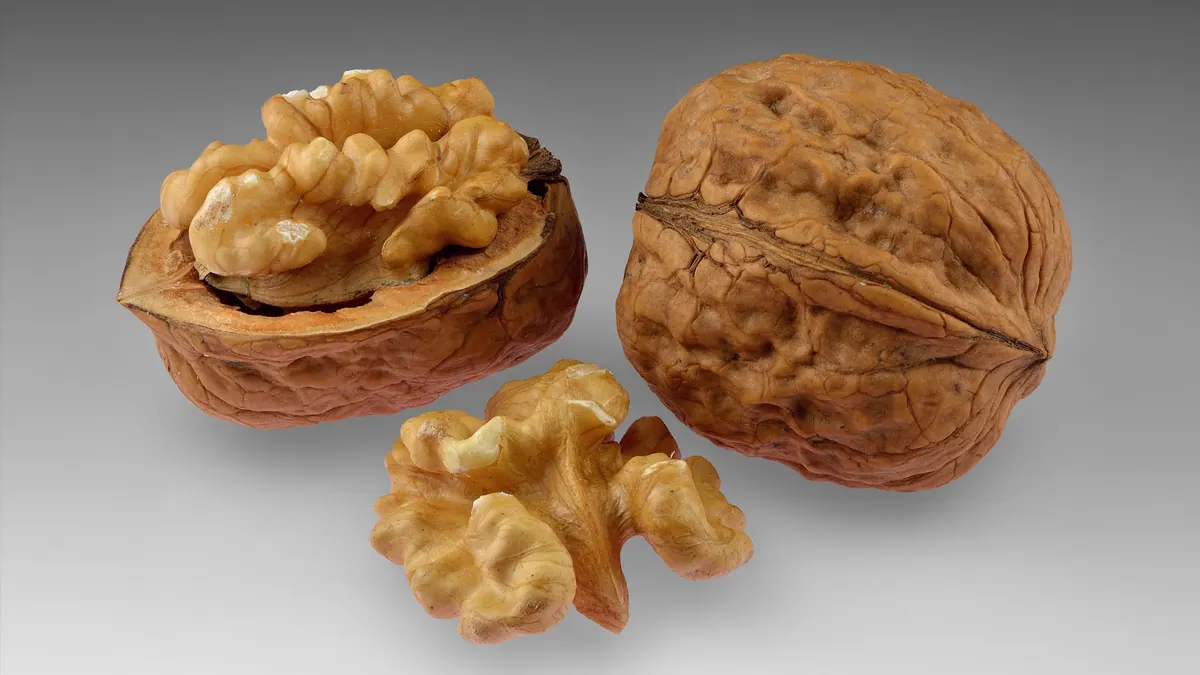
Walnut residues (shell, skin, green husk) — BMP: 3 studies, weighted mean 148 m³ CH₄/t VS
148 m³ CH₄/t VS weighted mean from 3 studies
neutral — editorial rating for biogas plants≈52 %

Coconut meal / oil cake — BMP: 3 studies, weighted mean 296 m³ CH₄/t VS
296 m³ CH₄/t VS weighted mean from 3 studies
≈66 %
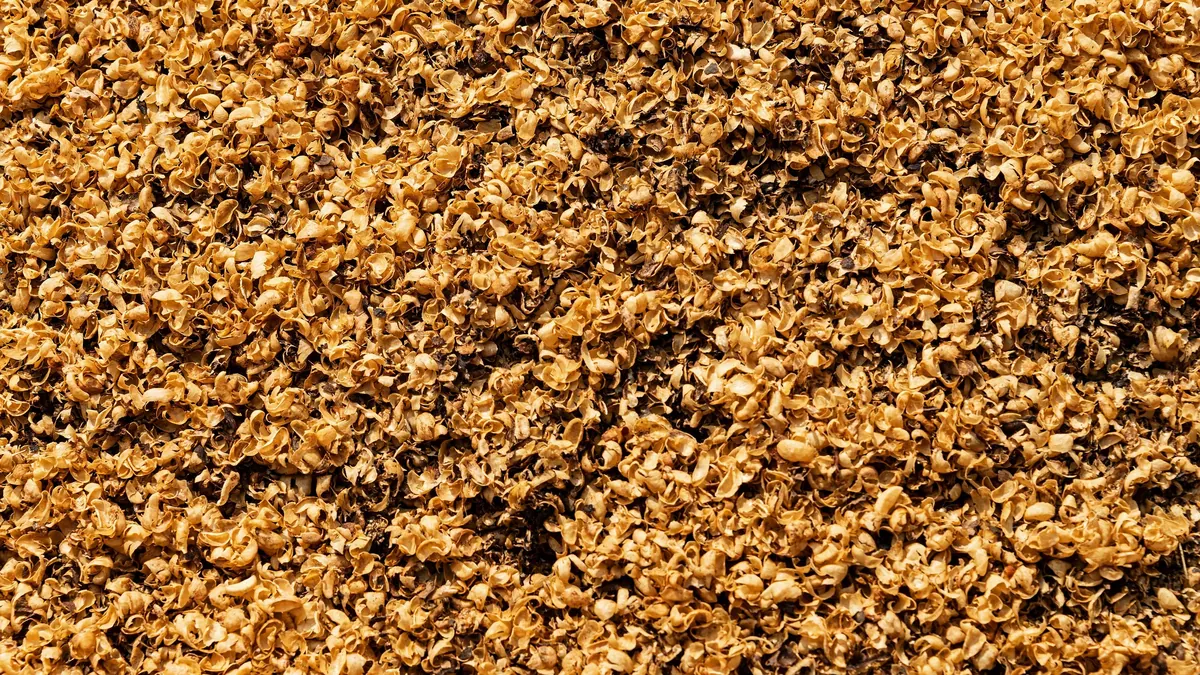
Coffee husk — BMP: 3 studies, weighted mean 152 m³ CH₄/t VS
152 m³ CH₄/t VS weighted mean from 3 studies
≈52 %
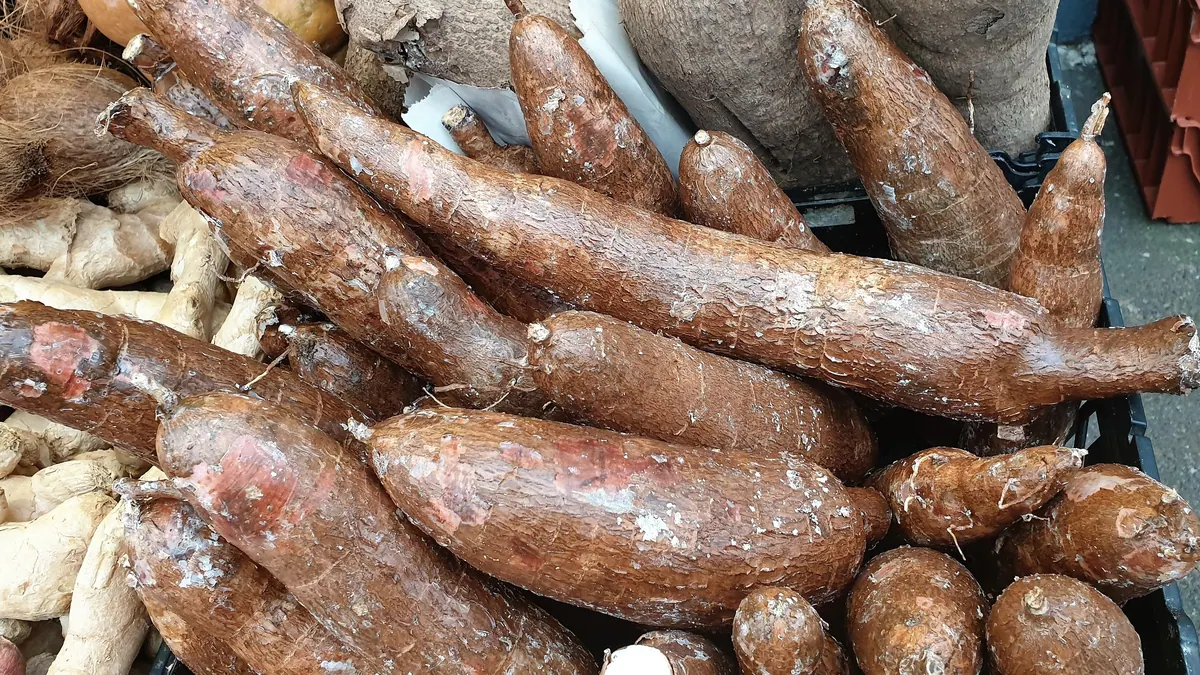
Cassava residue — BMP: 4 studies, weighted mean 170 m³ CH₄/t VS
170 m³ CH₄/t VS weighted mean from 4 studies
neutral — editorial rating for biogas plants≈52 %