

BMP testingGrasses, green forage and fodder plantssingle study (2 samples)
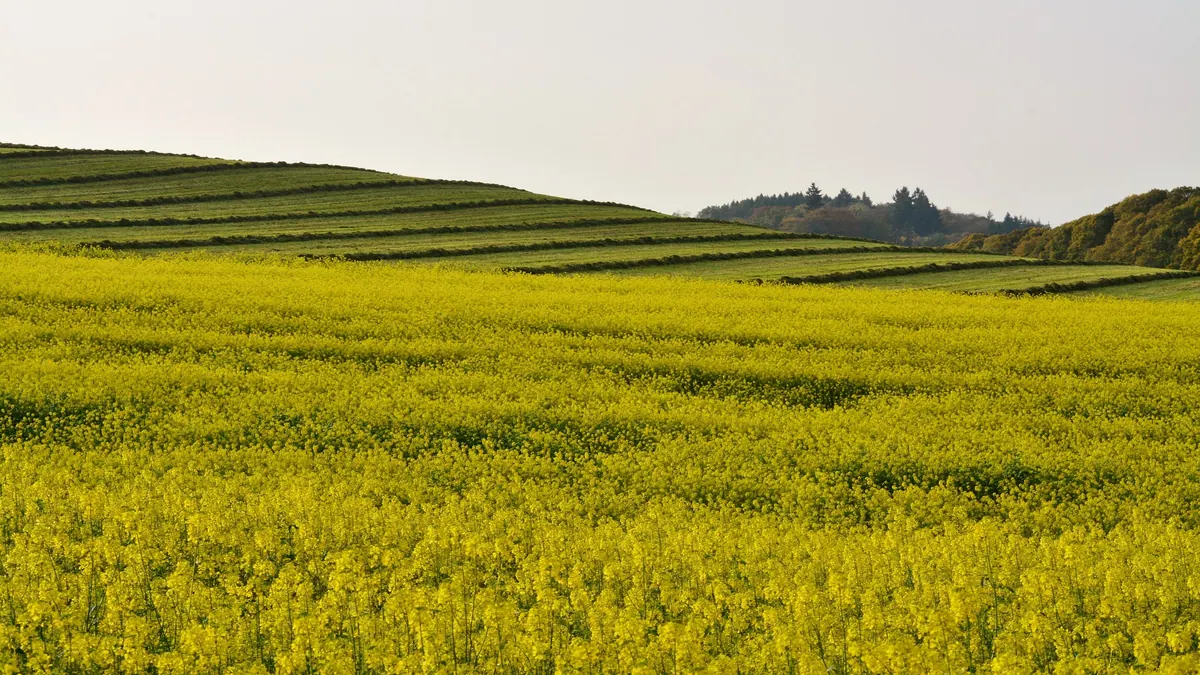
White mustard (tops) — BMP: 2 studies, weighted mean 313 m³ CH₄/t VS
White mustard as green mass is a fast-growing catch crop rich in sulphur compounds. The compilation is based on an old study with a small number of records for above-ground parts.
Photo Gilles San Martin from Namur, Belgium / Wikimedia Commons, licence CC BY-SA 2.0, source file; changes: cropping

- Weighted mean
- 313m³ CH₄/t VS
- Range
- 300–326m³ CH₄/t VS
- Records
- 2single study (2 samples)
- Publications
- 1source
- Temperatures
- 35 °Cof the test
Methane in biogas
High methane content · ≈ 6.8 kWh/m³ of biogas
measured mean of 2 studies BMP, range 64.2–71.8 %; in a batch test the CH₄ share tends to be higher than in a plant.
Rating for biogas plants
good — editorial rating for biogas plantsStable, usually accepted without a fee
Potential per tonne of fresh matter: moderate (27 m³ CH₄/t); no particular threats to stability. No additional handling requirements.
Why? Rating factors
Potential per tonne +1
- +1potential 27 m³ CH₄/t fresh matter (BMP 313 × DM 10.3 % × VS 83 %)
Process stability 0
- 0no factors
Handling and costs 0
- 0no factors
Total points: 1 · thresholds: ≥ 2.5 very good, ≥ 1 good, below — neutral; negative with cumulative process risk.
Add to the co-digestion calculator CSV data
BMP curves from 2 studies
Weighted mean Individual records
Dashed lines are a model curve (first-order kinetics, B(t) = B₀·(1 − e−kt)); the end point comes from the publication. All curves are model curves.
Cumulative methane production over the test [m³ CH₄/t VS]. The thick line is the weighted mean of all records (313); dots mark the end values given in the publications. Point at the chart to read values; click a legend item to hide or show a record.
Records and sources
Download CSV| Source | BMP m³ CH₄/t VS | CH₄ in biogas % vol., measured | Temperature | Sample | Curve |
|---|---|---|---|---|---|
| Zubr (1986) · 1 DOI | 300 | 64.2 % | 35 °C · mesophilic | Mustard | end point (model curve) |
| Zubr (1986) · 2 DOI | 326 | 71.8 % | 35 °C · mesophilic | Mustard · pretreatment: Silage: Air tight glass jars , fermented 30-40 days at 20 oC. | end point (model curve) |
| Weighted mean | 313 | 68.0 % | arithmetic mean 313, SD 18 | ||
Typical composition
- Dry matter (DM)
- 10.3% (range 10.3–10.3)
- Volatile solids (VS)
- 83 % DM (range 83–83)
- C/N ratio
- 10
Median and range of the determinations reported in the publications behind this substrate's BMP records (read from: CROPGEN D4); dry matter: 1 determination, volatile solids: 1 determination. DM from a single determination – indicative value.
Sources: Zubr (1986).
The composition of the raw material varies between batches — for plant calculations use an analysis of your own sample. The calculator inserts typical values automatically.
Process properties
Low confidence: the description is based on general characteristics of the substrate group, not on studies of this material. Treat it as a hint to be verified.
Advantages
- Methane potential in the database: weighted mean 313 m³ CH₄/t VS (median 313; range 300-326; 2 records from 1 source).
- Green catch-crop mass, available in the season after cereal harvest; result from one study (Zubr 1986), well ensiled and stored in those studies.
Drawbacks and risks
- Spread of results in the database: standard deviation 18 at a mean of 313 m³ CH₄/t VS (2 records from 1 source).
Co-digestion — what to combine it with, what to watch out for
- combines well
group: Animal excreta (slurry, manure, poultry litter)
Co-digestion with excreta (slurry/solid manure) is the standard arrangement for plant biomass: they supply alkalinity and microflora.[1][2]
Dosing
No dose data; the material is poorly studied.
Introduce gradually, starting with a small dose and monitoring the process (e.g. FOS/TAC, pH, gas composition).
Practical requirements
- Ensiling makes it possible to store seasonal biomass; properly ensiled plants (in the study maize, sorghum, forage rye, triticale) can be stored for up to a year without loss of methane production (Herrmann et al. 2011).
Sources of the process data
- Zubr, J. (1986) Methanogenic fermentation of fresh and ensiled plant materials. Biomass 11(3), 159–171
- Weiland, P. (2010) Biogas production: current state and perspectives. Applied Microbiology and Biotechnology
- Herrmann et al. (2011). Effects of ensiling, silage additives and storage period on methane formation of biogas crops. Bioresour. Technol.
The co-digestion calculator will assess a specific mixture containing this substrate.
What it is and where it comes from
White mustard (Sinapis alba) is a plant of the brassica family, grown as a stubble catch crop, a green manure crop and for seed (spice and for mustard production). It has rapid growth and a short growing season, so it has been considered as additional biomass for biogas plants. The compilation is based on a small number of records for above-ground parts from a single, older study.
Properties relevant to digestion
Brassicas contain sulphur compounds, including glucosinolates, from which derivatives affecting the odour and composition of the biogas arise. In the digester sulphur is reduced to hydrogen sulphide, which lowers the quality of the biogas, has a corrosive effect on the installation and engine and in excess can inhibit methanogenesis. The green mass of mustard is moist, and after the flowering phase it becomes woody, which lowers digestibility. Ensiling is possible, best with wilting or in a mixture with other plants. As a catch crop the material is seasonal and requires harvest logistics.
How to read the spread of results
The records come from a single study in which the material was described generally as above-ground parts. The result depends on the development stage, the variety, the harvest date, the growing conditions and fertilisation (especially with sulphur and nitrogen). Differences in size reduction, storage of the sample (fresh or ensiled), inoculum and test length add further variability. Data from a single, older publication do not include the effect of modern varieties and cultivation techniques.
In biogas plant practice
Mustard is mainly a catch crop, so its use in a biogas plant makes sense on farms that grow it anyway for other purposes (soil protection, nematode suppression). Harvesting the green mass at the pre-flowering stage gives better digestible material. In the mix its share should be limited because of the risk of rising hydrogen sulphide, and biogas desulphurisation should be ensured. The yield is worth checking with a BMP test, and the effects of the dose assessed by measuring H₂S in the biogas. Before starting regular use of such biomass, it is recommended to check how it affects the biogas composition in the given installation, and to compare the costs of harvesting the catch crop with other available raw materials, because green mass yields of catch crops are variable.
Methodology in brief
BMP is the amount of methane obtained from volatile solids (VS) in a batch test, given in m³ CH₄ per tonne of VS (numerically the same as NmL CH₄/g VS in the publications) and converted to normal conditions (0 °C, 101.325 kPa). The weighted mean gives each publication a total weight of 1, split equally between its results for the substrate — a paper testing twenty varieties does not outweigh a paper with a single sample. In inter-laboratory programmes the unit is the laboratory (total weight 1), and within it the weight of a test grows with the number of bottles (replicates). Results after pretreatment (e.g. thermal, chemical, enzymatic) are shown separately and are not included in the mean.
Solid lines are curves measured in the tests. Where a publication gives only the final result, we draw a first-order kinetic model, B(t) = B₀·(1 − e−kt): only the end point comes from the publication, and the shape of the curve serves purely as visualisation — do not read the production on a particular day from it. For this substrate k = 0.091 d−1 was assumed (no kinetic data for the group – the median of all available rate constants k (93 values) was used).
The statistics describe the spread of published results — a descriptive compilation, not a meta-analysis or a guarantee of plant yield.
Bibliography
- Zubr, J. (1986). Methanogenic fermentation of fresh and ensiled plant materials. Biomass 11(3), 159–171. DOI: 10.1016/0144-4565(86)90064-8 DOI
All sources of the site: bibliography.
Other substrates in the group “Grasses, green forage and fodder plants”
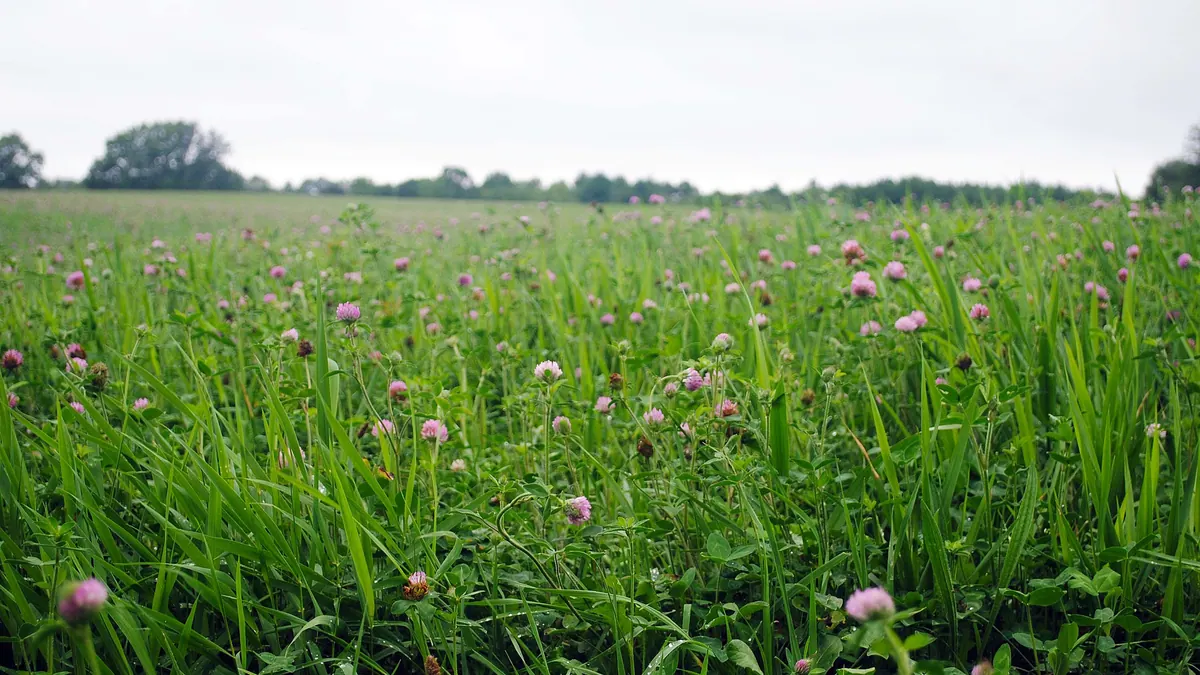
Clover — BMP: 5 studies, weighted mean 394 m³ CH₄/t VS
394 m³ CH₄/t VS weighted mean from 5 studies
neutral — editorial rating for biogas plants59 %
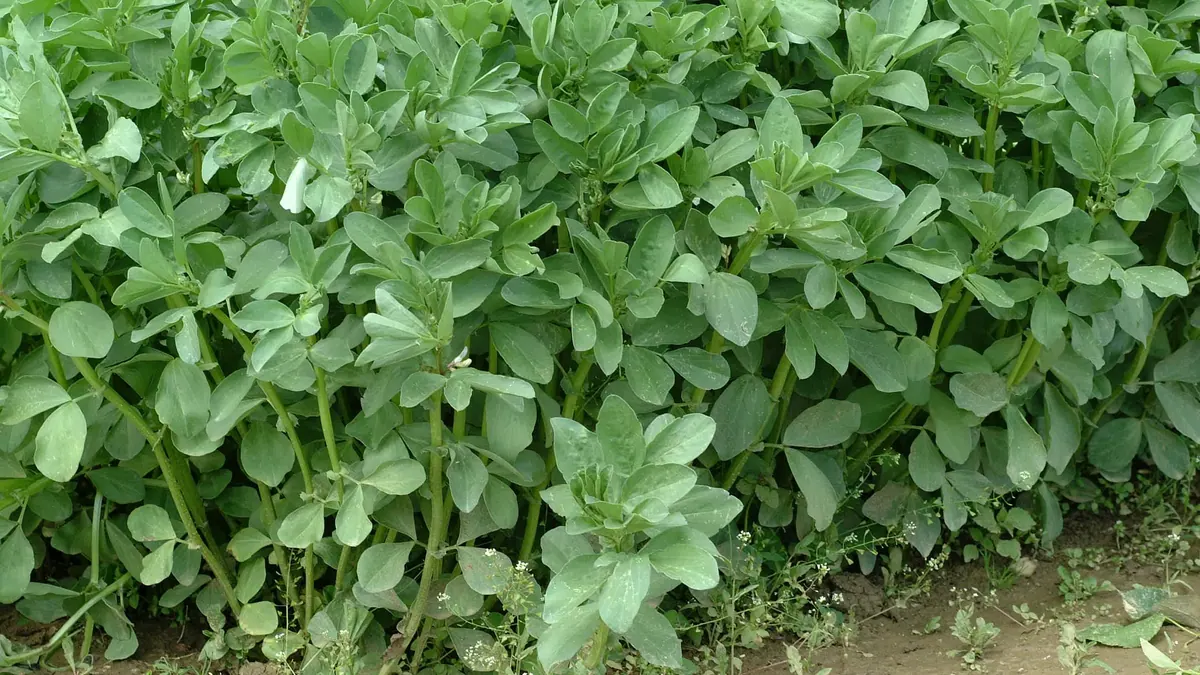
Faba bean, whole crop — BMP: 2 studies, weighted mean 296 m³ CH₄/t VS
296 m³ CH₄/t VS weighted mean from 2 studies
≈52 %
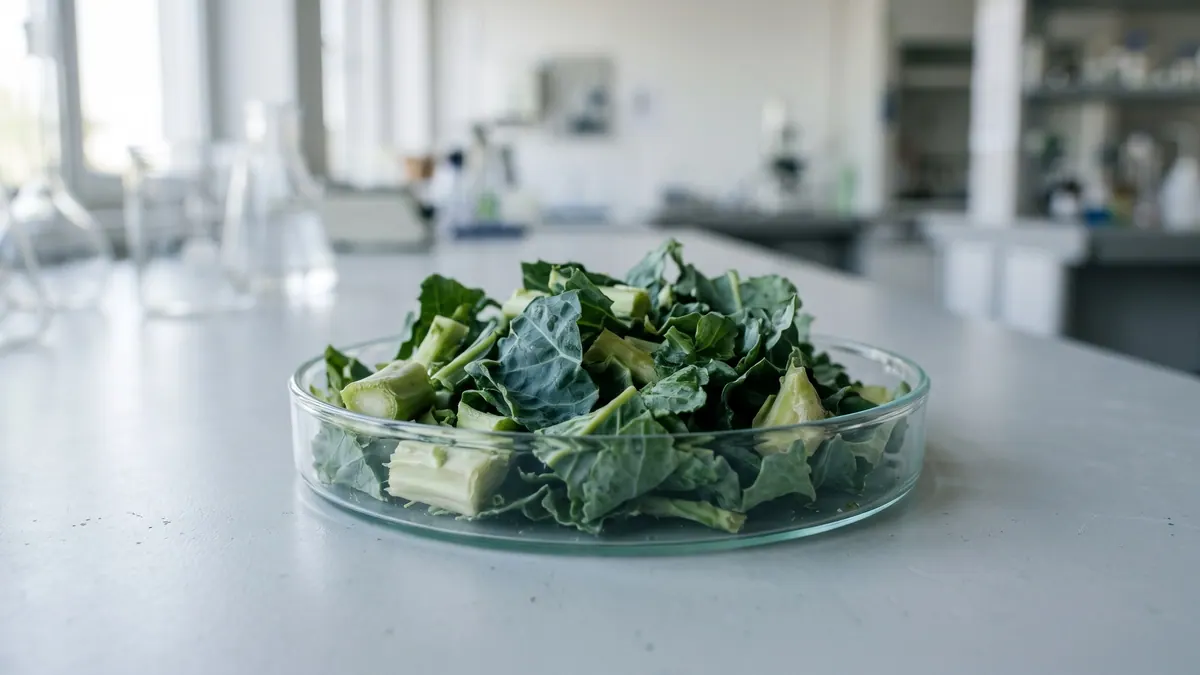
Marrow kale — BMP: 2 studies, weighted mean 315 m³ CH₄/t VS
315 m³ CH₄/t VS weighted mean from 2 studies
≈52 %
Grass (fresh and silage) — BMP: 145 studies, weighted mean 345 m³ CH₄/t VS
345 m³ CH₄/t VS weighted mean from 145 studies
good — editorial rating for biogas plants≈53 %