
Waste and circular economyAnalysis
Compostable bags and digester retention time: will they have time to break down?
The "compostable" certificate applies to industrial composting, not to a digester. We compare the two processes and explain when a bag can go into a digester without risk to the digestate.
Other language versions: Polski, Deutsch, Español, Français, Italiano, Nederlands.
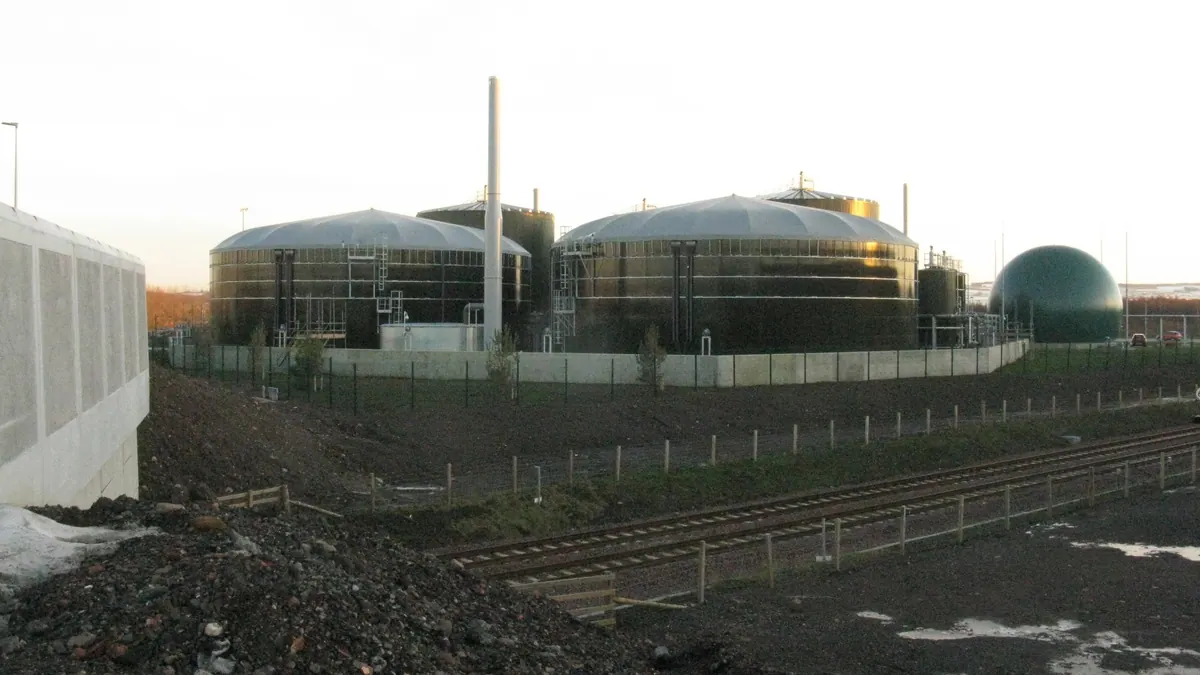

A bag marked as compostable is not automatically "safe" for a digester. The certificate is based on testing breakdown under industrial composting conditions, that is, in the presence of oxygen and at an elevated temperature, whereas a methane digester is an anaerobic environment with different microbiology and a different contact time. The question "is the retention time sufficient" therefore requires a comparison of two processes, not a simple conversion of days.
What the "compostable" marking actually confirms
The EN 13432 standard sets out requirements for packaging suitable for recovery by composting and biodegradation. It tests, among other things, physical disintegration (whether fragments of film disappear from the compost within a specified time), biodegradation of the organic material under composting conditions, the absence of an adverse effect on compost quality, and the content of hazardous substances. The tests are carried out under conditions modelling industrial composting, in which the windrow reaches thermophilic temperatures, is aerated, and the process lasts from several weeks to several months.
The basic conclusion follows: the test result is valid for a composting plant. A packaging standard is not a test of how a bag behaves in a digester, nor does it say anything about the behaviour of film in a mesophilic chamber kept at around 37–42 °C. Separate methods for testing anaerobic biodegradation exist, but the "compostable" marking on a bag usually does not refer to them.
Two processes, two sets of conditions
| Feature | Industrial composting | Methane fermentation |
|---|---|---|
| Oxygen | present (aeration) | absent |
| Typical temperature | thermophilic, often above 50 °C in the intensive phase | mesophilic or thermophilic, kept stable |
| Condition for film disintegration | tested in the standard | depends on the material, not covered by the packaging certificate |
| Mixing | turning of windrows | continuous or cyclical mechanical mixing |
| Removal of residues | screening after the process | digestate is usually not screened in its entirety |
| Time | weeks to months | hydraulic retention time: as a rule tens of days |
The difference in how time is "counted" is also important. In a continuously mixed digester, the hydraulic retention time (HRT) is an average value. Part of the feed leaves the tank faster than the average, part later. For solid particles such as shreds of film, a short passage through the tank is a realistic scenario. In multi-stage systems (digester, secondary digester, digestate tank) the total residence time is longer, but in the final tanks the temperature is lower and the film is no longer mixed as intensively.
The bag material matters more than HRT
"Bio" bags are made from various blends: starch, biodegradable polyesters, PLA and additives. They behave differently under anaerobic conditions. Materials based on starch and some polyesters break down faster, while PLA usually needs markedly higher temperatures than mesophilic ones to hydrolyse in a reasonable time. The result of one manufacturer must therefore not be generalised to all bags of similar appearance. Practical guidance:
- Assess the specific type of bag (composition, thickness, certificate), not the slogan on the packaging.
- Remember that thicker and stiffer films break down more slowly, because the process starts at the surface.
- In winter and at a low feed temperature, disintegration is slower than in the warm season.
- Bags contaminated with fat or stuck together with waste form lumps that are shredded less well.
Consequences for the installation: where the problem usually appears
- Blocked pumps and agitators. Strands of film wind around agitator blades and pump impellers. Even if the film ultimately breaks down, the equipment suffers sooner.
- Scum. Fragments of film with fibres build up a floating layer that hinders mixing and gas exchange.
- Contaminants in the digestate. Undegraded shreds of film are visible in the field and in the separator. For fertiliser quality, and for a fertiliser product for compliance with contaminant limits, this is the most serious consequence. The rules for qualifying digestate are set out in Regulation (EU) 2019/1009, and the specific obligations depend on the legal route chosen by the producer (see the entry on the status of digestate).
- Effect on the biogas balance. The biodegradable polymer itself yields a certain amount of biogas, but this is marginal compared with food waste, so there is no point buying "bio-bags" for the energy gain.
How to assess a specific bag
Instead of relying on a declaration, ask the bag supplier a few questions: what polymer it is made of (starch, PBAT, PLA, a blend), whether it has anaerobic biodegradation test data and at what temperature the tests were carried out, how thick the film is, and whether the composition includes additives that do not break down. The answer "only the compostability certificate" means that nothing certain is known about behaviour in a digester. It is also worth remembering that laboratory assessment applies to the pure material, while in reality the bag is smeared with fat, crushed and mixed with waste, which changes the rate of breakdown.
How to approach the subject in practice
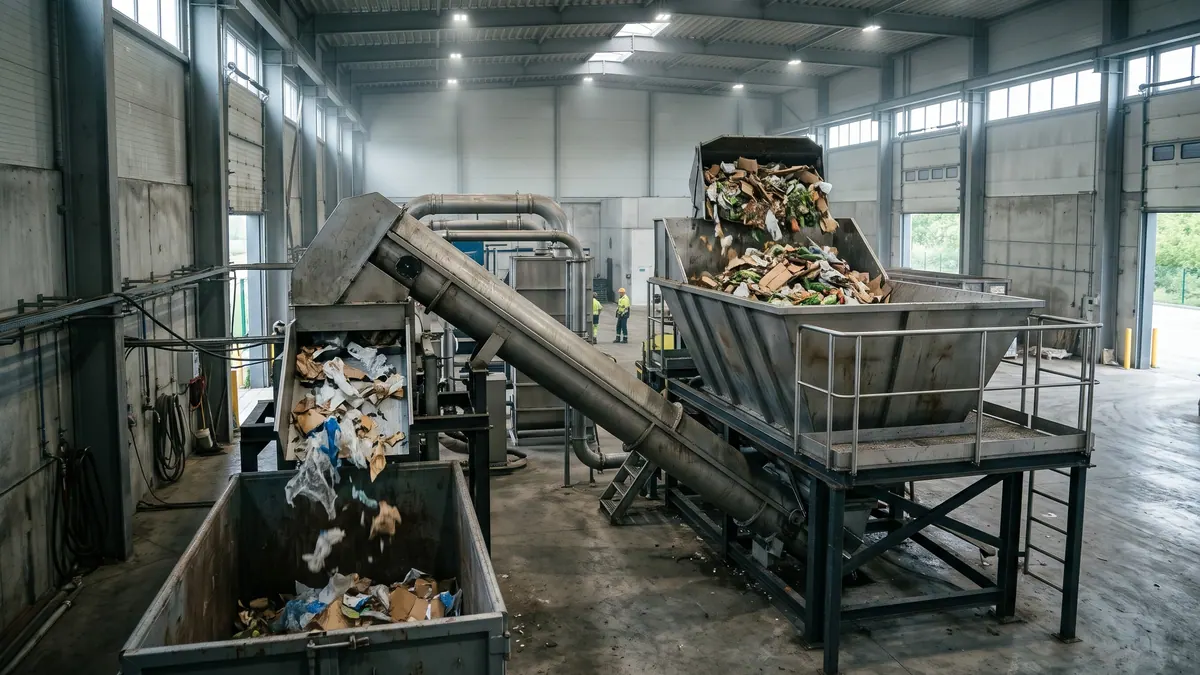
The most reliable model is to separate bags from the organic fraction before the digester. Biowaste preparation lines (pre-shredding, mechanical separation, depackaging, screens) are meant to remove packaging regardless of its declared biodegradability. In installations that accept waste from catering or retail, where the feed includes Category 3 animal-origin material (for example former foodstuffs containing animal products), hygienisation and particle-size requirements apply (Regulation (EU) No 142/2011), which forces intensive mechanical treatment, and this also helps to shred the film.
When setting rules for waste acceptance, it is worth stating in contracts with suppliers which types of bags are permitted, and verifying this by sight at unloading. A screening test is also good practice: take a batch of digestate and check whether the solid fraction after separation contains shreds of film. A broader discussion of feed preparation can be found in the entry on depackaging of food packaging waste, and on process stability parameters when the feed changes in the entry on feeding stability at biogas plants.
Summary
The digester's retention time does not decide the fate of a compostable bag. The certificate applies to a different process, and the behaviour of film in a digester is determined by the material, temperature, shredding and the way of mixing. For the operator, a sensible rule is to treat bags as a contaminant that must be removed or at least shredded, and to approve every exception on the basis of data on the specific product and observation of the digestate.
Sources
Questions and answers
Can a compostable bag be put into the digester together with biowaste?
This cannot be assumed in advance. A compostability certificate does not cover anaerobic digestion, so the decision is made by the installation after checking the specific bag and its own feedstock preparation line.
Related articles