
Waste and circular economyAnalysis
The future of organic waste management for cities and the food industry
From waste prevention, through separate collection and logistics, to fermentation and composting: how to arrange the hierarchy of handling biowaste from cities and food plants.
Other language versions: Polski, Deutsch, Español, Français, Italiano, Nederlands.
Organic waste is the largest fraction of many municipal waste streams and a significant part of the waste of the food industry. It is also the most obvious raw material for recovery, because it contains carbon and nutrients. How to manage it is decided by both regulations and logistics. A mature society judges it by how much of it returns to the cycle, not by how much goes to landfill. This is why this is the next part of the series on self-sufficiency that begins locally: in the kitchen bin, on production lines and in the municipal collection system.
The hierarchy: first, do not waste
The Waste Framework Directive sets the order: prevention, preparation for re-use, recycling, other recovery (including energy recovery) and, last of all, disposal. For organic waste this means: first reducing food waste, then passing food on to people (for example through charitable organisations) and, where the law allows it, using it as feed, then organic recycling (composting and fermentation), and only after that energy recovery in incinerators and landfilling. The scale of the problem is visible in the data: about 58 million tonnes of food waste arise in the Union each year, about 129 kg per inhabitant (Eurostat, 2024 data). Every tonne of food saved is better for the environment than the best biogas plant, because it saves all the energy and resources used to produce it. The biogas plant is here a tool for what can no longer be saved. This is described in the article Waste hierarchy and anaerobic digestion.
Collection: everything depends on it
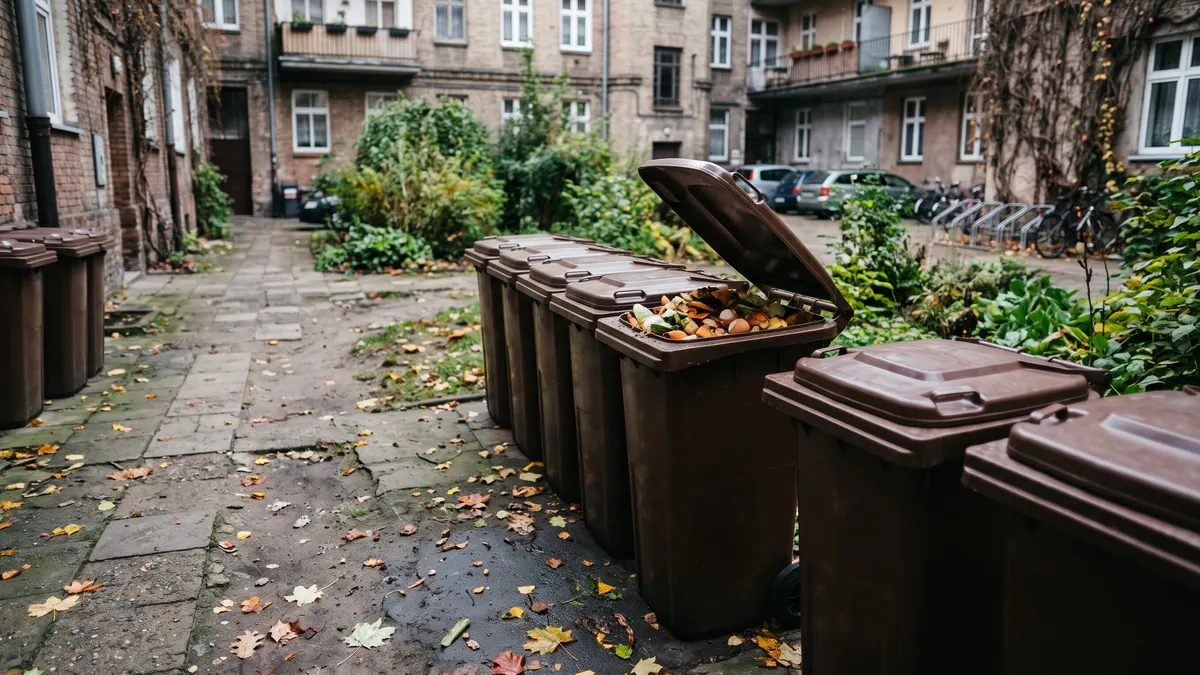
Directive 2008/98/EC (Article 22) requires biowaste to be collected separately or recycled at source (for example in home composters), and national implementation goes through municipalities. The share of biowaste collected separately is, however, low in many places, and reliable data must be taken from current municipal and voivodeship reports. Large differences between municipalities show that organisation matters more than the technology itself. The quality of collection depends on:
- the containers and their labelling, because legibility improves sorting,
- the collection frequency, especially in summer, when the fraction rots,
- information and checks for residents, without punishing, but with consistency,
- protection against contamination with film and packaging.
Details for municipalities are given in the article Separate collection of biowaste in municipalities.
The food industry: waste with value
Food plants have more uniform and predictable streams: pomace, stillage, whey, fats, slaughterhouse waste, out-of-date products. The high energy content makes them a valuable substrate, but requires recognition: fats can cause foaming and inhibition, and animal by-products require sanitisation in accordance with the rules on animal by-products (Regulation (EC) No 1069/2009). Packaged products must first be unpacked; this is described in the text Depackaging: packaging waste with food. It is also worth examining whether a given material is waste or a by-product, which is covered in the article By-product or waste.
Fermentation or composting
Both methods have their place. The comparison is made in the text Composting or fermentation of biowaste. In short: fermentation yields energy and fertiliser, and works in a closed system that limits odours and emissions, but requires more control and outlay. Composting copes well with green and wood waste and is simpler, but does not yield biogas. In modern plants the two technologies are combined: fermentation of wet fractions, followed by composting of the solid residue, which improves the quality of the final product.
Logistics and scale
Biowaste is heavy, wet and rotting, so its transport is a cost and a sanitary problem. The economic distance depends on the value of the waste and the gate fee, and the decision on the location of the installation is as important as the choice of technology. Planning at the regional level, in which municipalities, plants and farmers cooperate in a single cycle, gives better results than scattered, haphazard solutions; see Municipal installations, waste management plans and biowaste. In practice a local biogas plant that takes the city's biowaste and residues from surrounding plants and returns digestate to surrounding farms closes the cycle over an area of several dozen kilometres.
Pitfalls worth avoiding
- Oversizing the installation relative to the real quantity of waste, and then increasing the doses of purpose-grown feedstocks, which contradicts the idea.
- Underestimating the cost of contamination: waste with plastic requires depackaging and cleaning, and that costs money and produces its own waste.
- Neglecting the sale of digestate: without a recipient, digestate becomes a nuisance that eats up the profit from energy.
- Ignoring odours and neighbours: social acceptance requires enclosed halls and good communication.
Outlook
The future lies in combining three things: less waste, cleaner collection and installations matched to the local stream. This approach promises no miracles, but every element is concrete and verifiable. Waste that returns to the field as fertiliser and heats a home as gas is a resource the country has to hand. We write about the energy and fertiliser context in the articles Energy independence starts locally and Digestate and nutrient recovery.
Sources
Questions and answers
Which is better for the climate: composting or digestion of bio-waste?
Anaerobic digestion usually has a more favourable climate balance, because in addition to compost or digestate it yields biogas that replaces fossil fuels, while composting – if carried out properly – is simpler and cheaper but produces no energy.
Why is the quality of separate collection so important?
Plastic, glass and metals in biowaste end up in the digestate or compost, lower its quality, hinder its sale and raise the cost of cleaning. Clean collection is cheaper than sorting later.
Related articles