
Market and investmentExplainer
Dry ice from biogenic CO₂: how it is made and when it makes sense
Dry ice can be made from CO₂ separated during biogas upgrading. What the process looks like, what quality requirements must be met and what it means for the climate.
Other language versions: Polski, Deutsch, Español, Français, Italiano, Nederlands.
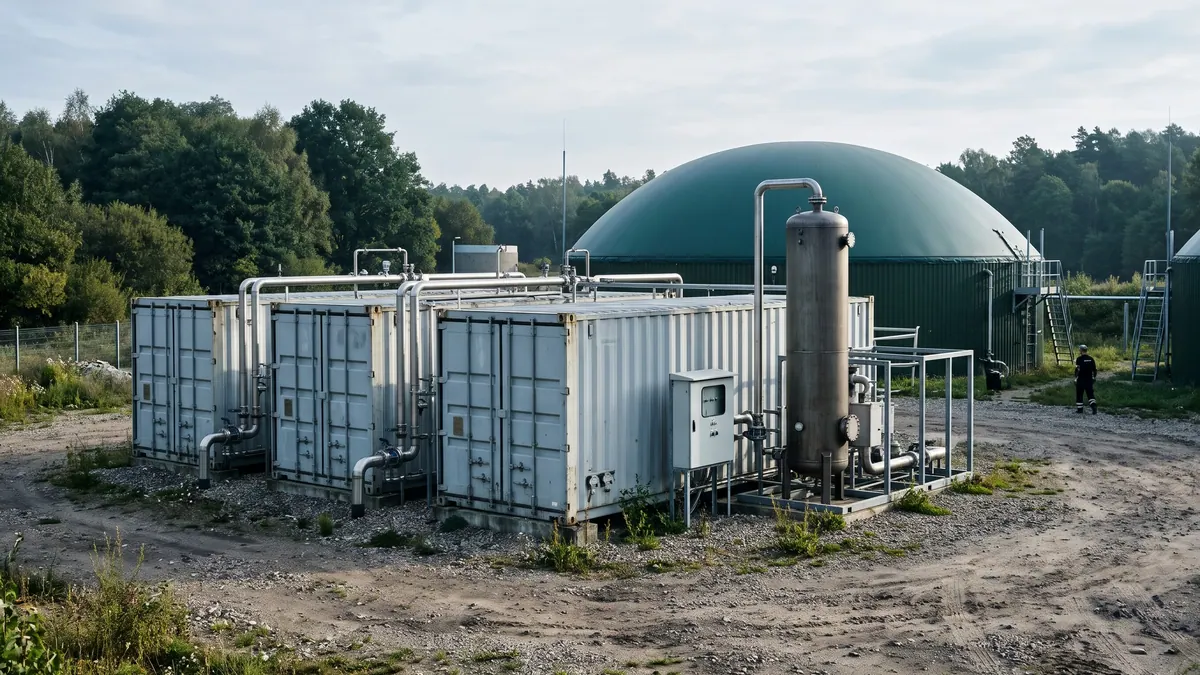
Dry ice from biogenic CO₂ is made by separating carbon dioxide from biogas in an upgrading plant, purifying it, liquefying it and expanding it into "snow", which is then pressed into pellets or blocks. Chemically it does not differ from dry ice from other sources; it differs in the origin of the carbon, which comes from biomass and not from fossil fuels. This matters for the climate balance, but does not change the technological and quality requirements.
Where the CO₂ comes from
Biogas usually contains several tens of per cent CO₂, which is removed in upgrading to obtain biomethane. The CO₂ stream leaving the plant can be pure or contaminated with residual methane, air, moisture and sulphur compounds, depending on the technology (see Upgrading: comparison of technologies). The use of CO₂ is described in the text Biogenic CO₂ from biomethane plants.
How dry ice is made
- Purification. Removal of water, sulphur compounds, volatile organic compounds, residual methane and other impurities, as appropriate to the intended use of the product.
- Liquefaction. CO₂ liquefies at elevated pressure and reduced temperature (the triple point of CO₂ is about 5.18 bar and −56.6 °C, so the liquid exists only above this pressure).
- Expansion. Liquid CO₂ expands to atmospheric pressure, as a result of which part turns into gas and part into fine snow. The gas produced during expansion can be recycled into the system.
- Pressing. The snow is pressed into pellets or blocks. The pressing parameters affect density and the rate of sublimation.
Quality requirements
Dry ice used in contact with food must meet the requirements for CO₂ as a food additive (designation E 290 in Regulation (EC) No 1333/2008) and the quality standards used in the industrial gases sector, such as the EIGA guidelines. For a technical product (cleaning, cooling in transport) the requirements are less strict. The requirements for food-grade CO₂ are high, so the raw stream from upgrading usually has to be purified and tested in a laboratory. Quality is determined by the plant supplier and the buyer; do not assume that every stream is "suitable".
Applications
- Cooling and transport of food and pharmaceutical products.
- Blast cleaning (waste-free removal of contaminants from surfaces).
- Food industry: chilling, freezing, mixing in processes.
- Visual effects and catering, subject to safe-use rules.
Does it make economic sense
Profitability depends on scale (the amount of CO₂ available), the purity of the stream, the distance to the market and customers, and the cost of liquefaction and cooling. Dry ice has a limited storage time (it sublimes), so logistics are demanding. In many cases it is profitable to use the CO₂ in liquid form, and dry ice is one of the forms that allow the product to be delivered to customers without a cryogenic tank. This scope decides whether the investment makes sense, and requires an analysis of the market of buyers.
The climate aspect
CO₂ from biomass belongs to the short carbon cycle. Dry ice returns to the atmosphere after sublimation, so it is not permanent carbon storage. The benefit is that it replaces CO₂ of fossil origin where it would otherwise be used. Solutions of the BECCS type serve for permanent removal of CO₂; see BECCS and storage of biogenic CO₂. Environmental claims should be based on the accounting methodology, not on the slogan "bio".
How much dry ice a CO₂ stream yields
When liquid CO₂ is expanded to atmospheric pressure, only part of the mass turns into solid snow and the rest returns as gas; this share depends on the pressure and temperature of the liquid before expansion and in typical systems is less than half. A well-designed plant recompresses and re-liquefies the evaporated gas, so the loss of CO₂ is smaller. For planning, you therefore need to ask the supplier about the yield over the whole cycle, not just the capacity of the press. On top of this comes the energy consumption for cooling, which in the cost balance is sometimes the decisive item.
Questions to consider before deciding
- What purity does the CO₂ stream from the existing upgrading technology have, and can it be raised?
- How many buyers are within a reasonable distance, and what is their demand over the year (seasonality)?
- Will the product be food-grade or technical, and what quality tests will be required?
- What happens to the CO₂ in periods when demand is low?
Safety
Dry ice causes cold burns, and its sublimation in enclosed spaces displaces oxygen. In storage and transport, ventilation and non-gas-tight packaging are used (dry ice must not be sealed in airtight containers). The rules for safe use should follow from the supplier's safety data sheet and the plant's procedures.
Sources
Related articles