
Safety and ATEXExplainer
Emergency biogas flaring, part 1: where excess gas goes and what the regulations say
Where excess biogas comes from, the order in which it is to be dealt with, and which requirements for a flare or another consumer are mandatory and which are only recommended.
Other language versions: Polski, Deutsch, Español, Français, Italiano, Nederlands.
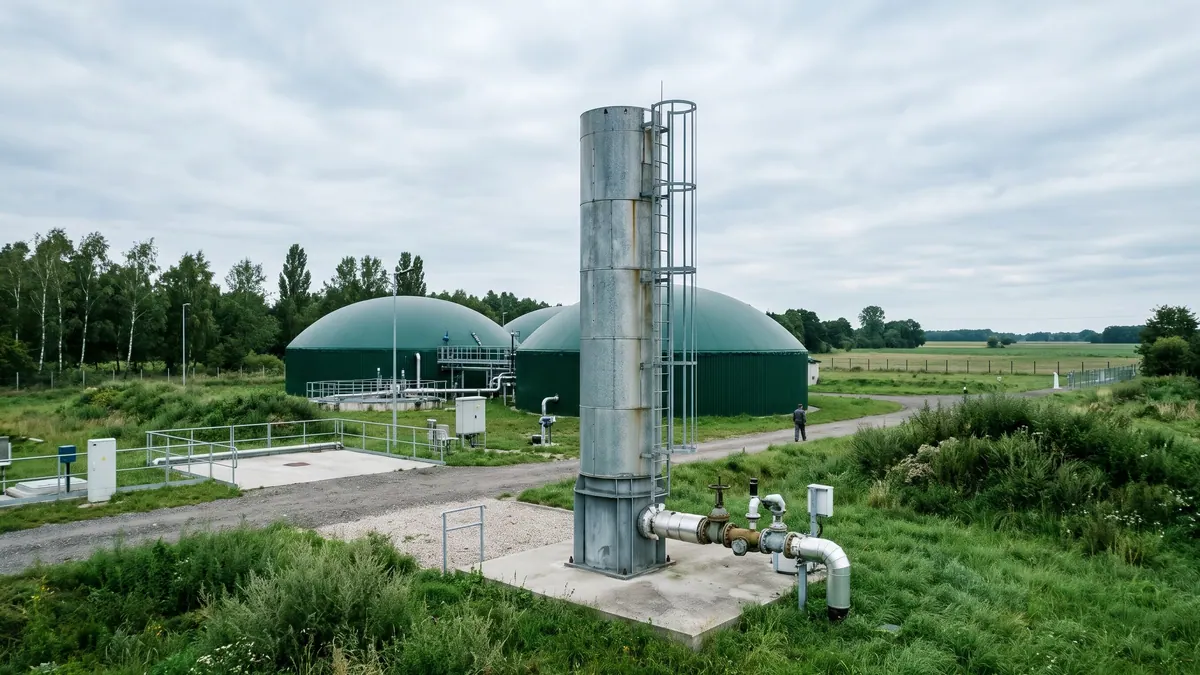
A biogas plant produces gas continuously (a biological process cannot be switched off like a boiler), while the consumers (cogeneration engine, boiler, upgrading) draw it unevenly, so every installation must have a planned destination for the excess. The principle is simple: gas should first be stored, then used, and only at the end burned in a flare. This article opens a series on emergency biogas flaring and sorts out the concepts and requirements. The details of flare construction are covered in the article Flare at a biogas plant: construction, requirements and safe operation, and crisis procedures in the emergency plan of a biogas plant. Here the focus is the big picture.
This article is part of the series "Emergency biogas flaring". The following parts compare specific solutions, and the last one summarises them in a table and a decision tree.
Where excess gas comes from
Fermentation cannot be switched off like a boiler. Biology produces gas even when the engine is down for servicing or a breakdown, has been switched off by the grid operator, or is running at reduced power. Typical causes include:
- a breakdown or planned servicing of the only engine,
- a limit on the offtake of electricity or heat,
- gas with parameters unacceptable for the engine (e.g. composition after a process disturbance, moisture, hydrogen sulphide),
- an increase in production after raising the dose of an easily degradable substrate,
- digester start-up, when gas with a low methane content is not yet suitable for the engine,
- a power failure, when the gas system must move to a safe state.
The last item shows that emergency flaring is not only a matter of economics. It is an element of protection against gas overpressure in the tanks, and therefore a safety topic that links to explosion hazard zones and ATEX.
Hierarchy of dealing with excess
In practice the order runs from the least to the most wasteful solutions:
- Reducing supply: limiting the substrate dosing, if the situation is predictable.
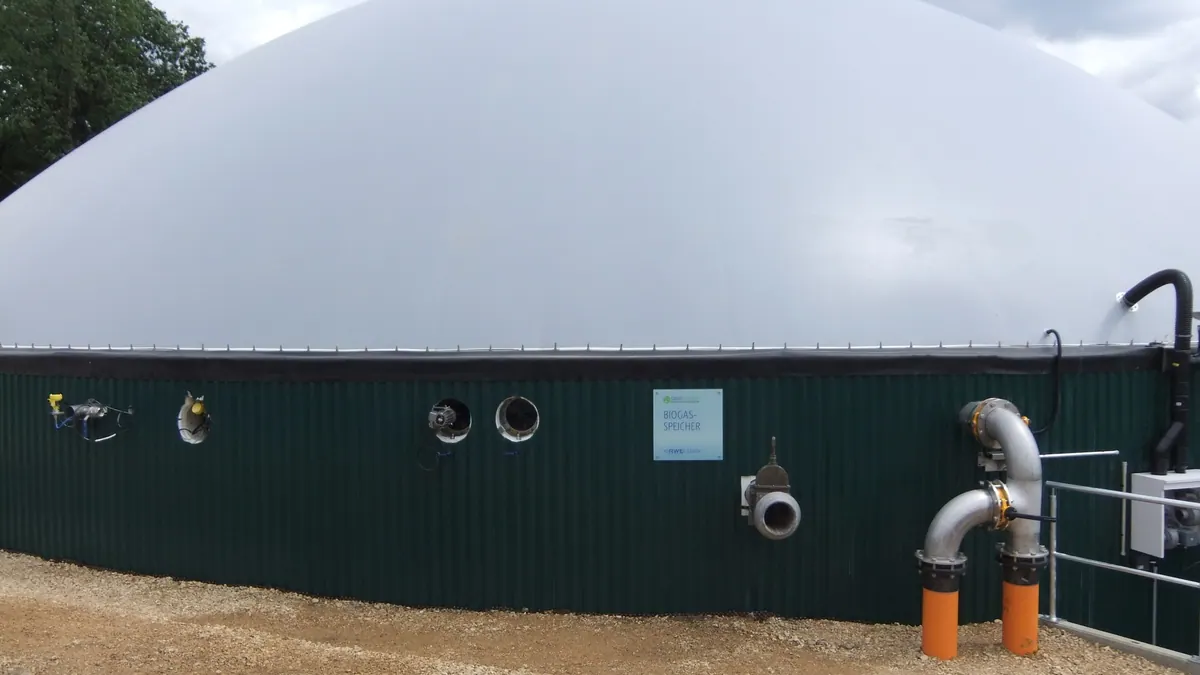
- Gas buffer: a membrane storage holder takes up the difference between production and consumption.
- Useful consumers: an additional engine or microturbine, a hot water boiler, a heat user, upgrading to biomethane.
- Flare: burning the gas without using its energy.
- Emergency release through a safety valve: the final protection of the structure, which acts automatically and whose operation should be avoided.
The fifth level is not a solution but a safeguard for the case when all the earlier ones fail. The following parts of the series discuss each level separately, and the article on gas storage under a double-membrane roof describes the structural side of the buffer.
What the regulations say
European Union. The BAT conclusions for waste treatment (Commission Implementing Decision (EU) 2018/1147) define flaring as the high-temperature oxidation of the combustible compounds of waste gases with an open flame. According to BAT 15, a flare is used only for safety reasons or in non-standard operating conditions (e.g. start-up, shutdown), and according to BAT 16, where flaring is unavoidable, monitoring and recording must be carried out, including continuous measurement of the quantity of gas sent to the flare. This applies to installations within the scope of these conclusions, so the scope must be checked for the specific installation (for anaerobic digestion of waste alone, a threshold of 100 t of waste per day has been adopted). The article Methane emissions from biogas plants shows why a flare is preferable to releasing methane.
Poland. The requirement for a flare does not follow from a single act for all biogas plants. It usually follows from several sources at once: the environmental decision, the permit for introducing gases or dust into the air (Article 181(1) of the Environmental Protection Law Act), the building permit, the process design and the explosion protection document. The content of the permit states how the flare is described and what operating conditions apply to it. The scope of permits is described in the article Environmental permits for biogas plants.
Germany as an example of detailed requirements. The German rule TRAS 120 provides separate requirements for membranes and gas storage (sec. 3.5) and for an additional gas consumption unit (zusätzliche Gasverbrauchseinrichtung, sec. 3.8). The German guidance KAS-28 concerns this additional unit directly, in particular a flare (insbesondere Fackel). A document of the German agricultural accident insurer, the Social Insurance Institution for Agriculture, Forestry and Horticulture (SVLFG) (status 12/2013), made available on the BG ETEM website, specifies, among other things, guarding of hot parts up to a height of 2.70 m, integrating the flare into the emergency power concept, and a compressor (blower) providing the required gas pressure. In its judgment of 11 May 2026 (case no. Au 9 K 25.85) the administrative court in Augsburg dismissed a biogas plant operator's complaint against orders to retrofit the installation with an automatically ignited flare and over- and underpressure protection, holding them lawful and in line with the duty to apply the state of the art; according to the court, manual flaring, free storage capacity and a cogeneration engine are not safety devices. These examples serve as a point of reference, not as Polish law.
Required versus recommended
| Element | Certain in practice | Recommended or dependent on the decision |
|---|---|---|
| Safe discharge of gas at overpressure | yes, follows from the risk assessment and the design | method (flare, consumer, valve) according to the design |
| Flare | usually written into the decisions and the design | type (open, enclosed) according to location and permit conditions |
| Second engine or boiler | not required by a general regulation | recommended where engine failures are frequent |
| Large gas storage | does not follow from a general regulation | recommended for flexible operation |
| Log of flare operating time | depends on the permit | recommended as good practice |
Insurers may set their own fire protection requirements for biogas plants, and the specific policy requirements are set by the contract with the insurer.
How to check your installation
- Record in one document all possible gas consumers and their maximum consumption.
- Check in the environmental decision and the permit how the flare is described and what limits on its operation apply.
- Compare the maximum possible gas production with the capacity of each consumer when the first one fails.
- Ask the designer whether the overpressure protection also works during a power failure.
- Check whether the flare is covered in the explosion protection document (hazard zones, ATEX at a biogas plant).
Why flaring is not a "free" solution
Every hour of flare operation is gas that did not become electricity, heat or biomethane. In addition, combustion is never perfect: some of the methane may pass through unburned, and the scale depends on the type of flare and the operating conditions. A well-run installation therefore treats the flare like a fuse: it should work reliably, but rarely. If the flare operates regularly, that is a sign that the gas balance is out of equilibrium and that it is worth checking the causes before investing in further equipment.
This article is general in nature and does not replace a design or the opinion of qualified persons. The requirements depend on the capacity of the installation, the type of substrates processed, the location and the content of the permits.
Sources
- Decyzja wykonawcza Komisji (UE) 2018/1147 — konkluzje BAT dla przetwarzania odpadów (EUR-Lex)
- TRAS 120 — spis treści (umwelt-online)
- Ustawa Prawo ochrony środowiska — ISAP
- SVLFG (materiał udostępniony na stronie BG ETEM, stan 12/2013) — Anforderungen an Gasfackeln aus Sicht des Arbeits- und Explosionsschutzes
- VG Augsburg, wyrok z 11.05.2026, sygn. Au 9 K 25.85 (gesetze-bayern.de)
Questions and answers
Does every biogas plant have to have a flare?
The flare requirement does not stem from a single regulation for all biogas plants, but in practice appears in the environmental decision, the permit to release gases into the air, the building permit and the technological design.
Related articles