
Market and investmentExplainer
Energy independence starts locally: organic waste as a national resource
Slurry, field residues and biowaste are energy and fertiliser nutrients that arise within the country. What biogas can give energy sovereignty, and what it does not promise.
Other language versions: Polski, Deutsch, Español, Français, Italiano, Nederlands.
On the National Independence Day it is worth asking a prosaic question: where does the energy that heats our homes come from, and where do the nutrients on which our grain grows come from? The independence of a state has a political dimension, but it also has an everyday and economic one. A country that can use its own resources, including those hitherto regarded as waste, is more resilient to price fluctuations, to supply disruptions and to decisions over which it has no influence. This text opens a series of seven articles on the subject, factually and without big words.
What exactly do we import
Poland uses annually from a dozen to over twenty billion m³ of natural gas (depending on the year), and domestic production covers only the smaller part of it, so most of the gas comes from imports. The share of imports depends on the year and on the definition adopted, so when citing figures it is always worth checking the year and the method. There is also a second, less visible dependence: nitrogen fertilisers. In Europe ammonia is produced mainly from natural gas, which is both the raw material and the energy source of the process. According to Statistics Poland (GUS), mineral fertiliser use in the 2022/2023 farming year was about 122 kg of NPK (pure nutrient) per hectare of agricultural land, including about 71 kg of nitrogen (GUS, Środki produkcji w rolnictwie; in other years the values are different). Gas and fertilisers are thus two streams on which world prices and availability have a direct effect.
A resource we already have
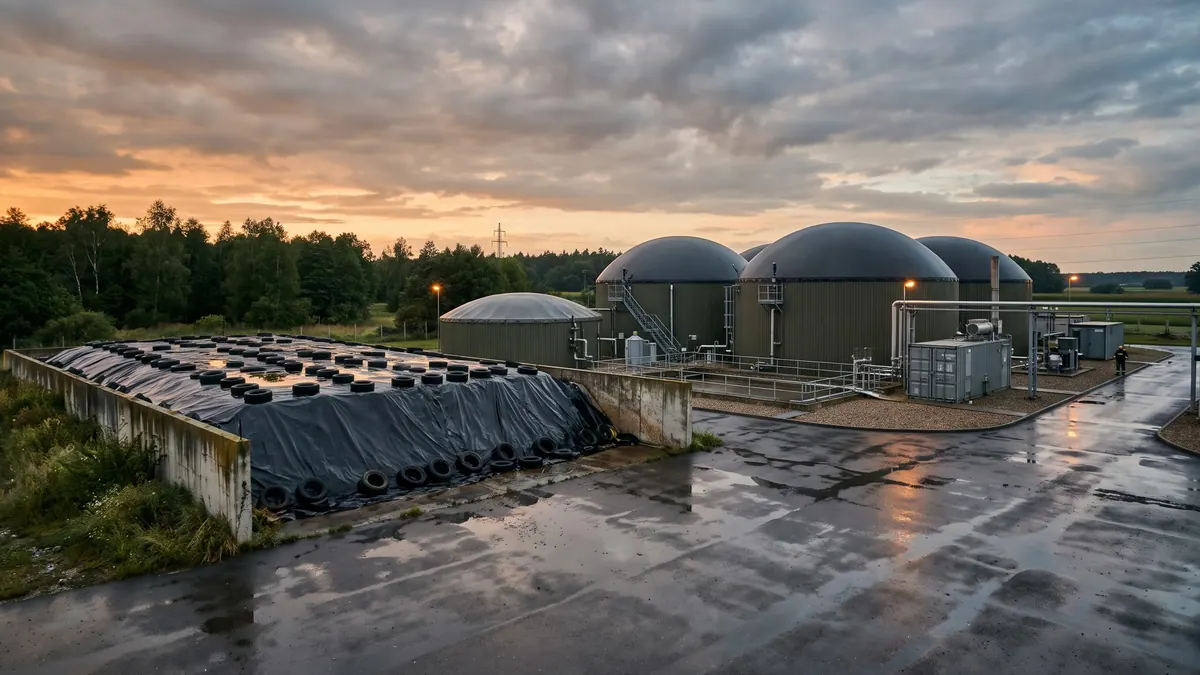
Alongside these imports there is a stream that arises in the country regardless of the economic cycle: slurry and solid manure from farms, residues from food processing, kitchen and green waste from municipalities, sewage sludge, and also straw and agricultural surpluses. Many of them tend to be a cost: odour, methane and ammonia emissions, a storage problem. Methane fermentation turns this nuisance into two products: biogas, from which electricity, heat or biomethane can be produced, and digestate, in which the mineral components of the substrate (nitrogen, phosphorus, potassium) remain, because it is mainly organic carbon that is lost from the process. The mechanism by which biowaste gains value is covered in the article The waste hierarchy and anaerobic digestion.
The scale is not made up. According to the International Energy Agency, the sustainable potential of biogas production worldwide is close to 1,000 billion m³ of natural gas equivalent per year, that is, about a quarter of world gas demand, and the European Union uses, according to the IEA, about 40% of its own potential (IEA, Outlook for Biogas and Biomethane, 2025). For Poland the estimates come from several sources and differ several-fold: the National Centre for Research and Development (NCBR) gives about 3.2 billion m³ of biomethane per year, and the Lower Silesian Institute of Energy Studies (DISE) about 8 billion m³ of theoretical potential, which, after taking account of access to feedstock and grid constraints, it puts at 3–4 billion m³ (the differences result mainly from assumptions about straw, solid manure and access to the grid). The very spread is information: the potential exists, but how much of it is realised depends on decisions, logistics and profitability, not on biology alone.
Why it starts locally
A biogas plant is not a refinery. The substrate has a low energy density and a high moisture content, so it does not pay to haul it far. A reasonable supply radius is, as a guide, a dozen or at most several dozen kilometres, depending on the substrate. This means that value stays on the spot: a farm hands over slurry and receives digestate, a municipality hands over biowaste and receives heat or gas, a food plant pays less for disposal. Part of the money that would otherwise flow abroad stays in the region. We also describe this mechanism in the article Domestic biomethane costs more than imported gas, but the money stays in Poland, which also honestly shows the difference in cost.
Denmark, often cited as an example, shows that it is possible to build a system based on slurry and biomethane that accounts for a significant share of the gas grid; this is discussed in the article Denmark: green gas in the grid, slurry and biomethane as a model. Every country, however, has a different structure of agriculture, grids and law, so the model has to be translated, not copied.
What biogas does not promise
Honesty towards the reader requires pointing out the limits. Biogas will not solve the problem of energy security on its own. Even an optimistic biomethane potential does not replace all gas, and straw and solid manure require logistics that have to be learned. An installation costs money, and its profitability depends on the price of the substrate, the support system or contracts, the possibility of connection and the management of the digestate. Crops grown specifically for biogas can compete with food production for land, and biogas and biomethane for energy purposes are subject, above certain capacity thresholds, to the sustainability criteria of the RED Directive (as amended by RED III). A bad project, for example one too large relative to the available substrate, can do harm instead of good. Energy independence is therefore not a single technology but a set of solutions: efficiency, renewable sources, grids, storage and, among them, also green gases from waste.
Duty and privilege
Environmental protection is sometimes presented as a burden. It can, however, be seen differently: as a duty to those who will come after us, and as a privilege, because we have the knowledge that allows us to do it better than previous generations. Slurry that does not evaporate methane, residues that become fertiliser, gas instead of a flare at a landfill are concrete things, not slogans. They improve air and water quality, reduce odours, cut emissions and reduce dependence on supplies from outside the country. All of this depends on sound engineering and farming work, not on declarations.
What next in this series
The following articles break this subject down into parts. In the following articles that day: digestate and the recovery of nutrients instead of part of the artificial fertilisers, biomethane as a domestic fuel, biohydrogen assessed without enthusiasm and without prejudice, the future of waste management for cities and industry, innovations coming out of laboratories, and a summary on intergenerational responsibility. In each we give the conditions and limitations, because only then is knowledge useful.
The figures in this article come from studies by the IEA, GUS, NCBR and DISE and relate to the years given; subsequent years may change them, so when planning a specific investment one should reach for current data for one's own region and feedstocks.
Sources
Questions and answers
Can biogas replace natural gas in Poland?
Not entirely. Estimates of biomethane potential range from about 3 billion m³ per year (NCBR) to about 8 billion m³ (theoretical potential according to DISE), while natural gas consumption is from over ten to more than twenty billion m³ per year, depending on the year. Biomethane can replace part of this gas, but as one of several components of a secure balance.
Why is organic waste called a domestic resource?
Because it arises locally, in steady quantities, and contains both energy (organic carbon) and fertiliser components: nitrogen, phosphorus and potassium. Processing it reduces demand for imported fuels and fertilisers.
Related articles