
Market and investmentAnalysis
What a biogas plant gives a municipality: tax, heat, slurry management and local energy
A biogas plant can give a municipality property tax revenue, cheaper heat for schools and buildings, collection of slurry and waste, and a local source of energy. What is certain and what depends on the project.
Other language versions: Polski, Deutsch, Español, Français, Italiano, Nederlands.
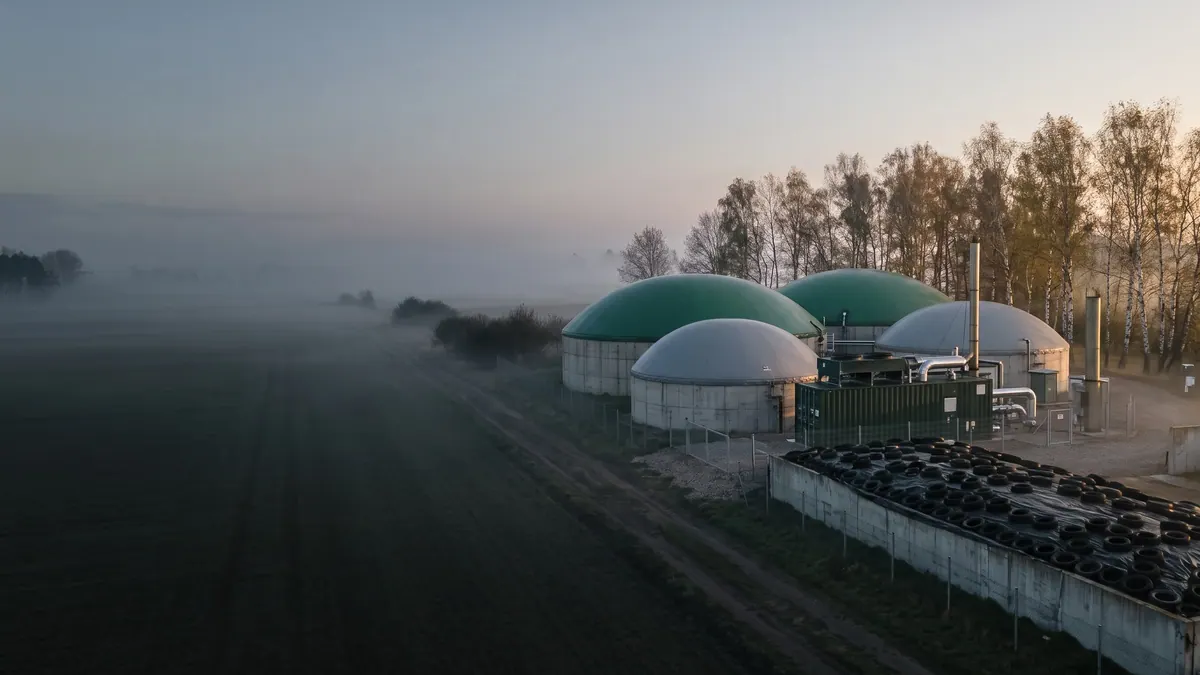
A biogas plant can give a municipality four things: property tax revenue, local heat, order in the streams of slurry and waste, and a source of energy from local raw materials. Each of these benefits is real, but none arises automatically: it depends on the specific project, on who the owner is, and on the agreements concluded before construction. This article opens a series on the biogas and biomethane plant in the countryside, in which we describe the opportunities first, and discuss the risks honestly and briefly, together with ways of limiting them.
Property tax
The land, buildings and structures of a biogas plant are subject to property tax, which goes entirely into the municipal budget. For structures, the Act on Local Taxes and Fees provides an upper rate limit: 2% of their value per year (Article 5(1)(3) of the Act of 12 January 1991). The basis is the value of the structure determined under the income tax regulations, in principle the value that forms the basis of depreciation, not the market value (Article 4(1)(3)). The municipal council may adopt a lower rate and introduce exemptions, so the impact for the municipality also depends on its own decisions.
An illustrative calculation (hypothetical assumptions, not taken from any project): if the value of the parts classed as structures (e.g. tanks, silos, slabs) came to PLN 5 million, and the municipality applied the maximum rate, the tax would be PLN 100,000 a year. This is only arithmetic to show the scale. The scope of what counts as a structure, and the exemptions, have been changed in the past, so the actual amount is determined from the current wording of the act and the municipal resolution, not from general estimates. The village head (wójt) or mayor should ask the investor for the values needed for the calculation before the location decision.
Heat for schools and municipal buildings
A cogeneration engine produces heat alongside electricity, and a considerable part of it is needed by the installation itself, especially in winter (see Heat balance of a biogas plant in winter). The surplus can be sold to local customers. An example from Poland is given by the National Support Centre for Agriculture (KOWR): in Michałowo in Podlasie a biogas plant has operated since 2015, and the heat went from the start to a primary school and a swimming pool. After the district heating pipeline was extended, a complex of two biogas plants with a combined capacity of 1.2 MW (the source does not say whether this is electrical or thermal capacity) supplies 12 entities connected to a network more than 5 km long; the customers include educational establishments, a health clinic, the town hall building and apartment blocks.
This example also shows the conditions: a network is needed, customers with steady consumption, and an agreement. A school or swimming pool are good customers, because they draw heat all year round. The summer surplus is sometimes harder to put to use; we describe ways in the texts Waste heat from cogeneration at a biogas plant and Dryers using heat from a biogas plant. Building the network is a separate investment, which has to be costed and agreed before the heat reaches the municipal budget as a saving.
Slurry, manure and processing waste
In municipalities with intensive livestock farming, slurry and manure are a logistical and environmental challenge: storage, fertilisation deadlines and odour during spreading. A biogas plant takes these raw materials as substrate. The advantages are also described in the literature: fermentation reduces methane emissions from natural fertilisers (see Negative emissions from slurry), and digestate returns from the installation. Danish centralised biogas plants collect slurry from many farms and return digestate (discussed in Denmark: green gas in the grid).
A biogas plant can also accept residues from local food plants. The Act of 13 July 2023 (Journal of Laws (Dz.U.) 2023, item 1597) permits for agricultural biogas plants, among other things, products from the processing of agricultural products, and waste and residues from that processing (Article 4(1)(3)(b)). We devote the next article in the series to farmers.
Biowaste and the municipal waste management system
Municipalities have obligations regarding the separate collection of biowaste (Separate collection of biowaste in municipalities), and anaerobic digestion is, alongside composting, one of the ways of processing it. The types of installation must, however, be distinguished: the list of substrates of an agricultural biogas plant within the meaning of the 2023 act is limited (Article 4(1)(3)), so municipal waste usually goes to waste treatment installations, which operate under other regulations and require a separate location assessment. The municipality should therefore know from the start what type of installation is planned and what substrates it will accept.
Jobs and the local economy
A single installation employs few staff, so “hundreds of jobs” should not be promised. A more important effect is the dispersed one: orders for local haulage firms, agricultural services and servicing, and contracts for substrate deliveries. For scale: according to the German Fachverband Biogas, the whole sector (installations and suppliers, including exports) provides about 67.3 thousand jobs, to a considerable extent in rural areas. This is a figure for the whole country with about 9,600 installations, not a conversion rate for one municipality.
Local energy and resilience
A biogas plant is a dispatchable source: it can be run regardless of the weather, and biogas can be stored. Local generation of heat and energy from local raw materials can reduce dependence on external supplies. In Germany, villages that supply themselves with energy from biomass through heating networks are called Bioenergiedörfer. According to a 2024 study by Fachagentur Nachwachsende Rohstoffe (FNR), the number of listed bioenergy villages rose from more than 130 in 2013 to 180; not all of them rely on biogas, and some use wood chips. In Poland analogous solutions are possible, including an energy cooperative (see Energy cooperative and energy cluster with a biogas plant). We write about the wider importance of domestic raw materials in the text Energy independence starts locally.
What has to be written down for the benefits to appear
- A heat plan. A list of customers, their consumption profiles and an indicative cost of the network, before the location decision is taken.
- Agreements. The price and conditions of heat supply, the transport schedule, a contact for residents.
- Municipal resolutions. The tax rate and any exemptions are set by the council, so the municipality decides this part of the balance itself.
- Location. A local spatial development plan or development conditions; the rules are described in the article Development conditions or a local plan (MPZP), and the facilitations for agricultural biogas plants are provided by the 2023 act (overview).
Risks: in brief
An installation generates vehicle traffic, may smell during unloading and requires compliance with safety rules. We take these matters apart in a separate article in the series (“Residents' concerns and the facts”). At this stage a rule is enough: the benefits for the municipality are real when the risks are named and limited in the design and agreements, not promised in a prospectus.
Sources
Questions and answers
Does a biogas plant always mean cheap heat for residents?
Not always. Heat from cogeneration is a by-product, but delivering it requires a network, consumers with steady demand and a contract with a price. Where these elements have been built, as in Michałowo (according to KOWR), heat goes to schools and other buildings.
How much property tax does a biogas plant pay the municipality?
The amount depends on the value of the taxable structures and the rate adopted by the municipal council. The Act on Local Taxes and Charges sets an upper limit on the rate for structures at 2% of their value per year (Article 5(1)(3)). On a hypothetical assumption of PLN 5 million in structure value, this would be at most PLN 100,000 per year; this is purely an illustrative calculation, not a forecast for any specific municipality.
Related articles