InnovationGuide
Microplastics and contaminants in digestate from biowaste: where they come from and how to limit them
Where plastic in digestate from biowaste comes from, how to limit it at intake and in the line, and how to relate to Regulation 2019/1009. With a checklist.
Other language versions: Polski, Deutsch, Español, Français, Italiano, Nederlands.
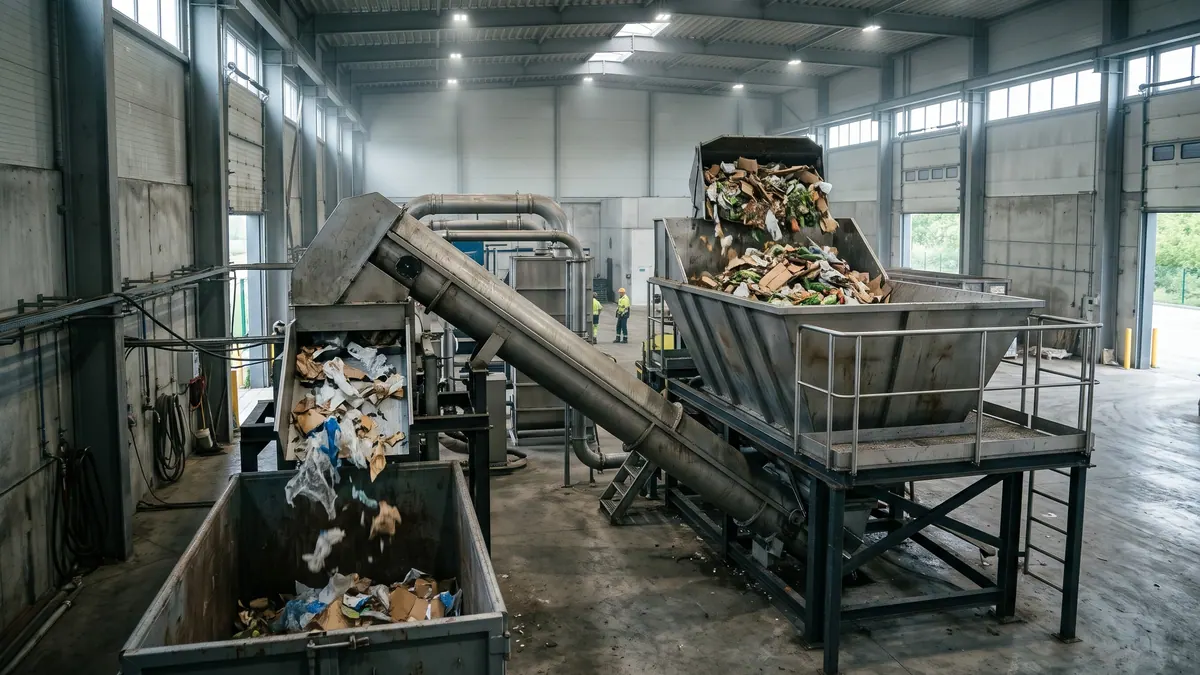
Plastic in digestate from biowaste does not arise in the digester: it enters with the substrate and after digestion it remains and fragments, so control must start at the gate, not in the field. Below is a guide in the order of the process and an operator's checklist.
Where the contaminants come from
- Packaging in food waste: out-of-date food in film, cardboard, jars and cans from retail.
- "Compostable" bags and sacks: under digestion conditions (several dozen days, 38–42°C, no oxygen) they often degrade insufficiently; they may fragment but not disappear.
- Waste from household separate collection: sorting mistakes, small plastics, glass, metals.
- Contaminants from containers, shovels and tools: seeds, rubber, structural parts.
- Contaminants from organic fertilisers: remnants of silage film and twine.
Mechanical shredding turns macroplastic into small particles that are harder to remove, so the order in the line matters.
The process line
| Stage | Purpose | Notes |
|---|---|---|
| Supplier control | rejecting bad batches | photos, inspection, a contract with criteria |
| Pre-sorting | picking out large items | manual or optical |
| Depackaging (wet or dry) | separating packaging from food | wet gives a cleaner fraction, but more wastewater |
| Shredder and screen | limiting particle size | choose the mesh according to the planned final control |
| Flotation and heavy-fraction separation | removing light plastics and heavy glass and stones | the contents of the vessel need cleaning |
| Digestate filtration | an additional final barrier | risk of clogging |
It is worth paying attention to the balance: the more waste enters in a raw state, the larger the reject fraction, which becomes waste and generates costs. The general rule: remove plastic early, with coarse screens, before it is cut up.
Reference to Regulation (EU) 2019/1009
Digestate that is to become an EU fertilising product with CE marking must meet the requirements for the relevant component material categories (CMC) and for the product function. The regulation sets, among other things, limits for macroscopic impurities (glass, metal, plastics with particles above 2 mm) in dry matter; the total limit is on the order of single grams per kilogram of DM, with a separate, lower limit for plastics alone. The exact values and the application dates of any tightening must be read from the current text of the regulation before planning for them at the plant. The regulation also sets limits for heavy metals, pathogens and other requirements, discussed in the articles Sanitary testing of digestate and Regulation 2019/1009 and digestate: CE marking and CMC.
The British specification PAS 110 (BSI) is sometimes used as a reference; it describes requirements for digestate and oversight of input quality. It has no legal force in the EU, but is a good model of a quality management system.
Microplastics: what we know
Particles below 5 mm are present in organic fertilisers, including compost and digestate, and their amount depends on the source and the technique. Research on effects in soil shows that the effects on soil life, soil structure and plants are uncertain: they depend on the polymer, particle size, dose and soil. There is no single "safe" value. The practical conclusion: limit the plastic input as far upstream as possible, do not count on "degradation in the soil" and document your actions.
Operator's checklist
- Contracts with suppliers contain purity criteria and the right to reject a batch.
- Every delivery is inspected; in case of doubt, take a photo and make a record.
- A rejection register is kept (date, supplier, reason, mass).
- Depackaging equipment and screens are cleaned and checked according to a schedule; the measured mass of rejects is balanced.
- Digestate samples are tested for foreign matter at set intervals, and the results archived.
- "Compostable" bags are treated as contamination unless there is confirmation that they degrade under the plant's conditions.
- The digestate recipient is informed about quality and the scope of testing.
- Every quarter, trends are discussed: the share of rejects, test results, comments from recipients.
Conclusions
There is no technology that will remove plastic completely; effectiveness comes from combining supplier control, early separation and monitoring. An operator who can show documentation is better prepared for inspections and for talks with digestate recipients.
Sources
Related articles