Waste and circular economyExplainer
Nigeria: biogas from abattoirs in Lagos and Abuja. What works and what has stalled
In Lagos a small biogas plant at the Ikorodu abattoir powered the facility for about six hours a day, while a project at the Karu abattoir in Abuja stalled in 2018 without the administration's consent. A review of reports on Nigerian biogas from waste.
Other language versions: polski.
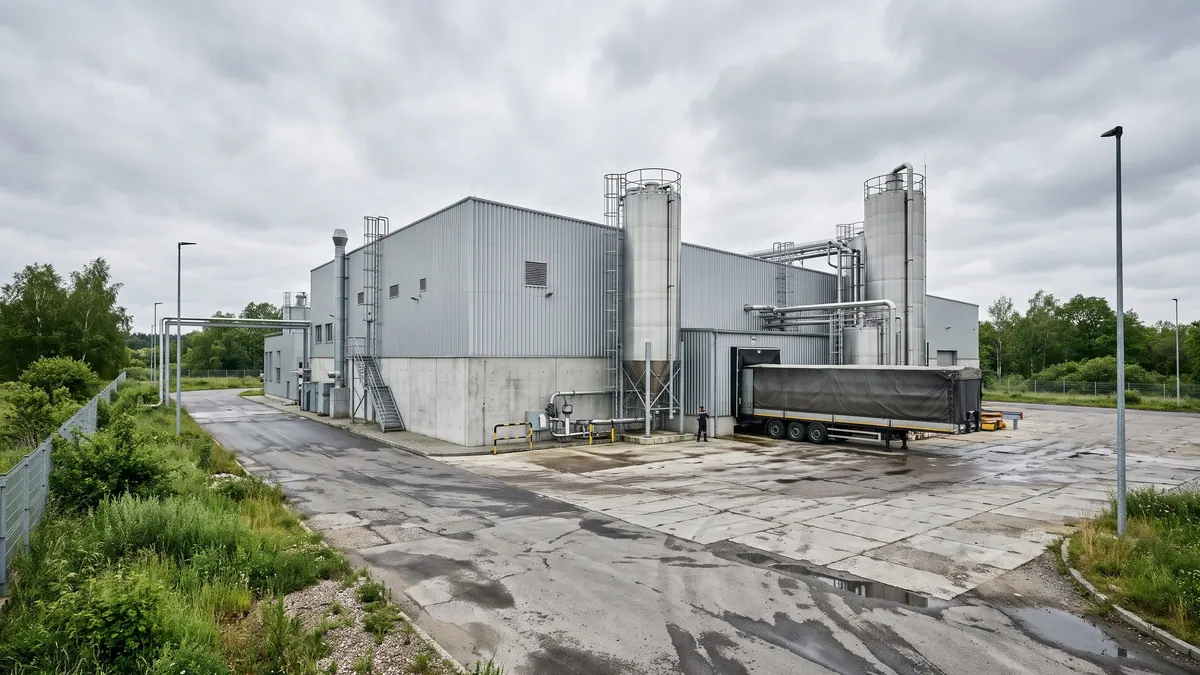
Nigeria has several pioneering biogas installations on abattoir waste, but reports show that installation alone is not enough: small projects work if they have a host, while large ones can get stuck in procedures. Below we put together what is known about them, with caveats regarding the date and completeness of the data.
Lagos: Ikorodu
The Guardian Nigeria (9 September 2019) described a small biogas plant at the Ikorodu Mini Abattoir in Lagos. The project was tripartite — the Lagos State Government, the organisation Friends of the Environment (FOTE) and the company HIS Biogas — and began in September 2018 under a design–build–supply–maintain formula. The installation has four digestion tanks of 5 thousand litres each, fed with biodegradable waste and concentrated abattoir wastewater; the designer, TOGATA Renewable Technology, used PVC water tanks instead of more expensive German technology and assured that 90% of the materials come from local sources. The abattoir's concessionaire said that 35–45 cows are slaughtered there daily and that the biogas powers lighting and water heating for about six hours a day, with the abattoir using the grid for the rest of the day. He also said that the odour had disappeared. The newspaper did not give the capacity or costs, so we do not know what part of its energy needs the installation covers.
Abuja: the Karu abattoir
In the fourth quarter of 2017 the Federal Capital Territory Administration (FCTA), together with the non-governmental organisation African Environment Action Network (EANet-Africa), inaugurated an initiative to build a low-emission biogas plant at the Karu abattoir in Abuja; an official promised that the facility would be ready to start up within six months of December 2017. In June 2018 ThisDay reported that nothing had happened on site since the inauguration, because the promoters had not received from the FCTA a formal letter of support needed to complete talks with international partners and funders. The organisation stressed that it has the technology and knowledge but no money. We found no later information, so the current status is unknown.
Why abattoirs are a good but demanding feedstock
Slaughter waste (stomach contents, blood, fats, wastewater) has a high methane potential, and its constant production makes planning easier. At the same time:
- fats and proteins can cause foaming and ammonia inhibition if the dose is too large,
- the waste must be sanitised to limit the risk of pathogens,
- changes in the number of animals slaughtered (holidays, season) affect the amount of substrate,
- discharging the digestate and wastewater requires water protection solutions.
In Poland substrates of animal origin must meet the requirements of Regulation 1069/2009 (animal by-products); we discuss these issues in the article on packaging waste from food (depackaging) and digestate.
What the Nigerian example teaches
- A pilot scale is easier to maintain if the facility has a permanent operator and a clear purpose (powering its own abattoir).
- Public projects depend on permits and decisions, and administrative delays can wreck even a well-designed installation.
- Data transparency: the lack of stated capacities, volumes and costs makes assessment and imitation difficult.
- The role of research: laboratory results (like the Energy Reports study) confirm that abattoir waste yields biogas, but do not replace data from the operation of a full-scale installation.
Press reports do not replace technical reports; for a serious assessment it is worth turning to project documentation and monitoring data.
Worked example: how much energy such an installation gives
The calculation below illustrates an order of magnitude; it assumes hypothetical values, not data from the projects described. Four tanks of 5 thousand litres give a total volume of about 20 m³. Assuming a loading rate of 2 kg VS/(m³·d), about 40 kg of volatile solids are fed to the chambers daily. With a yield of 250 NmL CH₄/g VS (that is, 0.25 m³ CH₄ per kg VS) this gives about 10 m³ of methane a day. Since 1 m³ of methane has a calorific value of about 10 kWh, the daily chemical energy is about 100 kWh. Such an amount is enough to power a burner or boiler with a capacity of a dozen or so kilowatts for several hours, which is consistent with the order of magnitude of the report of about six hours of operation a day. If the actual yield is lower, the running time shortens. The calculation also shows that powering a larger consumer would require a much larger installation.
Sanitisation and safety
Slaughter waste can contain pathogens, so thermal treatment or process control is assumed before the digestate goes to the field. In tropical conditions heating the digester is needed to a lesser degree, because the ambient temperature favours the mesophilic process, but daily fluctuations affect stability. Gas safety is also important: biogas contains hydrogen sulphide, which is toxic and corrosive, so installations are fitted with simple filters and ventilation, and operators are trained in the hazards.
The role of policy
The cases described show the role of administrative decisions: in Abuja the lack of a letter of support from a public body blocked the raising of financing. In principle, requirements for managing slaughter waste in abattoir licences are also an effective tool, because then the biogas plant ceases to be an optional extra and becomes an element of legal compliance. We found no confirmation in open sources that such requirements apply in Nigeria.
Sources
Questions and answers
Why is slaughterhouse waste a valuable biogas substrate?
It contains a lot of fats and proteins, so its methane potential is high. At the same time it requires hygienisation and careful dosing, because fats and ammonia can inhibit digestion.
Related articles