

BMP testingBy-products of the agri-food industry
Olive pomace / olive mill solid waste — BMP: 8 studies, weighted mean 266 m³ CH₄/t VS
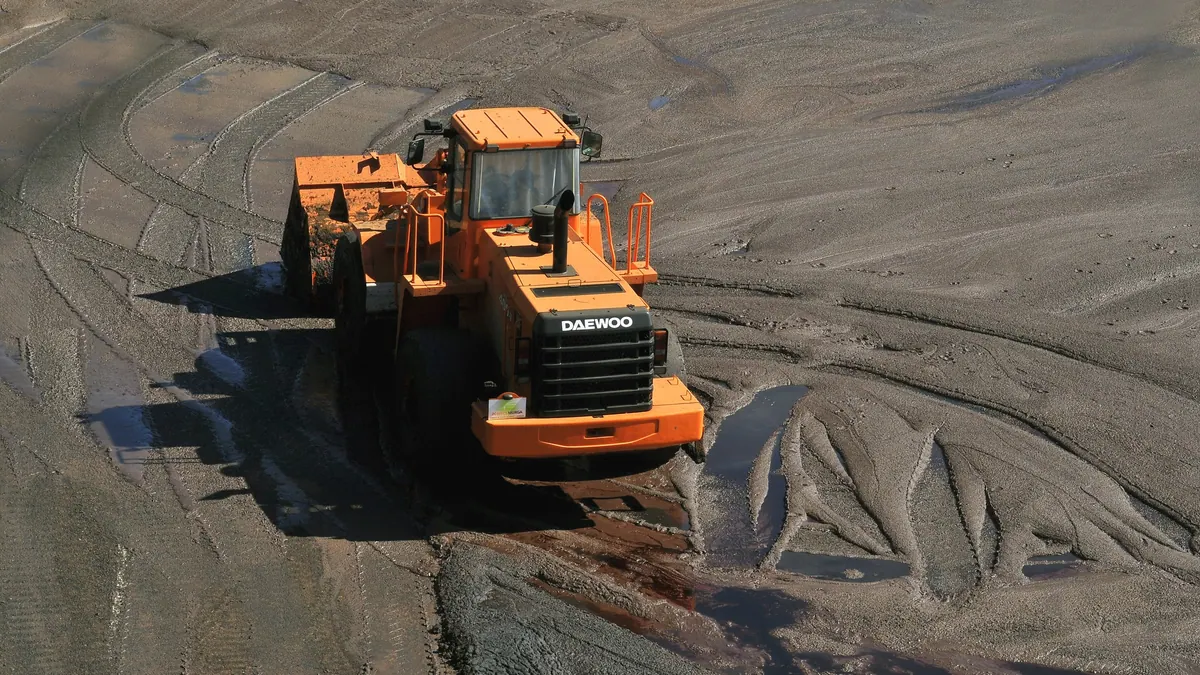
Olive pomace (pomace, alperujo) is a wet waste of olive oil mills, rich in polyphenols, lipids and lignin from the stones; the results vary widely.
Photo LBM1948 / Wikimedia Commons, licence CC BY-SA 4.0, source file; changes: cropping

- Weighted mean
- 266m³ CH₄/t VS
- Range
- 25–461m³ CH₄/t VS
- Records
- 8studies
- Publications
- 7sources
- Temperatures
- 35 °C, 37 °Cof the test
Methane in biogas
High methane content · ≈ 6.3 kWh/m³ of biogas
estimate from the substrate type The collected studies contain no measurement. The interval follows from the approximate composition (carbohydrate-dominated (no protein or fat characteristics); fat-rich (process classification)) and the yields of compound groups according to FNR.
Rating for biogas plants
not rated — editorial rating for biogas plants
Not rated: no dry matter or volatile solids in the data. We calculate the rating when the dry matter and volatile solids of the material are known.
Add to the co-digestion calculator CSV data
BMP curves from 8 studies
Weighted mean Individual records
Dashed lines are a model curve (first-order kinetics, B(t) = B₀·(1 − e−kt)); the end point comes from the publication. All curves are model curves.
Cumulative methane production over the test [m³ CH₄/t VS]. The thick line is the weighted mean of all records (266); dots mark the end values given in the publications. Point at the chart to read values; click a legend item to hide or show a record.
Records and sources
Download CSV| Source | BMP m³ CH₄/t VS | Temperature | Sample | Curve |
|---|---|---|---|---|
| Rubio et al. (2019) DOI | 25 | 35 °C · mesophilic | two-phase olive-mill waste (2POMW) | end point (model curve) |
| Üçok i Yang (2025) DOI | 340 | — | olive pomace (OLV) | end point (model curve) |
| Elalami et al. (2018) · 1 DOI | 98 | — | olive pomace T (three-phase extraction), milled 4 mm (KM4) | end point (model curve) |
| Elalami et al. (2018) · 2 DOI | 188 | — | olive pomace M (traditional extraction), milled 4 mm (KM4) | end point (model curve) |
| Rincón et al. (2014) DOI | 373 | 35 °C · mesophilic | two-phase olive mill solid waste (OMSW) without ultrasound pretreatment | end point (model curve) |
| Girardi et al. (2023) DOI | 234 | — | untreated DWOP (destoned wet olive pomace) | end point (model curve) |
| Correa et al. (2025) DOI | 284 | 37 °C · mesophilic | olive pomace (two-phase, 100%) | end point (model curve) |
| Fernández-Rodríguez M (2022) | 461 | — | 100% OMSW (two-phase olive mill solid waste) | end point (model curve) |
| Weighted mean | 266 | arithmetic mean 250, SD 145 | ||
Process properties
Advantages
- Methane potential in the Substraty.pl BMP dataset: weighted mean 265.7 m³ CH₄/t VS (SD 144.8; 8 records, 7 sources).
- Co-digestion of olive mill wastewater and solid pomace is described (Boubaker and Ridha 2007).
Drawbacks and risks
- Polyphenols (hydroxytyrosol, oleuropein) have antimicrobial activity (Chen et al. 2008).
- Acidic reaction.
Co-digestion — what to combine it with, what to watch out for
- combines well
substrates: high alkalinity (buffer) — e.g. Cattle manure, Pig slurry, Cattle slurry, Duck slurry, Rumen and digestive tract content
Slurry supplies N and alkalinity, balancing the high C/N of the material.[1][2]
Dosing
No source-based % in this database; low doses, adaptation of the microflora.
Introduce gradually, starting with a small dose and monitoring the process (e.g. FOS/TAC, pH, gas composition).
Practical requirements
- Shred: shredding increases the surface available for degradation and speeds it up, but does not necessarily raise the final gas yield (FNR 2010, Ch. 3 “Triturado”).
Sources of the process data
- Hagos et al. (2017). Anaerobic co-digestion process for biogas production: progress, challenges and perspectives. Renew. Sustain. Energy Rev.
- Weiland, P. (2010) Biogas production: current state and perspectives. Applied Microbiology and Biotechnology
- Boubaker, Ridha (2007). Anaerobic co-digestion of olive mill wastewater with olive mill solid waste in a tubular digester at mesophilic temperature. Bioresour. Technol.
- Chen, Cheng, Creamer (2008). Inhibition of anaerobic digestion process: A review. Bioresour. Technol.
- Long et al. (2012). Anaerobic co-digestion of fat, oil, and grease (FOG): A review of gas production and process limitations. Process Saf. Environ. Prot.
- FNR (2010). Guía sobre el Biogás – Desde la producción hasta el uso (hiszp. wydanie „Leitfaden Biogas”, GIZ 2013)
The co-digestion calculator will assess a specific mixture containing this substrate.
What it is and where it comes from
Olive pomace is the solid residue after olive oil pressing. Depending on the technology, different wastes arise: in a traditional and a three-phase mill the solid fraction is drier, and vegetation water arises separately; in a two-phase mill a wet paste called alperujo arises, combining the pomace and the vegetation water. The largest olive oil producers are Spain, Italy, Greece, Turkey and Portugal. Olives are not grown in Poland, so the material is of significance mainly in the literature.
Properties relevant to digestion
The pomace contains fibre from the stones and pulp (cellulose, hemicellulose, lignin), residual oil, protein, sugars and phenolic compounds, including hydroxytyrosol and oleuropein. Polyphenols have antimicrobial action, and lipids may cause accumulation of long-chain fatty acids. The stones are hard and poorly degradable. The reaction is usually acidic. The material is seasonal and spoils quickly, and without adaptation of the microflora the doses must be low.
How to read the spread of results
The set contains several records from several sources, and the spread is large. The differences result from the pressing technology (two-phase, three-phase, traditional), the olive variety, ripeness, stone share, residual oil, particle size (some studies ground the material to 4 mm) and test conditions. One of the studies gives the result in the unit m³/kg ODM, which required conversion. In addition, the adaptation of the inoculum to polyphenols is of great importance.
In biogas plant practice
Olive pomace is used in producing countries in a mixture with manure or sludge, often after dilution and with the addition of buffering material. Pretreatment, e.g. stone removal, shredding or partial dephenolisation, improves the yield. Competition comes from composting, burning of the stones and extraction of residual oil. For installations in Poland the material has no practical significance.
When interpreting the results, it is worth remembering that stating the yield per volatile solids hides a large difference in the amount of water: two-phase pomace contains much more of it than three-phase pomace, so less gas is obtained from one tonne of fresh matter than the BMP result alone would suggest.
The presence of stones also causes mechanical wear of pumps and agitators, so in many solutions the stones are separated beforehand and used as fuel. The result for pomace with stones therefore does not describe the fraction that actually enters the digester after such separation.
Methodology in brief
BMP is the amount of methane obtained from volatile solids (VS) in a batch test, given in m³ CH₄ per tonne of VS (numerically the same as NmL CH₄/g VS in the publications) and converted to normal conditions (0 °C, 101.325 kPa). The weighted mean gives each publication a total weight of 1, split equally between its results for the substrate — a paper testing twenty varieties does not outweigh a paper with a single sample. In inter-laboratory programmes the unit is the laboratory (total weight 1), and within it the weight of a test grows with the number of bottles (replicates). Results after pretreatment (e.g. thermal, chemical, enzymatic) are shown separately and are not included in the mean.
Solid lines are curves measured in the tests. Where a publication gives only the final result, we draw a first-order kinetic model, B(t) = B₀·(1 − e−kt): only the end point comes from the publication, and the shape of the curve serves purely as visualisation — do not read the production on a particular day from it. For this substrate k = 0.091 d−1 was assumed (no kinetic data for the group – the median of all available rate constants k (93 values) was used).
The statistics describe the spread of published results — a descriptive compilation, not a meta-analysis or a guarantee of plant yield.
Bibliography
- Rubio, J.A.; Romero, L.I.; Wilkie, A.C.; García-Morales, J.L. (2019). Mesophilic Anaerobic Co-digestion of Olive-Mill Waste With Cattle Manure: Effects of Mixture Ratio. Frontiers in Sustainable Food Systems 3, 9. DOI: 10.3389/fsufs.2019.00009 DOI
- Üçok, S.; Yang, X. (2025). Chemical Composition and Methane Production Potential of Agricultural Residues: Olive Pomace, Cottonseed Meal and Red Pepper Processing Waste. Tekirdağ Ziraat Fakültesi Dergisi 22(1), 195–204. DOI: 10.33462/jotaf.1513484 DOI
- Elalami, D.; Carrère, H.; Abdelouahdi, K.; Oukarroum, A.; Dhiba, D.; Arji, M.; Barakat, A. (2018). Combination of Dry Milling and Separation Processes with Anaerobic Digestion of Olive Mill Solid Waste: Methane Production and Energy Efficiency. Molecules 23(12), 3295. DOI: 10.3390/molecules23123295 DOI
- Rincón, B.; Bujalance, L.; Fermoso, F.G.; Martín, A.; Borja, R. (2014). Effect of Ultrasonic Pretreatment on Biomethane Potential of Two-Phase Olive Mill Solid Waste: Kinetic Approach and Process Performance. The Scientific World Journal 2014, 1–9. DOI: 10.1155/2014/648624 DOI
- Girardi, F.; Mascitti, A.; d’Alessandro, N.; Tonucci, L.; Marzo, G.A.; Remetti, R. (2023). Effects of Oxidative Treatments on Biomethane Potential of Solid Olive Residues. Waste and Biomass Valorization 14(5), 1525–1538. DOI: 10.1007/s12649-022-01987-4 DOI
- Correa, S.; Llamas, M.; Passos, F.; Zahedi, S.; Espinosa, J.M.; Fermoso, F.G.; Ferrer, I. (2025). Enhancing methane yield and microbial resilience in olive pomace anaerobic digestion via co-digestion with pig manure. Biotechnology for Biofuels and Bioproducts 18(1), 114. DOI: 10.1186/s13068-025-02711-9 DOI
- Fernández-Rodríguez M, de la Lama-Calvente D, García-González M, Moreno-Fernández J et al. (2022). Integral Valorization of Two-Phase Olive Mill Solid Waste (OMSW) and Related Washing Waters by Anaerobic Co-digestion with Microalgae. Journal of Agricultural and Food Chemistry. https://doi.org/10.1021/acs.jafc.1c08100 source
All sources of the site: bibliography.
Other substrates in the group “By-products of the agri-food industry”
Sugarcane filter cake / press mud — BMP: 4 studies, weighted mean 190 m³ CH₄/t VS
190 m³ CH₄/t VS weighted mean from 4 studies
≈54 %
Sweet corn processing residues — BMP: 8 studies, weighted mean 323 m³ CH₄/t VS
323 m³ CH₄/t VS weighted mean from 8 studies
good — editorial rating for biogas plants≈52 %
Distillery stillage and vinasse — BMP: 5 studies, weighted mean 326 m³ CH₄/t VS
326 m³ CH₄/t VS weighted mean from 5 studies
neutral — editorial rating for biogas plants58 %
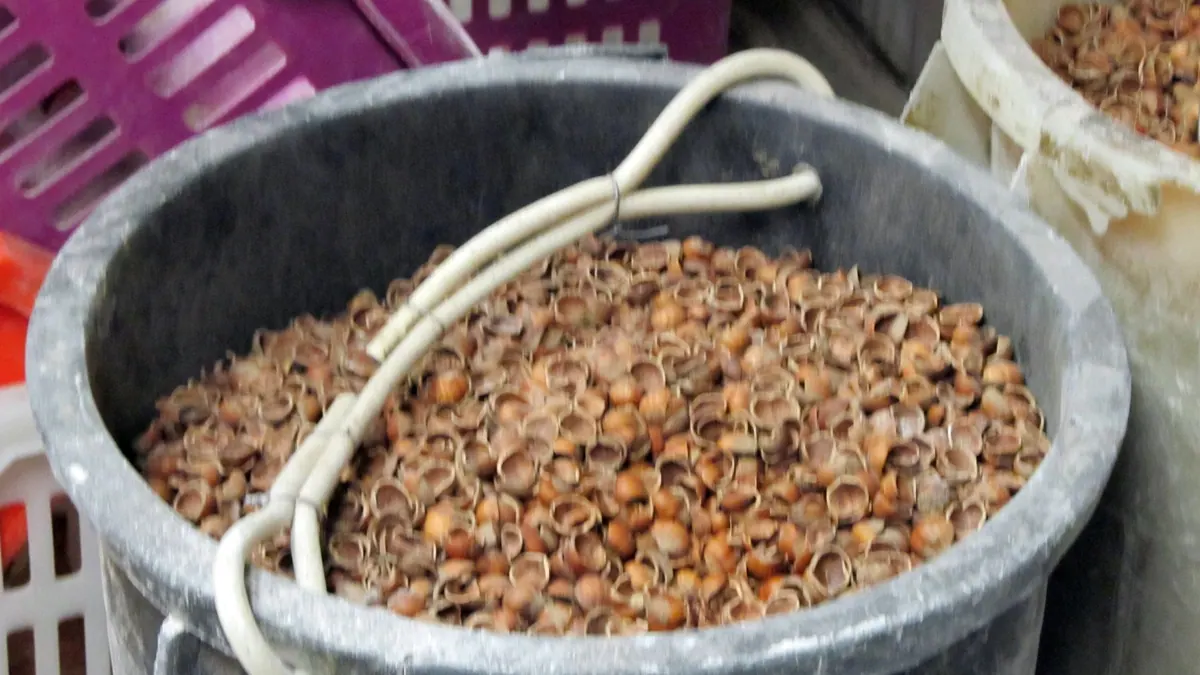
Hazelnut residues (shell, skin) — BMP: 2 studies, weighted mean 153 m³ CH₄/t VS
153 m³ CH₄/t VS weighted mean from 2 studies
neutral — editorial rating for biogas plants≈51 %