InnovationGuide
Flexible biogas production: feeding, gas storage and energy price signals
How to shift energy production from biogas to hours of high prices: storage capacity, feeding schedule and installed capacity. With a calculation and a pilot plan.
Other language versions: Polski, Deutsch, Español, Français, Italiano, Nederlands.
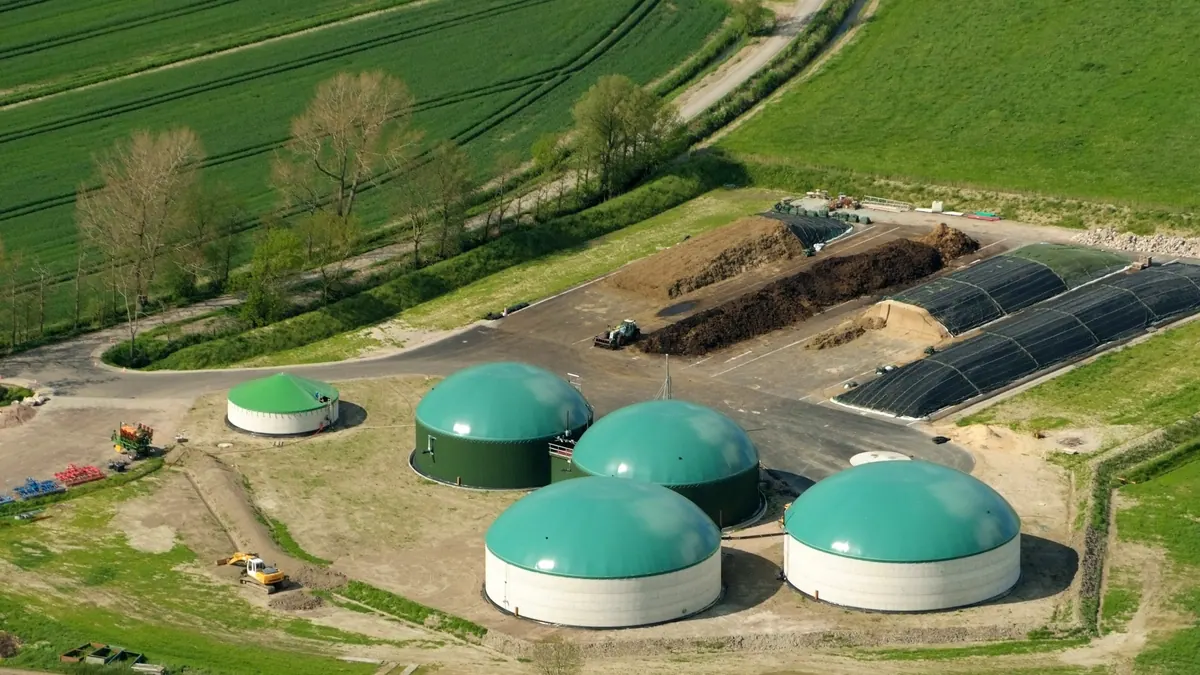

Flexible biogas production means running the plant so that electricity is generated mainly when it is most expensive, while the digester continues to work evenly. This is not a change to the biology of the process, but a use of gas storage and installed capacity. Below is a guide in the order of actions.
Step 1. Understand the principle
Biogas is produced in the digester continuously, and the daily variation is small. If the engine runs around the clock at nominal output, there is no flexibility at all. If the engine has 2 times the capacity of the average gas production, it can run, for example, 12 hours at full power and stand idle for the remaining hours while gas accumulates in the storage. The signal to run is high energy prices, which in Poland result from the day-ahead market and the demand profile (usually a morning and an evening peak).
This formula concerns only the gas and its storage. The design and operation of engines is a separate subject, covered in the articles on cogeneration.
Step 2. Calculate the first lever: gas storage
Storage capacity determines how many hours gas can be produced without being wasted. An illustrative example: a biogas plant produces 250 Nm³/h of biogas. An engine stoppage of 10 hours requires 2500 Nm³ of gas to be accumulated (at a constant pressure close to atmospheric). If the storage above the digester has 1500 m³ of usable capacity and is half full in normal operation, the buffer is about 750 m³, that is 3 hours. To reach 10 hours, additional storage has to be built or the filling rules changed.
Safety is crucial: a double-membrane roof, level sensors, pressure and vacuum relief valves and a defined alarm level. Filling the storage to a high level before the peak reduces the emergency margin, so the rules must be set out in the operating manual. Technical details are described in the article on biogas storage and the double-membrane roof.
Step 3. The second lever: the feeding schedule
Substrates differ in the speed at which gas forms. Maize silage and other readily degradable materials give most of their gas in the first hours after being fed, while slurry and straw give it more slowly. By shifting feeding times, production can be raised slightly in the periods preceding the price peak. The effect is limited, however: fluctuations in gas production of 10–20% over a span of several hours are a realistic range, and deeper changes carry a risk of acidification.
Precautionary rules:
- Do not change the organic loading rate (OLR) abruptly; monitor volatile fatty acids and pH. The rules are given in the article on OLR, and the symptoms of acidification in the post on diagnosing acidification.
- Keep the temperature constant, because fluctuations above about 1°C per day disturb the methanogens.
- Introduce schedule changes in stages (e.g. by half an hour each week), with measurement of biogas and gas composition.
Step 4. The third lever: installed capacity
Without capacity larger than the average production there is no flexibility; gas from the storage will not be "made up". In principle, increasing capacity requires a new investment, a recalculation of the grid connection and changes to permits. The target capacity follows from the gas buffer and the price profile: doubling the capacity with a three-hour buffer makes no sense, because the engine would have to stand idle too often with a full storage.
Step 5. The profitability calculation
A simplified model: additional annual revenue = (average price in operating hours − average round-the-clock price) × energy generated. Subtract the investment cost (annuity), the cost of additional start-ups and servicing, and the loss of useful heat if the customer requires a constant supply. An example with illustrative assumptions: a difference of PLN 150/MWh in favour of peak hours, with 4000 MWh per year shifted into the peak, gives PLN 600 thousand. If the investment costs PLN 2 million at an annuity of 12% (PLN 240 thousand), and additional costs are PLN 100 thousand, the net profit is about PLN 260 thousand per year. The values serve only as an illustration; before deciding, use your own data from several years of prices and take into account the support scheme under which the installation operates.
Step 6. From audit to pilot
- Audit: assess the storage, the stability of the biology, the capabilities of the engine and the useful heat.
- Model: a price profile from 2–3 years, storage capacity, the cost of additional hours.
- Pilot: 2–4 weeks of operation with one peak window per day, with measurements of gas and biological parameters.
- Approval: update the manual, train staff, set up alarm notifications.
- Expansion: only after the pilot results, plan investments in capacity and storage.
An operator who can document stable biology and safe operation of the storage also has a better position in talks with the bank and the insurer.
Sources
Related articles