

BMP testingFood and catering waste
Bread and bakery waste — BMP: 7 studies, weighted mean 370 m³ CH₄/t VS
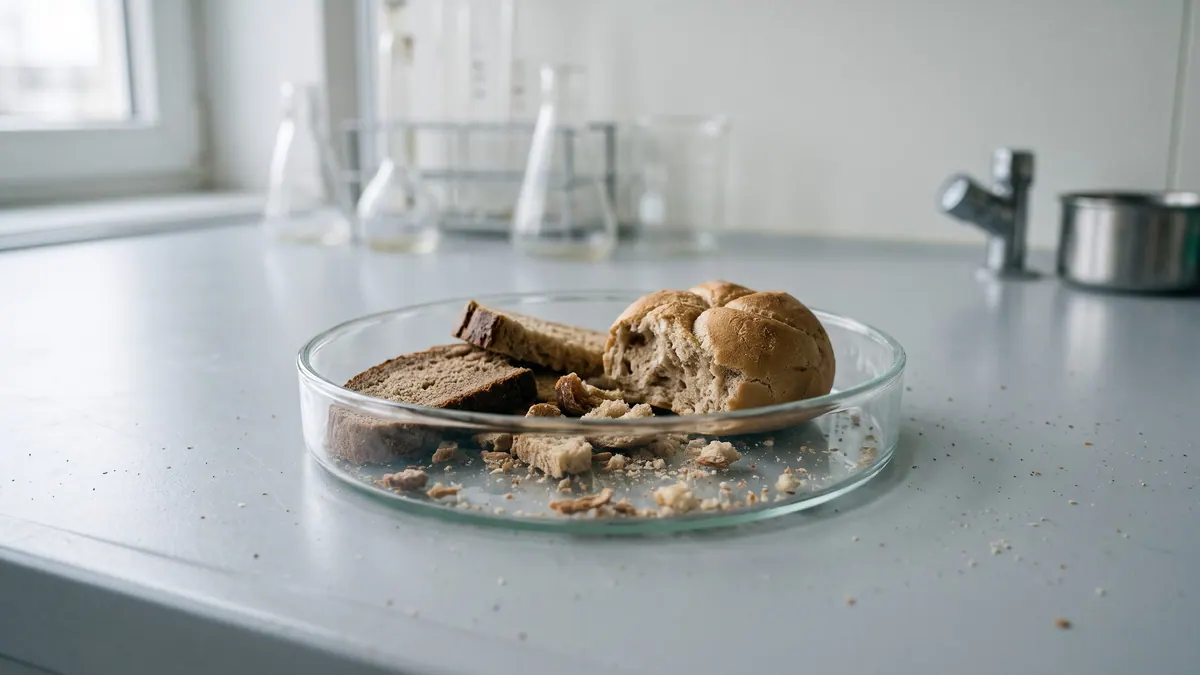
Bread and bakery waste (wheat, rye, toast bread) is a starchy, readily fermentable substrate; the risk is rapid acidification at too high a dose.
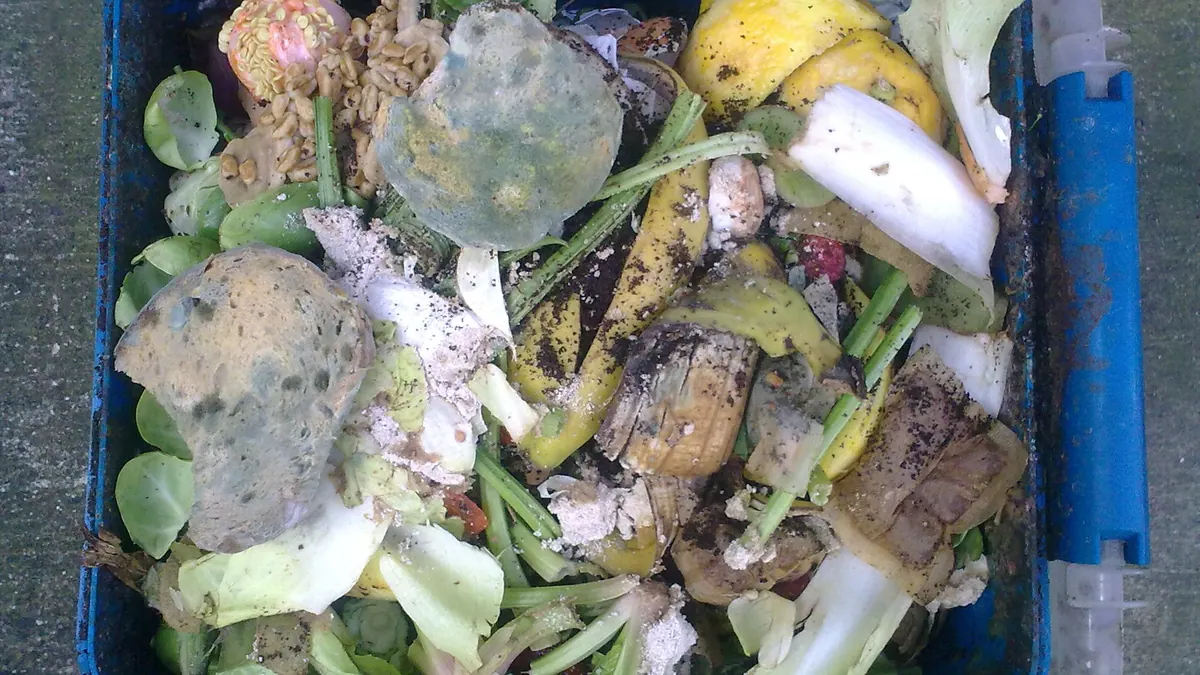
Illustration: FeedstockData (AI, Google Gemini)
- Weighted mean
- 370m³ CH₄/t VS
- Range
- 295–459m³ CH₄/t VS
- Records
- 7studies
- Publications
- 3sources
- Temperatures
- 35 °C, 38 °Cof the test
Methane in biogas
Low methane content · ≈ 4.8 kWh/m³ of biogas
measured mean of 5 studies BMP, range 44.9–50.9 %; in a batch test the CH₄ share tends to be higher than in a plant.
Rating for biogas plants
not rated — editorial rating for biogas plants
Not rated: no dry matter or volatile solids in the data. We calculate the rating when the dry matter and volatile solids of the material are known.
Add to the co-digestion calculator CSV data
BMP curves from 7 studies
Weighted mean Individual records
Dashed lines are a model curve (first-order kinetics, B(t) = B₀·(1 − e−kt)); the end point comes from the publication. All curves are model curves.
Cumulative methane production over the test [m³ CH₄/t VS]. The thick line is the weighted mean of all records (370); dots mark the end values given in the publications. Point at the chart to read values; click a legend item to hide or show a record.
Records and sources
Download CSV| Source | BMP m³ CH₄/t VS | CH₄ in biogas % vol., measured | Temperature | Sample | Curve |
|---|---|---|---|---|---|
| Dubrovskis i Plume (2017) · 1 DOI | 312 | 44.9 % | 38 °C · mesophilic | Toaster bread (TB), damaged | end point (model curve) |
| Dubrovskis i Plume (2017) · 2 DOI | 313 | 50.9 % | 38 °C · mesophilic | Wheat flour coarse bread (WF), damaged | end point (model curve) |
| Dubrovskis i Plume (2017) · 3 DOI | 335 | 50.6 % | 38 °C · mesophilic | French bread (FB), damaged | end point (model curve) |
| Dubrovskis i Plume (2017) · 4 DOI | 392 | 49.9 % | 38 °C · mesophilic | Rye flour bread (RF), damaged | end point (model curve) |
| Dubrovskis i Plume (2017) · 5 DOI | 427 | 45.4 % | 38 °C · mesophilic | White bread with egg and milk (WB), damaged | end point (model curve) |
| Dubrovskis et al. (2018) DOI | 459 | — | 38 °C · mesophilic | Rye bread Kursu waste | end point (model curve) |
| Kouas et al. (2017) DOI | 295 | — | 35 °C · mesophilic | bread | end point (model curve) |
| Weighted mean | 370 | 48.3 % | arithmetic mean 362, SD 64 | ||
Process properties
Low confidence: the description is based on general characteristics of the substrate group, not on studies of this material. Treat it as a hint to be verified.
Advantages
- Methane potential in the Substraty.pl BMP dataset: weighted mean 369.9 m³ CH₄/t VS (SD 64.1; 7 records, 3 sources).
- Starch and gluten protein; hydrolyses readily (Zhang et al. 2007).
Drawbacks and risks
- A sharp rise in VFA at a high dose (Hagos et al. 2017).
- Moulds and preservatives (e.g. propionate) in out-of-date bread may inhibit (Chen et al. 2008).
Co-digestion — what to combine it with, what to watch out for
- combines well
substrates: high alkalinity (buffer) — e.g. Cattle manure, Pig slurry, Cattle slurry, Duck slurry, Rumen and digestive tract content
Dosing
No source-based threshold; dose in portions.
Introduce gradually, starting with a small dose and monitoring the process (e.g. FOS/TAC, pH, gas composition).
Practical requirements
- Shred: shredding increases the surface available for degradation and speeds it up, but does not necessarily raise the final gas yield (FNR 2010, Ch. 3 “Triturado”).
Sources of the process data
- Hagos et al. (2017). Anaerobic co-digestion process for biogas production: progress, challenges and perspectives. Renew. Sustain. Energy Rev.
- Weiland, P. (2010) Biogas production: current state and perspectives. Applied Microbiology and Biotechnology
- Zhang et al. (2007). Characterization of food waste as feedstock for anaerobic digestion. Bioresour. Technol.
- Chen, Cheng, Creamer (2008). Inhibition of anaerobic digestion process: A review. Bioresour. Technol.
- FNR (2010). Guía sobre el Biogás – Desde la producción hasta el uso (hiszp. wydanie „Leitfaden Biogas”, GIZ 2013)
The co-digestion calculator will assess a specific mixture containing this substrate.
What it is and where it comes from
Bread is a product made of wheat, rye or mixed flour, and bakery waste includes unsold, damaged bread, failed bakes, dough remnants and crumbs. It arises in bakeries, shops, canteens and households. Bread waste is widespread, and in the food waste hierarchy priority goes to reducing losses and passing food on for consumption or feed. The dataset includes toast bread, wholemeal wheat bread, French bread, rye bread and white bread with added eggs and milk, as well as general bread waste.
Properties relevant to digestion
The main component is starch from flour, broken down by amylases into simple sugars, so degradation is rapid. Gluten protein, fat, sugar and salt are also present. Rye bread contains pentosans and more fibre, wholemeal bread more bran. Additives such as eggs and milk increase the protein and fat content. The main risk is acidification: a large dose of bread leads to a sudden formation of volatile acids and a drop in pH. Salt, preservatives (e.g. propionate) and moulds on out-of-date bread can affect microorganisms in larger amounts.
How to read the spread of results
Several records concern different kinds of bread, mostly from the studies of one team, so the spread partly reflects recipes: type of flour, share of bran, additives (eggs, milk, seeds, fat) and the degree of damage to the batch. The degree of size reduction, the substrate-to-inoculum ratio, the adaptation of the inoculum to starch, the temperature and the length of the test also matter. Records from one laboratory are more comparable with each other than with others, but they do not describe bread from other markets.
In biogas plant practice
Bread is a valuable co-substrate, which must be dosed evenly and at a small share, with monitoring of pH and volatile acids. Before feeding it should be size-reduced and packaging removed. Storing damp bread risks moulding, so storage should be short or after drying. Products with meat, dairy or eggs are subject to the rules on animal by-products, and food waste is waste within the meaning of the waste act, so acceptance requires a plant permit. Bread from bakeries may also be sent for feed.
Compared with other food wastes, bread is relatively uniform and dry, so it is easy to store after drying and to dose in constant amounts, which eases process control.
Methodology in brief
BMP is the amount of methane obtained from volatile solids (VS) in a batch test, given in m³ CH₄ per tonne of VS (numerically the same as NmL CH₄/g VS in the publications) and converted to normal conditions (0 °C, 101.325 kPa). The weighted mean gives each publication a total weight of 1, split equally between its results for the substrate — a paper testing twenty varieties does not outweigh a paper with a single sample. In inter-laboratory programmes the unit is the laboratory (total weight 1), and within it the weight of a test grows with the number of bottles (replicates). Results after pretreatment (e.g. thermal, chemical, enzymatic) are shown separately and are not included in the mean.
Solid lines are curves measured in the tests. Where a publication gives only the final result, we draw a first-order kinetic model, B(t) = B₀·(1 − e−kt): only the end point comes from the publication, and the shape of the curve serves purely as visualisation — do not read the production on a particular day from it. For this substrate k = 0.232 d−1 was assumed (median of rate constants k reported in the sources and/or fitted to the mean measured curves).
The statistics describe the spread of published results — a descriptive compilation, not a meta-analysis or a guarantee of plant yield.
Bibliography
- Dubrovskis, V.; Plume, I. (2017). Biogas potential from demaged bread. Engineering for Rural Development. DOI: 10.22616/erdev2017.16.n087 DOI
- Dubrovskis, V.; Plume, I.; Straume, I. (2018). Methane production from bread Kursu and potatoes Vineta waste and effect of catalyst metaferm. Engineering for Rural Development. DOI: 10.22616/erdev2018.17.n414 DOI
- Kouas, M.; Torrijos, M.; Sousbie, P.; Steyer, J.P.; Sayadi, S.; Harmand, J. (2017). Robust assessment of both biochemical methane potential and degradation kinetics of solid residues in successive batches. Waste Management 70, 59–70. DOI: 10.1016/j.wasman.2017.09.001 DOI
All sources of the site: bibliography.
Other substrates in the group “Food and catering waste”
Supermarket waste (mixed) — BMP: 3 studies, weighted mean 417 m³ CH₄/t VS
417 m³ CH₄/t VS weighted mean from 3 studies
≈66 %
Pasta (food waste) — BMP: 2 studies, weighted mean 310 m³ CH₄/t VS
310 m³ CH₄/t VS weighted mean from 2 studies
≈52 %
Confectionery waste — BMP: 6 studies, weighted mean 318 m³ CH₄/t VS
318 m³ CH₄/t VS weighted mean from 6 studies
neutral — editorial rating for biogas plants≈63 %
Food waste — BMP: 22 studies, weighted mean 466 m³ CH₄/t VS
466 m³ CH₄/t VS weighted mean from 22 studies
neutral — editorial rating for biogas plants≈62 %