

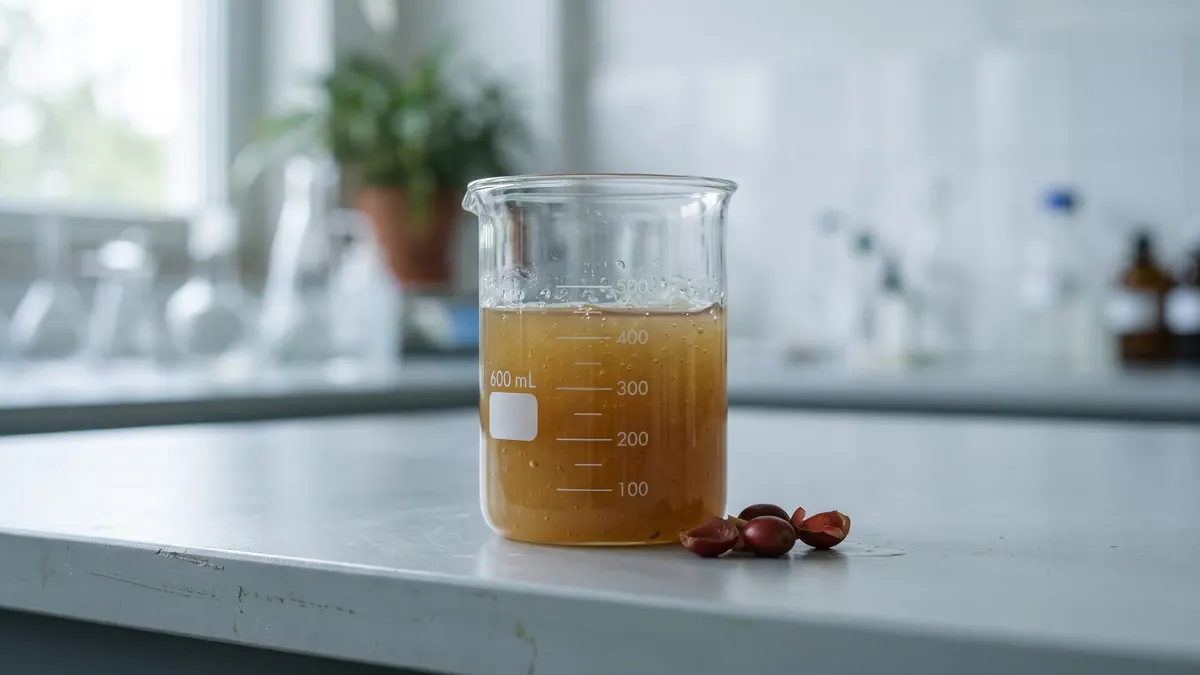
BMP testingBy-products of the agri-food industrysingle study (3 samples)
Coffee mucilage — BMP: 3 studies, weighted mean 279 m³ CH₄/t VS
Coffee mucilage is the sugar- and pectin-rich layer of the coffee bean, removed in wet processing; it ferments readily, and it was studied at several temperatures.
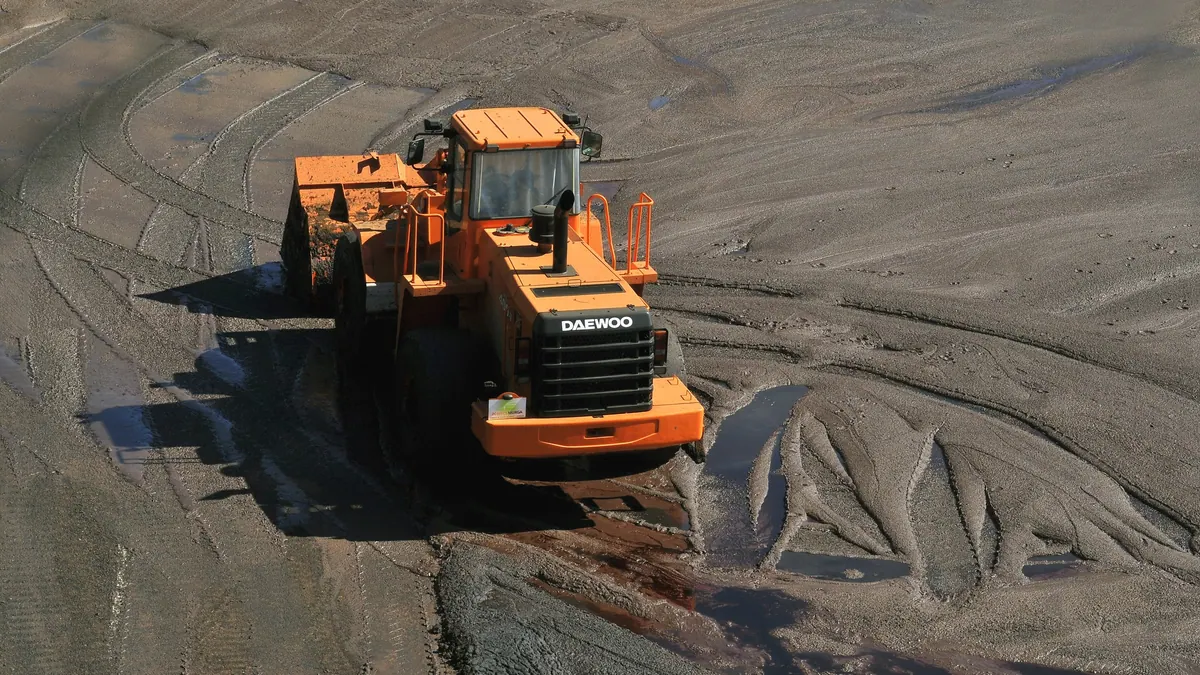
Illustration: FeedstockData (AI, Google Gemini)
- Weighted mean
- 279m³ CH₄/t VS
- Range
- 256–294m³ CH₄/t VS
- Records
- 3single study (3 samples)
- Publications
- 1source
- Temperatures
- 21 °C, 30 °C, 37 °Cof the test
Methane in biogas
Medium methane content · ≈ 5.2 kWh/m³ of biogas
estimate from the substrate type The collected studies contain no measurement. The interval follows from the approximate composition (carbohydrate-dominated (no protein or fat characteristics)) and the yields of compound groups according to FNR.
Rating for biogas plants
not rated — editorial rating for biogas plants
Not rated: no dry matter or volatile solids in the data. We calculate the rating when the dry matter and volatile solids of the material are known.
Add to the co-digestion calculator CSV data
BMP curves from 3 studies
Weighted mean Individual records
Dashed lines are a model curve (first-order kinetics, B(t) = B₀·(1 − e−kt)); the end point comes from the publication. All curves are model curves.
Cumulative methane production over the test [m³ CH₄/t VS]. The thick line is the weighted mean of all records (279); dots mark the end values given in the publications. Point at the chart to read values; click a legend item to hide or show a record.
Records and sources
Download CSV| Source | BMP m³ CH₄/t VS | Temperature | Sample | Curve |
|---|---|---|---|---|
| Chala et al. (2019) · 1 DOI | 256 | 21 °C · psychrophilic | Coffee mucilage, 21 C | end point (model curve) |
| Chala et al. (2019) · 2 DOI | 287 | 30 °C · mesophilic | Coffee mucilage, 30 C | end point (model curve) |
| Chala et al. (2019) · 3 DOI | 294 | 37 °C · mesophilic | Coffee mucilage, 37 C | end point (model curve) |
| Weighted mean | 279 | arithmetic mean 279, SD 20 | ||
Process properties
Low confidence: the description is based on general characteristics of the substrate group, not on studies of this material. Treat it as a hint to be verified.
Advantages
- Methane potential in the Substraty.pl BMP dataset: weighted mean 279.2 m³ CH₄/t VS (SD 20.5; 3 records, 1 source).
- A liquid, sugar-and-pectin substrate; fits into liquid mixes (Hagos et al. 2017).
Drawbacks and risks
- Pectins may give methanol (Chen et al. 2008, organic inhibitors).
Co-digestion — what to combine it with, what to watch out for
- combines well
substrates: high alkalinity (buffer) — e.g. Cattle manure, Pig slurry, Cattle slurry, Duck slurry, Rumen and digestive tract content
Slurry supplies N and alkalinity, balancing the high C/N of the material.[1][2]
Dosing
No source-based threshold; dose continuously with slurry.
Introduce gradually, starting with a small dose and monitoring the process (e.g. FOS/TAC, pH, gas composition).
Sources of the process data
- Hagos et al. (2017). Anaerobic co-digestion process for biogas production: progress, challenges and perspectives. Renew. Sustain. Energy Rev.
- Weiland, P. (2010) Biogas production: current state and perspectives. Applied Microbiology and Biotechnology
- Chen, Cheng, Creamer (2008). Inhibition of anaerobic digestion process: A review. Bioresour. Technol.
The co-digestion calculator will assess a specific mixture containing this substrate.
What it is and where it comes from
Coffee mucilage is the gelatinous layer between the pulp and the parchment of the coffee bean. In the wet method it is removed by fermentation or mechanically, and then washed out with water, forming a liquid or semi-liquid waste with a high organic load. It arises on coffee farms in many tropical countries. In Poland this material does not occur.
Properties relevant to digestion
Mucilage consists mainly of water, simple sugars (glucose, fructose, sucrose), pectins and organic acids. It contains little lignin and protein. As a result it is very readily fermentable, and the risk is rapid acidification in the absence of a buffer. Pectins can yield methanol, and in addition mucilage contains small amounts of caffeine and polyphenols. It is a low-energy material per unit volume because of its high water content. It undergoes spontaneous fermentation quickly.
How to read the spread of results
The dataset contains several records from one study: mucilage examined at temperatures of 21, 30 and 37 °C, with similar results. This means a small dependence of the result on temperature in this range, but does not allow variability between laboratories to be assessed. The actual result is affected by the degree of ripeness of the fruit, the method of removing the mucilage (fermentation or mechanical), dilution with wash water, the inoculum and the substrate-to-inoculum ratio.
In biogas plant practice
Coffee mucilage can supplement the feed on coffee farms, together with pulp and manure. Because of its easy hydrolysis, doses should be spread over time and the pH monitored. The liquid form eases pumping, but dilutes the feed. In producing countries it is sometimes the main source of water pollution, so the biogas plant also serves a treatment function. For Poland the data are of comparative character.
Good practice is to combine mucilage with materials of higher fibre content, such as coffee husk or manure, which stabilise the process and supply buffer. Using mucilage alone as a mono-substrate risks a sudden drop in pH and the halting of methanogenesis.
It is also worth remembering that wash water contains mucilage in dilution, so the actual dry matter content of waste from the farm may be much lower than in the sample examined in the laboratory, which changes the profitability of transport and the necessary retention times.
Methodology in brief
BMP is the amount of methane obtained from volatile solids (VS) in a batch test, given in m³ CH₄ per tonne of VS (numerically the same as NmL CH₄/g VS in the publications) and converted to normal conditions (0 °C, 101.325 kPa). The weighted mean gives each publication a total weight of 1, split equally between its results for the substrate — a paper testing twenty varieties does not outweigh a paper with a single sample. In inter-laboratory programmes the unit is the laboratory (total weight 1), and within it the weight of a test grows with the number of bottles (replicates). Results after pretreatment (e.g. thermal, chemical, enzymatic) are shown separately and are not included in the mean.
Solid lines are curves measured in the tests. Where a publication gives only the final result, we draw a first-order kinetic model, B(t) = B₀·(1 − e−kt): only the end point comes from the publication, and the shape of the curve serves purely as visualisation — do not read the production on a particular day from it. For this substrate k = 0.091 d−1 was assumed (no kinetic data for the group – the median of all available rate constants k (93 values) was used).
The statistics describe the spread of published results — a descriptive compilation, not a meta-analysis or a guarantee of plant yield.
Bibliography
- Chala, B.; Oechsner, H.; Müller, J. (2019). Introducing Temperature as Variable Parameter into Kinetic Models for Anaerobic Fermentation of Coffee Husk, Pulp and Mucilage. Applied Sciences 9(3), 412. DOI: 10.3390/app9030412 DOI
All sources of the site: bibliography.
Other substrates in the group “By-products of the agri-food industry”
Sugarcane filter cake / press mud — BMP: 4 studies, weighted mean 190 m³ CH₄/t VS
190 m³ CH₄/t VS weighted mean from 4 studies
≈54 %
Soapstock — BMP: 3 studies, weighted mean 516 m³ CH₄/t VS
516 m³ CH₄/t VS weighted mean from 3 studies
≈63 %
Coffee pulp — BMP: 3 studies, weighted mean 225 m³ CH₄/t VS
225 m³ CH₄/t VS weighted mean from 3 studies
≈52 %
Olive pomace / olive mill solid waste — BMP: 8 studies, weighted mean 266 m³ CH₄/t VS
266 m³ CH₄/t VS weighted mean from 8 studies
≈63 %