InnovationExplainer
The carboxylate platform: fatty acids and PHA from waste instead of biogas
Blocking methanogenesis leads to fatty acids, which can be a feedstock for PHA. We explain the principle and the limitations, and why in a biogas plant this is a failure.
Other language versions: Polski, Deutsch, Español, Français, Italiano, Nederlands.
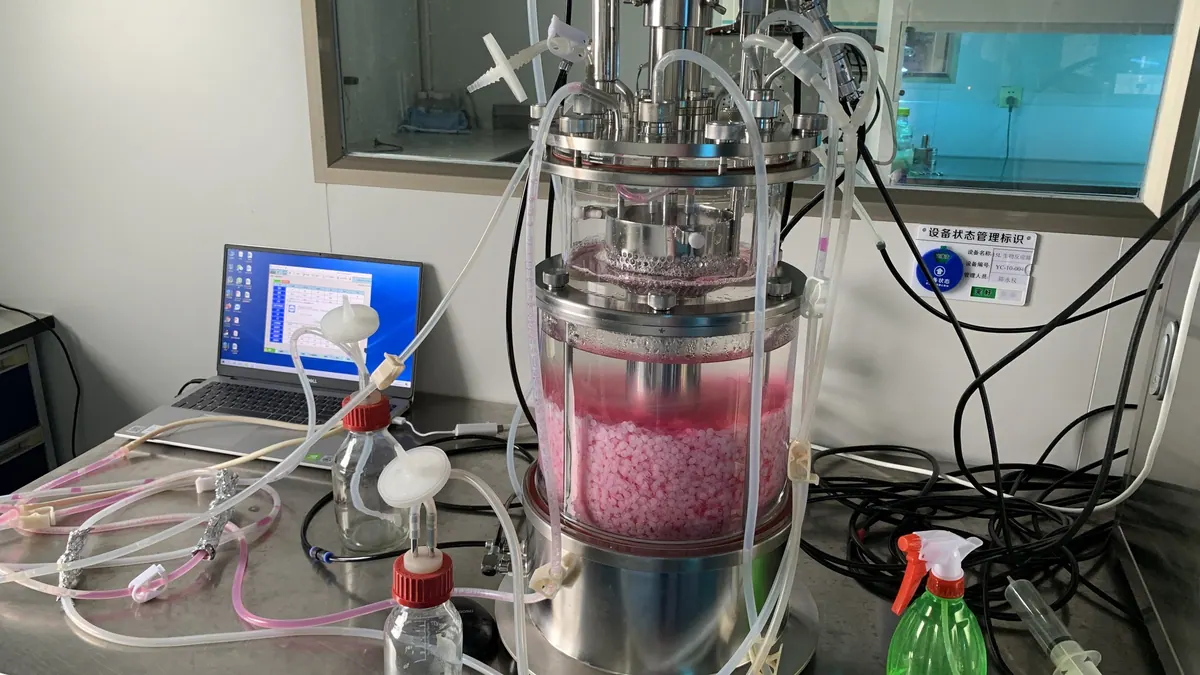

The carboxylate platform is anaerobic fermentation run so that no methane is formed, only volatile fatty acids (VFAs), from which polymers, chemicals and fuels can be produced. It is the reverse of the logic of a biogas plant: there methanogenesis is the goal, here it is deliberately blocked.
How it works
In classical methane fermentation, four groups of microorganisms cooperate, and the last converts acetate and hydrogen into methane. If the methanogens are inhibited, the products of the earlier stages, acetic, propionic, butyric and valeric acids, accumulate in the liquid. Inhibition is achieved by:
- low pH (usually 5–6), at which methanogens do not grow,
- a short retention time (days), so that the slowly growing methanogens are washed out,
- inhibitors (e.g. chemical blockers of methanogenesis) or loading conditions,
- control of temperature and substrate composition.
In a process run this way some hydrogen and CO₂ are also formed, but the microbiome can be steered towards producing acids of the desired chain length.
Chain elongation
Mixed cultures can combine short acids with ethanol or lactate in a process of chain elongation, in which butyric and caproic acid (C6) and higher acids are formed. They are more valuable than acetate: they are suitable for esters, feed additives, fragrance compounds and fuel precursors. The process requires an electron donor (ethanol, lactate) and a stable environment.
What VFAs are used for
- PHA (polyhydroxyalkanoates): biodegradable polyesters produced by bacteria that accumulate them in their cells. Mixed cultures fed with VFAs can produce PHA of different monomer composition, depending on the proportion of acetate and propionate.
- Bioplastics and platform chemicals after further conversion.
- Fuels: esters or alcohols after reduction, a higher level of processing.
- A carbon source at treatment plants for denitrification, which is a simple and mature application.
When chemicals beat biogas
The energy in biogas is cheap per tonne of substrate, and chemical products are usually more expensive per tonne, but their production requires separation from a dilute broth (acid concentrations of the order of several to a dozen or so grams per litre), dewatering, purity and stable buyers. In market terms the advantage of chemicals usually appears only for clean and homogeneous streams, such as waste from the food industry of constant composition, and not for mixed municipal biowaste. The price of oil and gas, the waste fee system and support for bioproducts also matter.
An indicative order of magnitude: a kilogram of acids from a tonne of waste costs quite a lot of energy to recover in processing, so the economic balance is sensitive to the cost of separation; in analyses from the literature it is precisely this stage that accounts for a significant part of the cost.
Technical challenges
- Separation: liquid-liquid extraction, membranes, electrodialysis, distillation; all are energy-intensive.
- Purity: residues of substrates and pigments hinder use in polymers.
- Scale: most reports come from laboratory and pilot reactors.
- Stability: mixed cultures are variable, and the process requires control so as not to revert to methanogenesis.
- Readiness level: TRL 5–7 in pilots; the first demonstration installations in Europe concern mainly PHA and acids from industrial waste.
Why in a biogas plant this is a failure
The same mechanism is dangerous in a digester: excessive loading or inhibition causes acids to accumulate, pH to fall and methanogenesis to be suppressed, which ends in acidification and loss of gas production. The carboxylate platform maintains such a state deliberately, in a reactor designed and monitored for the purpose, with different parameters. A biogas plant operator should not experiment with "partial" acid production in an existing digester. The difference is that in a carboxylate platform the acids are the product and are regularly withdrawn from the reactor, whereas in a methane digester their accumulation is an alarm signal that requires the loading to be reduced. The symptoms and the acid profile are described in the articles VFAs in a biogas plant: profile and thresholds and diagnosing acidification.
Conclusions
The carboxylate platform is an interesting direction for operators of selected industrial waste streams, but for an agricultural biogas plant it remains something to observe, not an investment. Before any decision it is also worth establishing whether the waste stream is sufficiently homogeneous and available all year round, because the stability of the microbiome and the quality of the product depend on it. If a local buyer of VFAs or PHA appears, it makes sense to consider cooperation with a research centre in the form of a pilot on a selected stream.
Sources
- Kleerebezem R., Joosse B., Rozendal R., van Loosdrecht M.C.M. (2015), Anaerobic digestion without biogas?, Reviews in Environmental Science and Bio/Technology 14, 787–801
- IEA Bioenergy Task 37 — materiały o beztlenowym przetwarzaniu odpadów
- Bio-based Industries Consortium (BIC) — informacje o biogospodarce w UE
Related articles