Tanks and membranesGuide
Digester heat losses: a step-by-step calculation with a numerical example
Digester heat losses depend on the area, the U-value and the temperature difference. We show the calculation on an example and its verification by measurement.
Other language versions: Polski, Deutsch, Español, Français, Italiano, Nederlands.
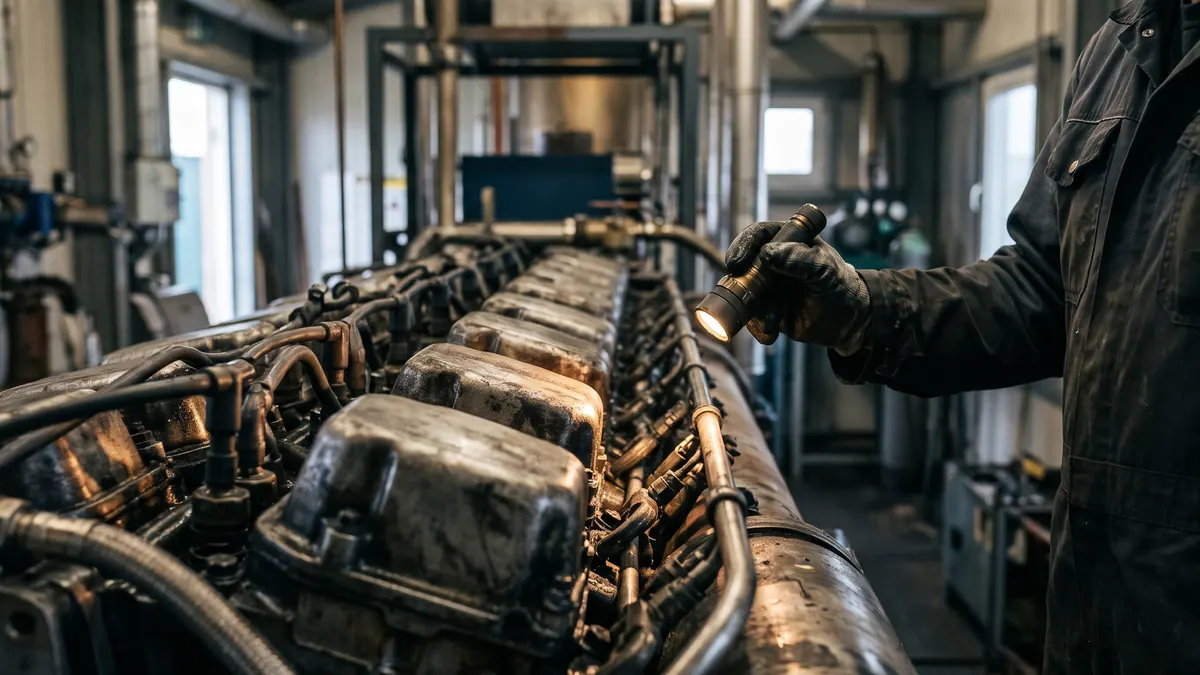
The calculation of digester heat losses is simple and makes it possible to compare insulation variants without expensive simulations. We calculate the loss through a partition from the formula Q = U · A · ΔT, where U is the heat transfer coefficient, A the area and ΔT the temperature difference between the interior and the surroundings. The example below is hypothetical and serves to illustrate the method; it does not describe a specific plant.
Assumptions of the example
- A cylindrical digester with a diameter of 24 m and a wall height of 7 m, process temperature 40°C.
- Wall: reinforced concrete with 12 cm of insulation and a jacket; assumed U = 0.28 W/(m²·K).
- Roof: double-membrane with an air cushion; assumed U = 0.8 W/(m²·K) (the typical range for membranes with an air layer is values several times higher than for an insulated wall).
- Base: insulation and ground; assumed U = 0.3 W/(m²·K), ground temperature under the tank 8°C.
- Outside temperature: 0°C in winter, 15°C in summer.
All values are assumptions; in a real calculation they should be replaced with project and manufacturer data.
Step 1: areas
- Wall: π · D · H = 3.14 · 24 · 7 ≈ 528 m².
- Roof (approximate plan area, bulge ignored): π · D² / 4 ≈ 452 m².
- Base: ≈ 452 m².
The bulge of a membrane roof increases the area by several to over ten per cent; in an indicative calculation it can be ignored or a factor added.
Step 2: losses in winter (surroundings 0°C)
- Wall: 0.28 · 528 · (40 − 0) ≈ 5,913 W ≈ 5.9 kW.
- Roof: 0.8 · 452 · 40 ≈ 14,464 W ≈ 14.5 kW.
- Base: 0.3 · 452 · (40 − 8) ≈ 4,339 W ≈ 4.3 kW.
- Total: ≈ 24.7 kW.
To this is added the effect of wind: an increase in speed increases the external heat transfer coefficient and can raise the losses of the wall and roof by several to several dozen per cent. For a cautious assessment, 10–20% can be added, which gives a value of about 27–30 kW.
Step 3: losses in summer (surroundings 15°C)
- Wall: 0.28 · 528 · 25 ≈ 3.7 kW.
- Roof: 0.8 · 452 · 25 ≈ 9.0 kW.
- Base: unchanged, ≈ 4.3 kW.
- Total: ≈ 17.0 kW.
The seasonal difference (about 25 vs about 17 kW) is in the example about one third; in practice, with a harsher winter, it is more.
Step 4: share in heat production
Suppose a CHP module with an electrical output of 500 kW produces roughly 500–550 kW of useful heat (depending on efficiency and recovery). The digester losses in winter are about 5% of this value. Remember, however, that this is only one element of the balance: the warming of the substrate dose from ambient temperature to process temperature is calculated separately, and with a large quantity of cold substrate it can be much greater than the losses of the partitions.
Step 5: effect of insulation thickness
Changing the wall U from 0.28 to 0.20 W/(m²·K) lowers the wall losses in winter by about 1.7 kW, that is by about 7% of the total. With a membrane roof, a similar gain depends on a change in construction, not only on the insulation thickness. This means that increasing wall insulation has a limited effect if the roof has the largest share, so it is the roof that should be assessed first.
Step 6: verification by measurement
The calculation is worth checking. The simplest method is to measure the heat delivered to the digester heating loop (a heat meter on the loop) over a period without adding cold substrate, or taking into account its quantity and temperature. If the measurement significantly exceeds the calculation, the causes are usually: moistened insulation, bridges, open manholes, roof leaks, draughts or an underestimated U.
How to use the result
The calculated losses make sense only when set against the whole heat balance of the plant. It is worth comparing them with the heat needed to warm the substrate, with the heat available from the CHP in the coldest month and with any heat sales. If the winter margin is small, even an improvement of a few per cent in roof insulation or the elimination of bridges can reduce the risk of underheating the digester. The calculation can be repeated for several variants, changing one parameter at a time, and in this way the change with the best ratio of effect to outlay can be identified. The practical consequences of winter losses for biology are described in the article Winter operation of the digester, and typical failures of the heating system in Digester heating.
Most common calculation mistakes
- Omitting the warming of the substrate.
- Taking the material U from the data sheet without allowing for bridges and moisture.
- Using a single outside temperature for the whole year.
- Neglecting losses through penetrations, manholes and the external heat exchanger.
- Mixing units (kW and kWh/day).
Summary
The calculation Q = U · A · ΔT gives a quick assessment of digester losses and indicates which partition is the most worthwhile to improve. The result must be confronted with heat measurements, because real losses depend on the condition of the insulation and on wind. The example given has methodological value only.
Sources
Related articles