Process biology and start-upAnalysis
The digester microbiome: what 16S sequencing analysis offers the operator, and its limitations
A 16S rRNA profile describes which microbes are in the digester, but not what to do about it. We assess when the test makes sense and how to read the results.
Other language versions: Polski, Deutsch, Español, Français, Italiano, Nederlands.
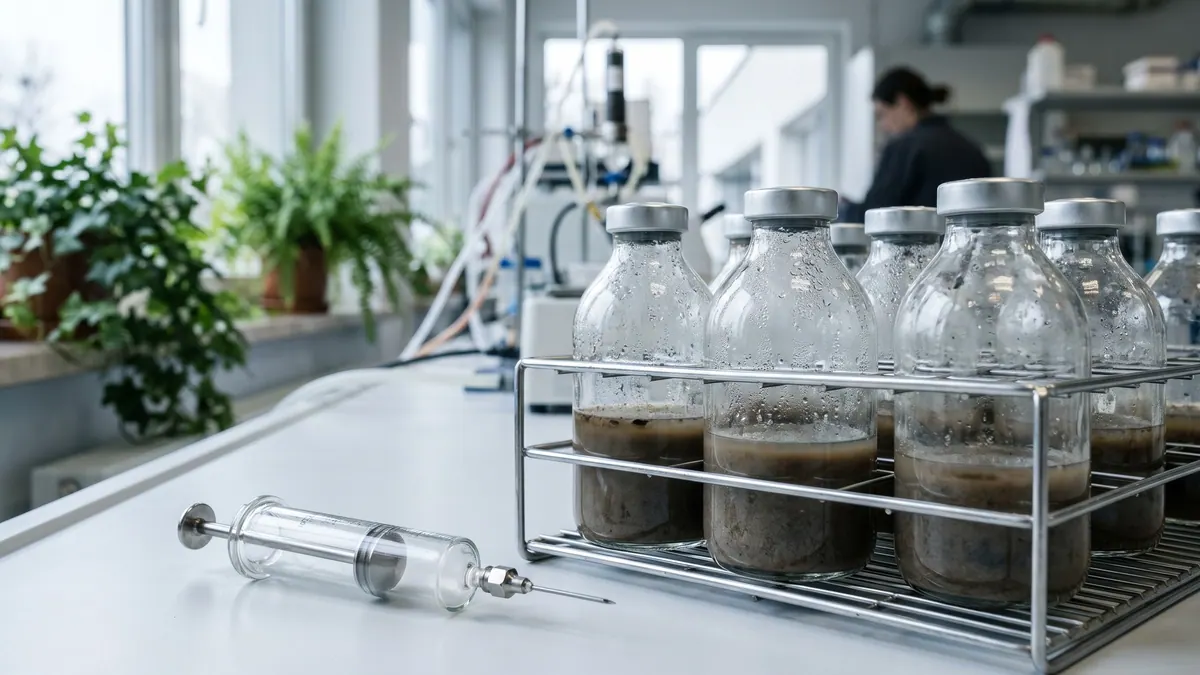
Analysis of the digester microbiome is a determination of which groups of microorganisms are present in a sample of the contents and in what proportions, most often by sequencing a fragment of the 16S rRNA gene. In recent years laboratories have also been offering such tests to biogas plant operators. The results can be extensive, but their usefulness for daily operation is limited, and it is worth understanding this before ordering a test.
What exactly is measured
In the amplicon approach, DNA is extracted from the sample, a fragment of the 16S rRNA gene (containing variable regions that differ between species) is amplified, the resulting fragments are sequenced and compared with reference databases. The outcome is a list of taxonomic units (families, genera) together with their percentage share in the whole pool of reads.
For archaea, to which methanogens belong, suitable primers are needed; some protocols designed for bacteria underestimate their share. A fuller picture is given by metagenomics (sequencing of all DNA), which also makes it possible to assess functional genes, but is more expensive and harder to interpret. Besides DNA, RNA is sometimes studied (transcriptomics), which reflects activity better but requires rapid preservation of samples.
The most important rule: this is a relative profile. A rise in the share of one group may result from a fall in another, not from its real multiplication. The data also do not say whether cells are alive and active, because DNA remains in the sample after cells have died.
Which groups are usually described
The picture below is simplified and based on general conclusions from review literature, without reference to specific plants:
| Group | Role in the process | What a rise in share usually suggests |
|---|---|---|
| Bacteroidota | hydrolysis of carbohydrates and proteins | high availability of complex polymers |
| Firmicutes (incl. Clostridia) | hydrolysis, acidogenesis, fermentation | high load, rapid acidogenesis |
| Syntrophic acid-oxidising bacteria | breakdown of propionate, butyrate | capacity to process higher acids |
| Methanothrix (Methanosaeta) | acetoclastic methanogenesis | low acetate concentration, low NH₃ |
| Methanosarcina | acetoclastic and hydrogenotrophic methanogenesis | higher acid concentration, faster load changes |
| Methanoculleus, Methanobacterium | hydrogenotrophic methanogenesis | higher ammonia, higher temperature (link with SAO) |
Broader background is given by the description of the four stages of fermentation and of acetoclastic and hydrogenotrophic methanogens. For example, a predominance of Methanoculleus combined with high ammonia suggests the pathway described in the article on syntrophic acetate oxidation.
What cannot be concluded from the result
- There are no decision thresholds. There is no accepted value for the share of a given genus above which action should be taken. Communities differ between plants more than within one plant over time.
- Function does not follow from the name. Genera include organisms with different properties, and the resolution of 16S does not always make it possible to tell species apart.
- No absolute values. To know whether there are "few" methanogens, a quantitative determination (qPCR) or another method is needed.
- A momentary state. The composition changes with the feed, temperature and substrate; a single sample is a snapshot of one day.
- No indication of action. The report says who is present, but not a recommendation on what to change in the feedstock.
Influence of sampling and sample preparation
The quality of the result depends on the stages preceding sequencing:
- sampling: a non-representative sample (see representative sampling) gives a picture of one zone of the tank,
- preservation and transport: without cooling or freezing the composition changes during transport,
- DNA extraction: different kits break cell walls with different effectiveness; methanogens with compact walls are sometimes underestimated,
- choice of primers and reference database: they affect which groups are visible,
- bioinformatic analysis method: filtering parameters change the results.
Results from different laboratories or from different years are hard to compare if the methodology is not the same. For monitoring over time it is therefore worth using one test provider and one protocol.
When the test makes economic sense
A cost of analysis in the order of several hundred to several thousand zloty per sample (depending on scope) is small compared with the loss of several weeks of production, but only if the result changes a decision. Justified scenarios:
- An unexplained disturbance, when FOS/TAC, VFA, ammonia and trace elements do not explain a drop in performance.
- A change in conditions (e.g. moving to higher ammonia, a change in temperature), when we are interested in how the community rebuilds.
- A before-and-after comparison of the use of an additive or a technology change, with an adequate number of replicates.
- Research and optimisation projects, in which the microbiological profile supplements chemical measurements.
A routine test without a research question rarely brings benefit. The basis remains chemical monitoring (FOS/TAC, VFA, biogas), which is cheaper and gives a result faster.
How to read the result once we have it
Good practice is to set the microbiological profile against chemical parameters from the same day and the history of the plant. We look for consistency: does the change in community composition explain the observed changes in VFA or methane production? If so, the hypothesis gains support; if not, the result remains a curiosity. Conclusions are worth formulating carefully (suggests, is consistent with), and process decisions based on measurements that can be repeated. The microbiome is a supplementary tool; it does not replace the basics of operation.
Sources
Related articles