Process biology and start-upGuide
Antibiotics and disinfectants in substrates: when they inhibit fermentation and how to reduce the risk
Veterinary drugs in slurry and cleaning and disinfecting agents from dairies and slaughterhouses can limit methanogenesis. Where they come from in the digester, what research says about thresholds and how to reduce the risk.
Other language versions: Polski, Deutsch, Español, Français, Italiano, Nederlands.
Veterinary antibiotics and disinfectants are by nature substances directed against microorganisms, so in theory they can also hit methanogenic bacteria and archaea. In practice the outcome is decided by the concentration in the digester, that is, the load supplied over time compared with the reactor volume, not by the mere presence of a substance in the substrate. Typical slurry from a mixed herd is rarely a problem; concentrated or sudden streams are risky.
Where drugs and disinfectants reach the digester from
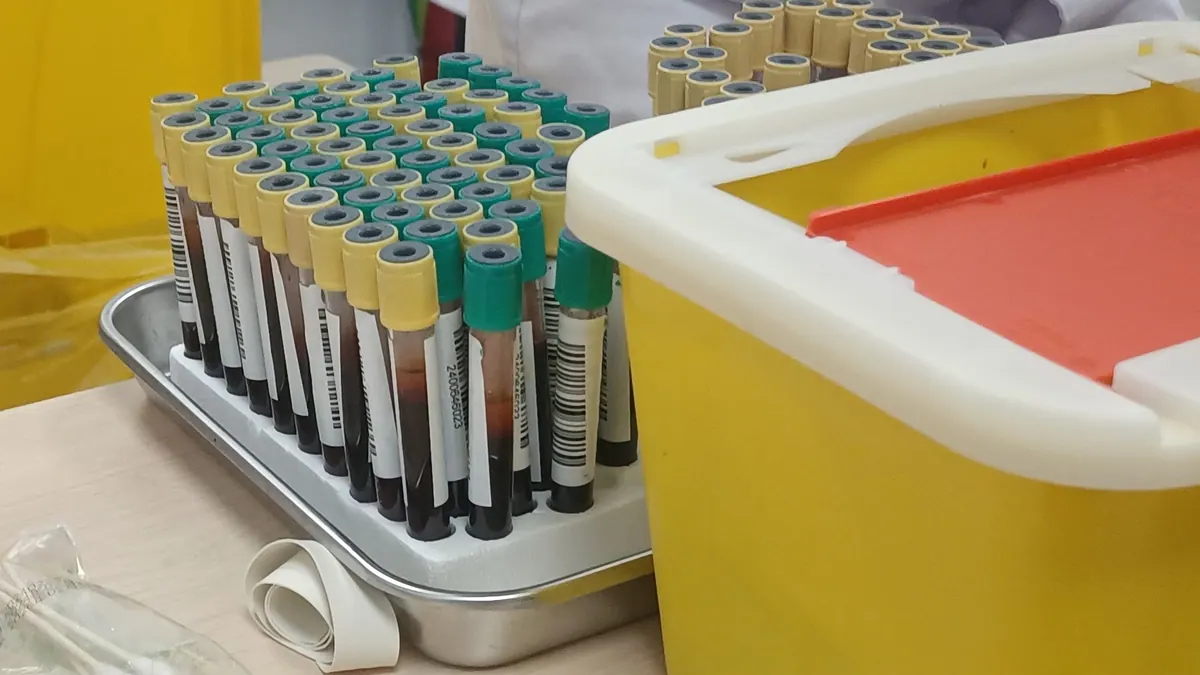
Antibiotics given to animals are partly excreted unchanged or as metabolites, so they are found in urine and faeces and hence in slurry and manures. They can also reach the digester with milk from treated cows that is unfit for sale, with bedding and with slaughterhouse waste (e.g. stomach contents, blood, tissue). Cleaning and disinfecting agents come from washing milking equipment, milk lines, slaughter and cutting halls, from washing transport vehicles, and from waste containing residues of working solutions.
The most commonly encountered groups of agents are quaternary ammonium salts, chlorine compounds, peroxides (including hydrogen peroxide and peracetic acid) and the strong alkalis and acids used in closed-circuit cleaning. They differ in mechanism of action and persistence: oxidants react quickly with organic matter in wastewater and waste, while cationic compounds readily sorb onto solid particles and sludge.
What research says about thresholds
Results from the literature depend strongly on the type of inoculum, the substrate and the method, so treat them as an order of magnitude, not a norm. The table below collects examples from peer-reviewed studies.
| Substance or group | Observation in studies | Source |
|---|---|---|
| Ampicillin, sulfamethazine | no effect on total biogas production up to 350 and 280 mg/l; ampicillin slowed the production rate at the start | Mitchell et al., 2013 |
| Tylosin | biogas production down by 10–38% in the range 130–913 mg/l | Mitchell et al., 2013 |
| Florfenicol | decrease of about 5%, 40% and 75% at 6.4, 36 and 210 mg/l respectively | Mitchell et al., 2013 |
| Quaternary ammonium salts (sewage sludge) | low concentrations stimulated or did not change methane production, high ones inhibited it; dialkyl compounds were the least toxic | Yang et al., 2023 |
The authors of the first of these studies note that the antibiotic concentrations tested were higher than those usually found in mixed slurry from beef cattle finishing, so the impact on full-scale plants should be small. It does show, however, that a single substance, e.g. florfenicol, can inhibit the process at relatively low concentrations, and that sensitivity is not the same for all drugs. The review by Chen et al. (2008) also stresses that results for individual toxicants can diverge widely, and that adaptation of the microflora to a compound often raises tolerance.
For quaternary ammonium salts, studies show an effect that depends on dose and chemical structure: at high concentrations, inhibition of methanogenesis is accompanied by the accumulation of volatile fatty acids. This is an important diagnostic clue, because in practice disinfectant poisoning looks like acidification. See digester acidification: diagnosis and action.
Where the risk is greatest
The risk is raised by situations in which the load of the biocidal substance is concentrated or changes abruptly:
- waste milk from treated cows in large quantities at once,
- sludge and rinse water from washing at the end of a shift, poured in batches into the feed tank,
- concentrated working solutions past their expiry date, and packaging from the agents if it is accepted together with the waste,
- small digesters or digesters at start-up, with less biomass and less capacity to adapt,
- substrates from plants that have changed their cleaning agent supplier or cleaning technology without informing the recipient.
In biogas plants accepting meat and dairy processing waste, variability adds to the problem: one stream is safe for weeks, and after a change in the formulation of the cleaning agents it starts to limit biogas. Information about changes on the supplier's side is therefore as important as substrate analysis.
How to reduce the risk
- Get to know the stream. Ask the supplier which cleaning and disinfecting agents are used, at what working concentrations, and whether the wastewater from cleaning arrives together with the waste. Safety data sheets of the agents are the basic source of information on composition.
- Separate and dilute. Concentrated solutions and waste from the treatment period are best directed to a separate buffer tank and dosed in amounts that do not exceed the digester's capacity for dilution; equalising the stream is more effective than rejecting everything.
- Even out the dose over time. The same amount of waste fed over a day has a different effect from one fed over an hour. Limit abrupt inflow through the feeding system, not manual addition.
- Test the new batch. A BMP test with a gradient of substrate share, or a toxicity test on biomass from the given plant, makes it possible to assess the share at which gas production falls. The principles of testing are described in the BMP test protocol step by step, and the choice of biomass for the test in inoculum in the BMP test.
- Watch the biology. A fall in biogas production with a constant feed, a rise in acids and a change in titration indicators are signals that require a response; see FOS/TAC and monitoring the biology of the digester.
- Plan the response. The site manual should state who limits feeding of a suspect substrate and on what basis, and how to dilute it; decisions on changing the feed are taken by the person responsible for the process.
In plants with a small share of these streams it is usually enough to mix them into the feed blend. The principles of planning the composition are described in the article co-digestion: planning the substrate mix.
Digestate and resistance: a separate issue
Fermentation does not guarantee removal of veterinary drugs or resistance genes. The review by Gurmessa et al. (2020) concerns the effectiveness of removing veterinary drugs and resistance genes during slurry fermentation and the role of treatment before and after fermentation; removal is sometimes incomplete and depends on the substance and the process conditions. This means that even when the biogas plant runs stably, digestate from the slurry of treated animals may carry residues. The assessment of risk to soil and the rules for applying digestate are set by regulations on fertilisers and environmental protection and by advisers' recommendations; this article concerns the process, not the digestate.
Checklist before accepting waste from cleaning or from treated animals
- Do we know the composition of the cleaning agents and their working concentrations?
- Is the stream constant, or does it depend on cleaning cycles?
- Do we have a buffer that will even out the inflow over time?
- Have we tested the mixture in a BMP or toxicity test?
- Do we know since when the supplier changed agents or technology?
- Does the process manager have the authority to limit the dose?
Many problems with antibiotics and disinfectants appear only when several factors add up at once: ammonia, fatty acids, a temperature change and an additional biocidal substance. It is therefore worth reading this article together with the description of ammonia inhibition: the microflora's reaction to several stressors is usually stronger than to a single one.
This article is informational. Thresholds from the literature depend on the inoculum, the substrate and the method; decisions for a specific plant are taken by a process engineer on the basis of tests of the plant's own substrates.
Sources
- Mitchell et al. (2013), The effects of the antibiotics ampicillin, florfenicol, sulfamethazine, and tylosin on biogas production and their degradation efficiency during anaerobic digestion — Bioresource Technology
- Chen, Cheng, Creamer (2008), Inhibition of anaerobic digestion process: A review — Bioresource Technology
- Yang et al. (2023), Impact of quaternary ammonium disinfectant on sewage sludge anaerobic digestion — Journal of Hazardous Materials
- Gurmessa et al. (2020), Manure anaerobic digestion effects and the role of pre- and post-treatments on veterinary antibiotics and antibiotic resistance genes removal efficiency — Science of the Total Environment
Questions and answers
Do residues of dairy plant cleaning agents harm the digester?
They can, if they reach the digester in concentrated form or all at once in a large amount. Agents containing quaternary ammonium salts or oxidants act as biocides, so rinse water should be diluted, equalised in a buffer tank and fed evenly.
Will slurry from animals treated with antibiotics stop digestion?
Usually not. In studies involving ampicillin, sulfamethazine, tylosin and florfenicol, the authors note that the concentrations tested were higher than those usually found in mixed slurry; even so, tylosin and florfenicol clearly reduced biogas production at concentrations of tens to hundreds of mg/l, and ampicillin slowed its initial rate. The risk rises with concentrated streams, e.g. waste from intensive treatment of a herd.