Cogeneration and enginesExplainer
Island operation of a biogas plant: can a biogas engine power the site without the grid
A CHP unit can power the site without the grid, but only if island operation has been designed in. We discuss governors, load steps, start-up and safety.
Other language versions: Polski, Deutsch, Español, Français, Italiano, Nederlands.
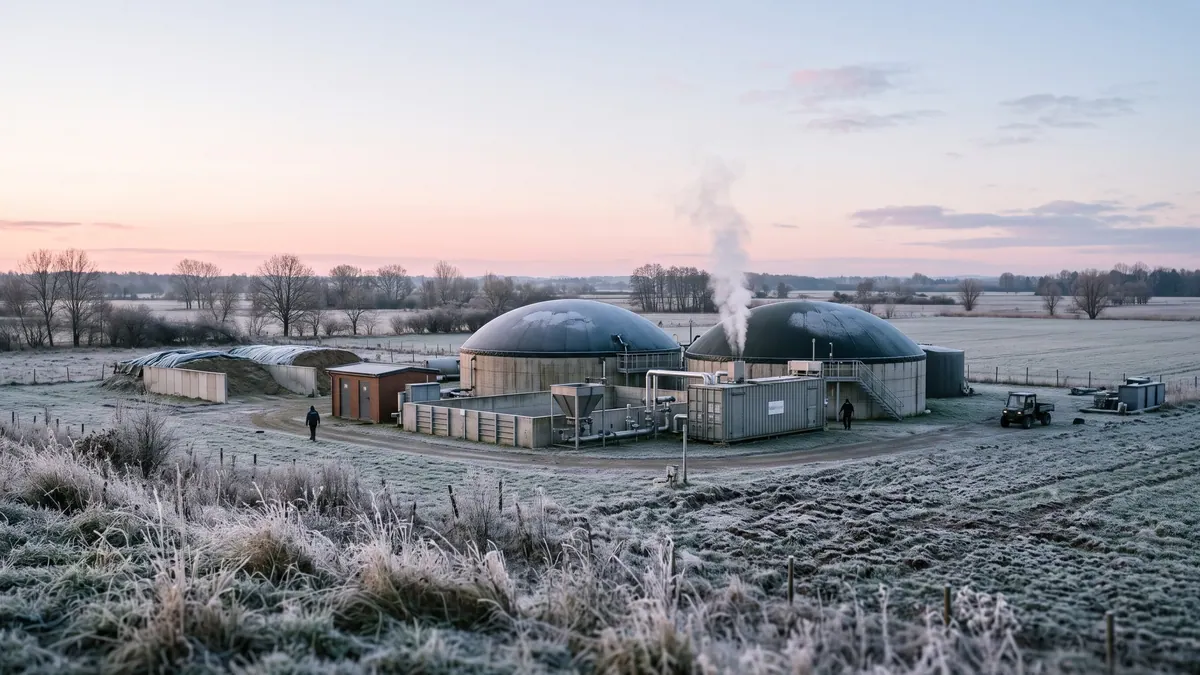
A biogas engine can power a site without the grid, provided that the whole system has been designed for island operation: with speed and voltage control, control of load steps and a safe start-up. An ordinary CHP unit that runs in parallel with the grid usually shuts down when the grid fails, because the protection detects the loss of mains. This is deliberate behaviour that protects people and equipment.
Parallel versus island operation
In parallel operation the grid imposes the frequency of 50 Hz and the voltage; the generator delivers power by regulating the fuel supply. In island operation the generator itself must maintain the frequency (speed governor) and the voltage (excitation regulator, AVR). The operating mode of the controller therefore changes: from power control to speed control, most often with droop or in isochronous mode.
Load step and the properties of a gas engine
An engine fed with gas through a mixer has a large inertia of the fuel-air and turbocharging system. When a large load is suddenly connected in island operation (an induction motor of a pump or mixer with direct-on-line starting can draw several times the rated current), the frequency and voltage may fall outside the permissible values, and the protection system will disconnect the CHP unit. Typically gas engines accept load gradually, in steps in the order of a dozen to several dozen percent of output, with a settling time; the exact data is given by the manufacturer in the load step chart (according to the classes in ISO 8528). Solutions:
- soft start or inverters for the drives of large loads,
- sequential switching on of loads with a delay,
- limiting the power connected at the same time to a reasonable share of the generator output,
- shedding less important loads (load shedding) when the frequency falls.
Blackstart and auxiliary power
When the grid fails and the CHP unit is stopped, it has to be started without external energy. This requires power for the starter, the controls, the oil pump, the gas valves and the ventilation. Solutions: batteries and inverters, a UPS, a small standby generating set or energy storage. It is also necessary to ensure gas at the correct pressure without electrically powered blowers or with priority power supply for them. The critical system should start first: mixing and heating of the digester, when the interruption is prolonged, and then the rest.
The role of the battery
Energy storage can take over short load steps and the start-up surge, improve the voltage quality and allow the CHP unit to run at a stable operating point. This requires an inverter capable of grid-forming operation, and its selection is a separate design task.
Process limitations and safety
A biogas plant has constraints that an ordinary generating set does not have: excess biogas must go to the flare or to storage; if the flare has no power, gas safety is at risk. Mixers, pumps and heating may require less power than the rated output of the generator, so the CHP unit runs at low load, which worsens efficiency and combustion cleanliness. The list of critical loads and the minimum load of the CHP unit should be determined in advance.
Planned versus accidental island operation
Designed island operation includes: separate regulator settings, a switchgear diagram with the possibility of a safe disconnection from the grid, interlocks that prevent an uncontrolled reconnection to the grid, a procedure for re-synchronisation and periodic tests. Accidental island operation, that is a situation in which, after a grid failure, some loads continue to be supplied from the CHP unit without the operator's knowledge, is dangerous: voltage must not be allowed onto a disconnected part of the DSO network, and this is the reason for using loss-of-mains protection. The DSO requirements and connection standards should always be checked before design; the course of the connection is described in the article Connecting a biogas plant to the power grid. A plan for responding to a loss of power across the whole installation can be found in the article Biogas plant emergency plan.
Tests and documentation
Island operation that has never been tested will not work at the moment of a failure. The test is carried out as planned, preferably at low load and in the presence of the service engineer: disconnection from the grid, transition to speed control, switching on the loads in sequence and return with synchronisation. The times, the frequency and voltage deviations and the behaviour of the flare and the gas valves are recorded. The documentation should contain the list of critical loads, the switching-on sequence and the operator's instructions, and the test is repeated after every change to the system.
Questions for the designer
Before commissioning the work, ask what the minimum permissible load level of the CHP unit is in island operation, how long the backup power of the controls will last, how the system will behave on a loss of gas and who is responsible for the re-synchronisation with the grid. It is worth obtaining the answers in writing. It is also good to establish who will carry out the island-transition test and how often, and whether its result will be handed to the operator in the form of a report. Without such a report, after a change of service provider or software nobody will know whether the system still works.
Summary
Island operation is feasible, but it requires a comprehensive design: control, start-up, storage or a UPS and safety rules. Without this, the engine will shut down after a grid failure, and this should be treated as the correct operation of the protection, not as a fault.
Sources
Related articles