CHP unit shutdowns: from the alarm message to the first checks
The CHP unit has stopped with an alarm. We show how to read the message, where to start checking each group of causes and when it must not be restarted.
Other language versions: Polski, Deutsch, Español, Français, Italiano, Nederlands.
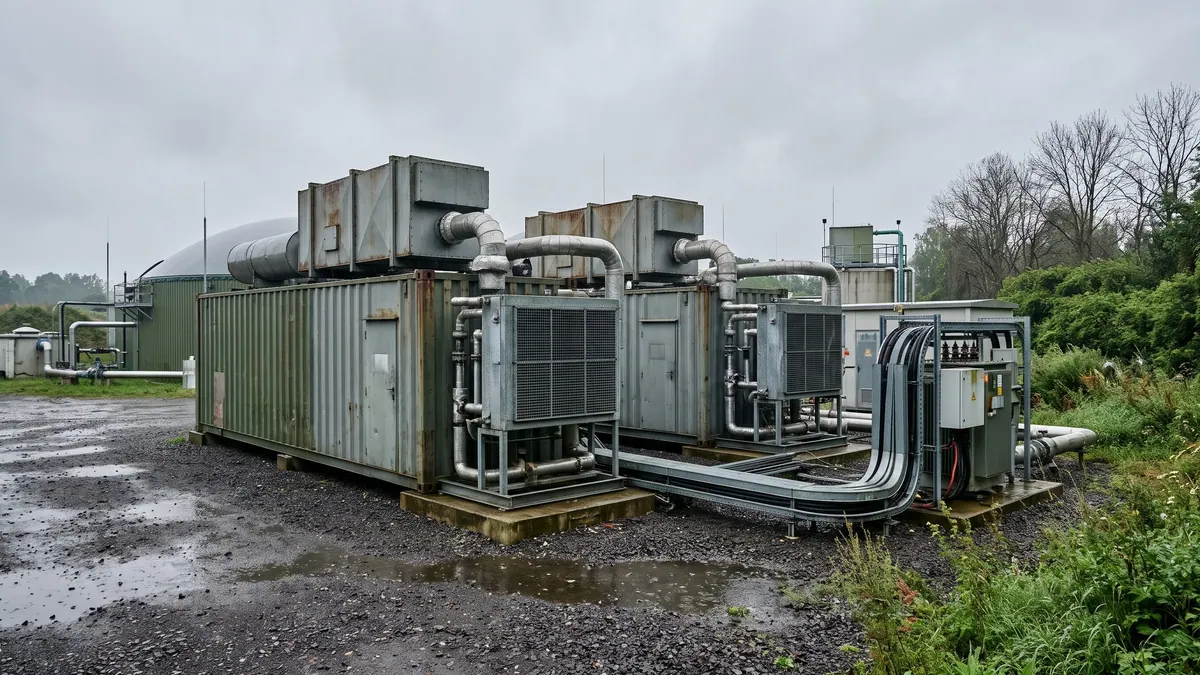
When a CHP unit stops with an alarm, the message on the screen describes a symptom, and the causes still have to be established; a fixed order of checks for each group of faults helps with this. Below we propose a practical summary for the operator: what the typical messages mean, what to check first and when to stop attempting to start. A detailed analysis of systemic causes after a serious failure is discussed separately in the article Root cause analysis after a biogas plant failure: the 5 Why method, and the calculation of availability indicators in the article MTBF, MTTR and biogas plant availability. Here we focus on the first minutes and hours after the shutdown.
Safety before diagnostics
The first question is not "why" but "is it safe". If gas can be smelled in the engine room, the gas detection is active, smoke is visible, there is an oil leak near hot surfaces or sparking, the CHP unit is not started and the alarms are not reset. The room is vacated and the installation's emergency plan is followed. Only after it has been established that there is no hazard does one move on to diagnostics. Repeated "trial" start attempts after a safety alarm can damage the engine or lead to a dangerous situation, so the number of start attempts is worth limiting in the instructions (usually to one, at most two, after the cause has been identified).
From the message to the first check
| Message (symptom) | The most common directions of the causes | What to check first |
|---|---|---|
| Low gas pressure upstream of the gas train | blower, clogged filter, condensate in the pipeline, closed valve, low gas holder level | gas holder level, pressure upstream and downstream of the filter, condensate traps, valve positions |
| High coolant or charge air temperature | fouled coolers, pump or fan, high ambient temperature, air in the system | cleanliness of the coolers, operation of the fans, coolant level, temperature trend |
| Misfires, knocking | worn spark plugs or coils, change of gas composition, excessive load | record of misfires by cylinder, gas composition, spark plug replacement history |
| Generator protection operated or loss of mains | disturbance in the DSO network, synchronisation error, settings | relay event log, DSO messages, voltage and frequency before the shutdown |
| Sensor or communication error | damaged sensor, broken wire, frozen controller | comparison with a local measurement, controller power supply, condition of connectors |
| Low oil pressure or high oil temperature | low level, leak, worn filter, overheating | oil level on the dipstick, traces of leaks, date of the last change |
The table is a summary of directions, not a repair algorithm. The final thresholds and procedures are given by the manufacturer of the unit. The frequency distribution of causes depends on the installation, so after several months it is worth building your own on the basis of the register.
What to secure before resetting the alarm
- A dump of alarms and events from the controller together with trends from several hours before the shutdown (pressures, temperatures, load, voltages).
- The physical state: photographs, local readings of pressure gauges and thermometers, oil condition, leak check.
- External conditions: ambient temperature, DSO messages, work being carried out on the installation at that time.
- The operator note: what happened before the shutdown, who did what.
- Samples of oil or condensate, if their involvement is suspected.
Recording this data takes a few minutes, and without it, after the alarm is reset, it is often impossible to reconstruct the course of the event.
Illustrative example
The CHP unit stopped with a low gas pressure alarm. The trend shows a gradual fall of the pressure upstream of the gas train over two hours, with a constant pressure in the gas holder. This points to resistance in the gas path, not to a lack of gas. The check shows a filter overloaded with condensate at the blower suction. After drying and replacing the filter the CHP unit runs, but the cause is an inoperative condensate trap at the lowest point of the pipeline. Cleaning the filter alone would have removed the effect, and the failure would have returned in a few days. For this reason, after the repair a check of the condensate traps is entered into the inspection schedule. The values in the example are hypothetical.
Shutdowns that keep coming back
If the same alarm appears every few days or weeks, repairing the symptom is not enough. In such a situation it is worth:
- compiling the events in a register with the date, time, downtime and the actions performed,
- comparing the conditions in which the alarm occurs (temperature, load, time of day, gas composition),
- establishing whether a change in the installation (a new filter, a different batch of substrate, a change of settings) preceded the first occurrence,
- carrying out a root cause analysis by the method described in the article on 5 Why,
- agreeing with the service provider whether a check by the manufacturer is required.
Helpful is the operator log, which makes it easier to reconstruct the situation, and the article on spare parts and equipment criticality, which helps to decide which items to keep on site in order to shorten downtime.
What to avoid
- Repeatedly resetting the alarm and starting the CHP unit without establishing the cause.
- Bridging or switching off protection "for a moment" in order to maintain production.
- Replacing several components at once without a note of exactly what was changed, because then it is not known what removed the problem.
- Working without event records, because after a week nobody remembers the details.
- Work on electrical and gas systems by persons without the required qualifications.
The role of the service provider and the contract
In many installations the first diagnosis is made by the operator and the further actions by the service provider. It is worth establishing in the contract what data the operator provides when reporting (an alarm dump, trends, photographs), within what time the service provider responds and whether it has remote access to the records. A well-prepared report shortens the travel and diagnostic time, and thus the downtime.
Summary
After a CHP unit shutdown, the order is what counts: safety, securing of data, checking by groups of causes, and only then repair and start-up. Recurring shutdowns require root cause analysis and an event register, not further repairs of the symptom. Numerical values and alarm thresholds must always be taken from the documentation of the manufacturer of the specific unit.
Sources
Related articles