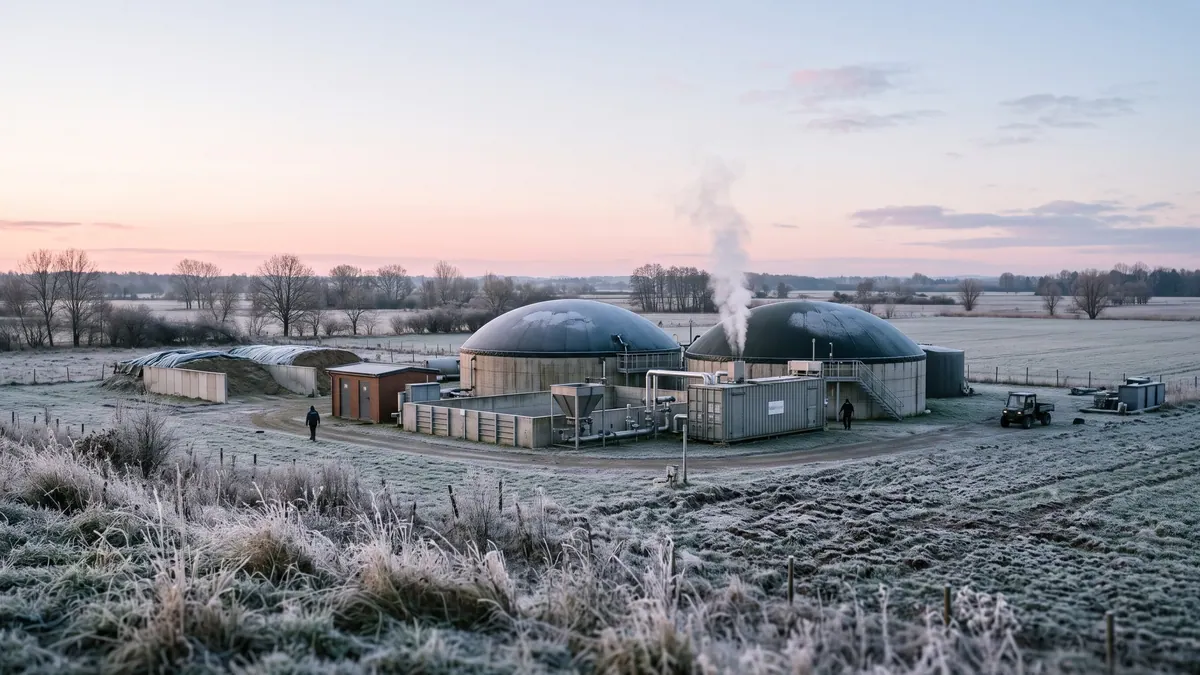
Cogeneration and enginesAnalysis
Energy storage at a biogas CHP plant: when a battery makes sense and when it does not
A battery at a CHP unit can back up the controls, shave peak demand or exploit price differences. We check which functions pay back.
Other language versions: Polski, Deutsch, Español, Français, Italiano, Nederlands.
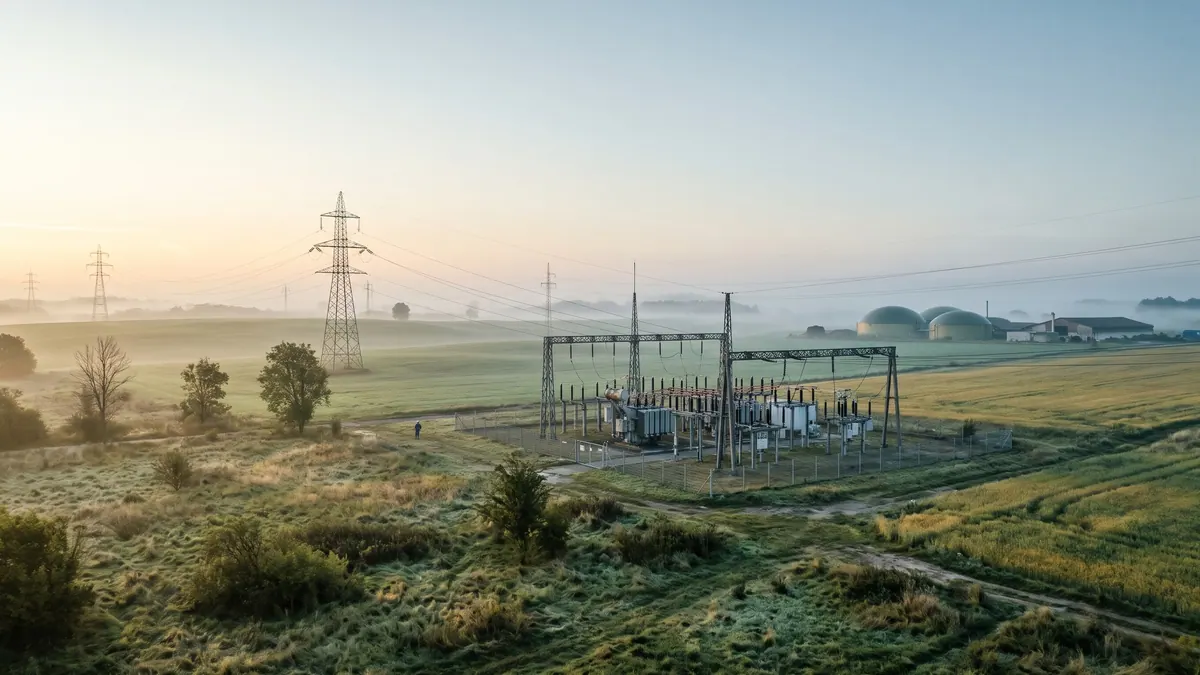
Energy storage at a biogas CHP plant makes sense mainly when it solves a specific problem: no backup power for the controls, exceeding the capacity at the connection point, or a wide spread of hourly prices that can actually be exploited. As a general add-on to a CHP unit that already runs stably, a battery rarely pays for itself. Below we compare the functions and show how to calculate; all figures are indicative values and depend on the offer and local conditions.
How a biogas plant differs from photovoltaics
A photovoltaic installation generates energy during sunny hours, often when the price is low, so shifting production in time brings a measurable gain. A CHP unit runs for most hours of the year at a constant output close to its rated output, and the biogas is stored in the gas holder. This means the biogas plant already has its own store: the gas in the tank. Shifting production by a few hours can be achieved by controlling the CHP unit and the gas holder level, without electrochemical cells.
Battery functions and their real value
| Function | Description | Assessment of merit |
|---|---|---|
| Control backup | power for the PLC, critical inverters, gas valves and communications during a grid outage | high, a small capacity is enough (a UPS or a small storage unit) |
| Peak demand reduction | covering the start-up of drives (mixers, pumps, feeders) so that the contracted capacity is not exceeded | depends on the tariff and the demand profile |
| Price arbitrage | charging at a low price, discharging at a high price | depends on the spread and the number of cycles |
| System services | participation in balancing markets through an aggregator | requires capacity, certification and a contract; value varies |
| Higher self-consumption | using own energy instead of buying it | usually low at a biogas plant, because production covers consumption anyway |
Limitations
The unit cost of storage has fallen in recent years, but it remains a significant part of the investment, and cell durability is limited by the number of cycles and the depth of discharge. The efficiency of a full charge-discharge cycle is typically about 85–92%, so some energy is always lost. In addition, negative and very low hourly prices can be dealt with in two ways: by stopping or throttling the CHP unit, and by storage. The first is cheaper if the gas holder has spare capacity; such operation is described in the articles Flexible biogas production: feeding, gas storage and energy prices and Start-stop cycles and biogas engine wear. Gas holder capacity is sized according to the article Biogas storage capacity: sizing for CHP and biomethane plants.
Illustrative example: arbitrage
Assumptions (indicative): a battery with 1 MWh of usable capacity, a cycle efficiency of 88%, 250 full cycles per year, and an average spread between the charging and discharging price of PLN 300/MWh.
- Energy discharged per year: 250 × 1 MWh × 0.88 = 220 MWh.
- Revenue from the price difference: about 250 × 1 MWh × PLN 300 = PLN 75 thousand per year, reduced by cycle losses (energy bought but not used); after the correction in the order of PLN 65–70 thousand.
- With a system cost of several hundred thousand zlotys per 1 MWh, the simple payback period is from several to over a dozen years, which approaches the durability of the cells.
Conclusion: under these assumptions, arbitrage alone does not justify the investment. It improves only with a higher spread, more cycles or additional revenue (system services, reduced capacity charges).
Decision criteria
- Production profile. A constant output and a large gas holder are an argument for controlling the CHP unit instead of installing a battery.
- Grid connection capacity. If the plant is limited by its connection capacity, a battery will not raise the export above the limit, but it can smooth the output within the limit.
- Hourly price. Calculate the price spread of recent years and plan a cautious scenario, not record values.
- Safety. Backing up the controls is worth doing even without economic profitability, because it protects against an uncontrolled shutdown and gas release.
- Durability and service. Take into account the warranty on the number of cycles, cooling, fire protection requirements and insurance.
Example from practice: a wastewater treatment plant
Energy storage can be justified where constant consumption is high and continuity of supply is important for the process. A description of a facility combining biogas from sludge with energy storage can be found in the article The Slupsk bioenergy island. The conditions differ from those of a typical agricultural biogas plant, so the conclusions should not be transferred directly.
Data needed for the decision
Before you order a quotation, collect hourly data covering at least one year: CHP production, own consumption, power at the connection point, energy prices and the number and duration of outages. On this basis a simulation will show how many cycles the battery will actually perform and what capacity it needs. It is worth comparing at least three variants: without storage, with a small storage unit for backup and with storage for arbitrage. A cautious model assumes a lower price spread and a higher service cost, and treats the result as a range, not a single figure.
Summary
For most biogas plants a two-stage approach is reasonable: first a small storage unit or UPS to back up the controls and for a safe shutdown, and only then an analysis of a large battery based on the plant's actual hourly data. The legal situation and market conditions should be checked on the date of the decision.
Sources
Related articles