Tanks and membranesAnalysis
Biogas storage capacity: a sizing method for cogeneration and for a biomethane plant
Biogas storage is a buffer between steady production and variable offtake. We show a method for sizing the capacity for CHP and a biomethane plant, and two hypothetical examples.
Other language versions: Polski, Deutsch, Español, Français, Italiano, Nederlands.

Biogas storage serves as a hydraulic buffer: the digester produces gas essentially continuously, while the consumer (CHP engine, upgrading unit, boiler) draws it according to its own schedule. Buffer capacity is sized from a balance of flows, not from a rule of thumb of one day's reserve for everyone. Below we describe the method, the influence of physical conditions and two hypothetical examples that show the order of magnitude.
The principle: a balance of flows over time
Let P(t) be gas production and O(t) offtake. The volume in storage V(t) changes according to the balance: dV/dt = P(t) − O(t). The required capacity is the difference between the largest and the smallest value of the cumulative difference between production and offtake in the analysed period, increased by a safety reserve. In practice an hourly summary for a typical day and for the worst day of the year is enough.
Physical conditions
Biogas is a compressible gas, and its volume depends on temperature and pressure. A membrane storage operates at a slight overpressure, of the order of a few millibars, so changes in atmospheric pressure and temperature affect the volume. It should also be remembered that production is often stated in normal cubic metres, while the capacity of a tank is a volume at operating conditions. The difference between these quantities at a temperature of about 35-40 °C is a dozen or so percent, which must be taken into account in the calculations. In addition there is the water vapour content and changes in gas composition, which affect the calorific value but do not change the volume balance.
Hypothetical example 1: CHP running continuously
Assume an installation with a production of about 500 m³ of biogas per hour, with a CHP drawing a constant flow. The buffer is needed only for fluctuations: short engine stops, start-ups, changes in gas production after a change of substrate dose. Assuming a buffer of one to four hours of production, we obtain a range of 500-2,000 m³. Such a capacity fits within the roof of a typical digester, so a separate tank is usually not needed. The example is hypothetical, and the figures serve to show the method.
Hypothetical example 2: flexible CHP operation
With the same production (500 m³/h), the engine runs for 12 hours a day at twice the rated output, i.e. it draws 1,000 m³/h, and stands idle for the other 12 hours. Production during the standstill is 12 × 500 = 6,000 m³, and the storage must hold that much, which, with a roof having a capacity of a few thousand cubic metres, means the need for an additional tank or an increase in roof capacity. For flexible operation the buffer is sized for the longest break in offtake, not for the average daily profile. To this is added the question of the CHP's ability to run at increased output and of grid and market requirements.
Biomethane plant
An upgrading unit usually runs continuously, because it has a high capital cost and frequent starts and stops worsen the performance indicators. The raw gas storage therefore has two roles:
- smoothing fluctuations in digester production and in the flow to the upgrading system;
- a reserve for upgrading unit standstills (inspection, failure, replacement of the medium), after which it may be necessary to dispose of the gas in another way, e.g. burning it in a flare.
The buffer for a biomethane plant is sized for the duration of typical short outages and for the requirements of the grid operator or the customer; for long standstills the solution is often a flare rather than a huge tank, because multi-day storage is expensive. We describe the choice of gas utilisation route in the article on choosing between CHP and biomethane.
Flexible operation and economics
With flexible operation, profitability is decided by the relationship between the cost of additional capacity and the revenue from higher energy prices at peak hours. This subject is developed in the article on flexible biogas production. It is worth calculating the balance for several variants (a different number of operating hours, a different engine output) and comparing the cost of expanding the storage with the expected benefit, instead of assuming in advance that a larger buffer will always pay for itself.
Where the roof is not enough
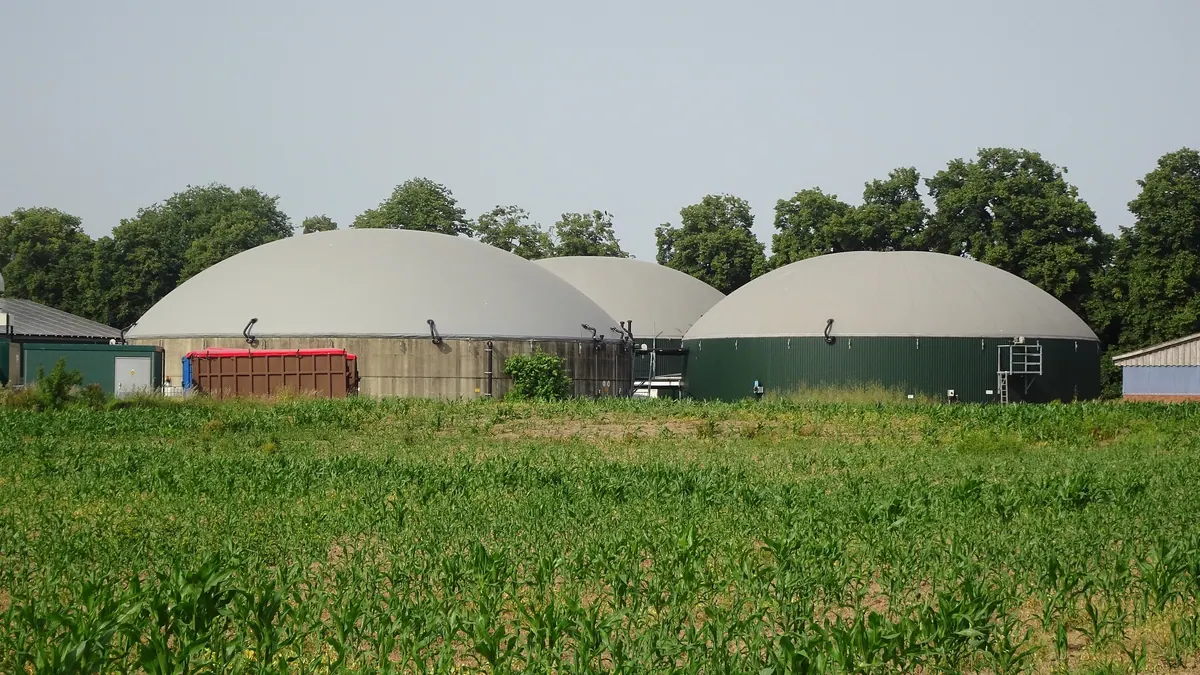
The double-membrane roof of a digester is the cheapest solution per cubic metre and usually suffices for an hourly buffer. For greater requirements the following are considered:
- a separate gas holder (membrane, with a double-membrane roof, ground-based);
- increasing the capacity by adding a post-digester with a gas roof;
- changing the operating mode, e.g. limiting peak output, if the cost of the storage outweighs the benefit.
For each solution, safety issues must be taken into account: the larger the volume of gas in one place, the greater the consequences of a failure, and this affects the distances and the requirements of regulations and of the insurer. Technical details of double-membrane roofs are described in the article on biogas storage with a double-membrane roof.
Conclusion
Sizing the storage capacity is an exercise in balancing: first it is established how long offtake can be lower than production, then this is multiplied by the surplus, a reserve is added and the result is converted to operating conditions. Only then is it checked whether the roof can carry it. The reverse approach, i.e. adjusting the mode of operation to the capacity available, is justified only when expanding the storage is uneconomic.
Sources
Related articles