Tanks and membranesExplainer
Methane permeability of membranes: does the roof let gas through and what is the scale of diffusive emissions
Every polymer lets gases through to a minimal degree. We explain the difference between diffusion through the material and a mechanical leak, and the scale of emissions.
Other language versions: Polski, Deutsch, Español, Français, Italiano, Nederlands.


The question of whether a membrane roof lets methane through always arises when the conversation turns to the emissions balance of a biogas plant. The short answer is: a trace amount of gas permeates every polymer, but in practice mechanical leaks, not the material itself, determine the losses. For a proper assessment, however, one has to understand what permeation consists of, which factors increase it and where the boundary lies between a physical phenomenon and damage.
Permeation through a polymer, or how gas passes through a material
The passage of gas through a polymer film or coating consists of three stages: dissolution of the gas in the material on the high partial pressure side, diffusion through the thickness of the layer and desorption on the low pressure side. The flow is greater the greater the methane partial pressure difference, the greater the area and the thinner and more permeable the layer. In simplified terms:
- the flow increases in proportion to the area and to the partial pressure difference;
- it decreases in inverse proportion to the thickness;
- it increases exponentially with temperature, because the mobility of the polymer chains rises.
The value of the permeability coefficient depends on the material, and different plastics (e.g. polyolefins, PVC, rubbers) have different permeability. The general conclusion for the operator is that exact figures for a given membrane should be sought in the manufacturer's data or in tests, not in general tables.
Why the figures must be treated with caution
The available studies indicate that the permeation flow for typical roof membranes is usually smaller than leaks from damage, but the data are scattered, and measurements at real installations often cover all sources together. For this reason we do not give a single figure here. When assessing a facility it is worth remembering that:
- the roof area of a digester or storage tank can be several hundred square metres;
- the inner membrane is in direct contact with biogas, which usually contains about 50-65 percent methane;
- over the years the properties of the material change: ageing, microcracks and fatigue increase permeability;
- condensate and moisture can affect the permeability of some materials.
Quantitative conclusions for a specific installation require measurement or manufacturer data.
Diffusion versus mechanical leaks
The distinction is important because the remedies are different. Diffusion is a uniform phenomenon, invisible and independent of the quality of installation; it can be reduced mainly through the choice of material and construction. A mechanical leak is a local loss: a weld, perimeter, penetration, valve, damage. It is usually easy to detect with a detector or camera and to repair, and its share in the balance is significant.
In operating practice the greatest gain comes from inspection measures: visual checks, inspection of the perimeter and penetrations, monitoring of the blower and pressure. Details are given in the articles on roof inspection and on leak detection and repair.
The role of a double-membrane roof
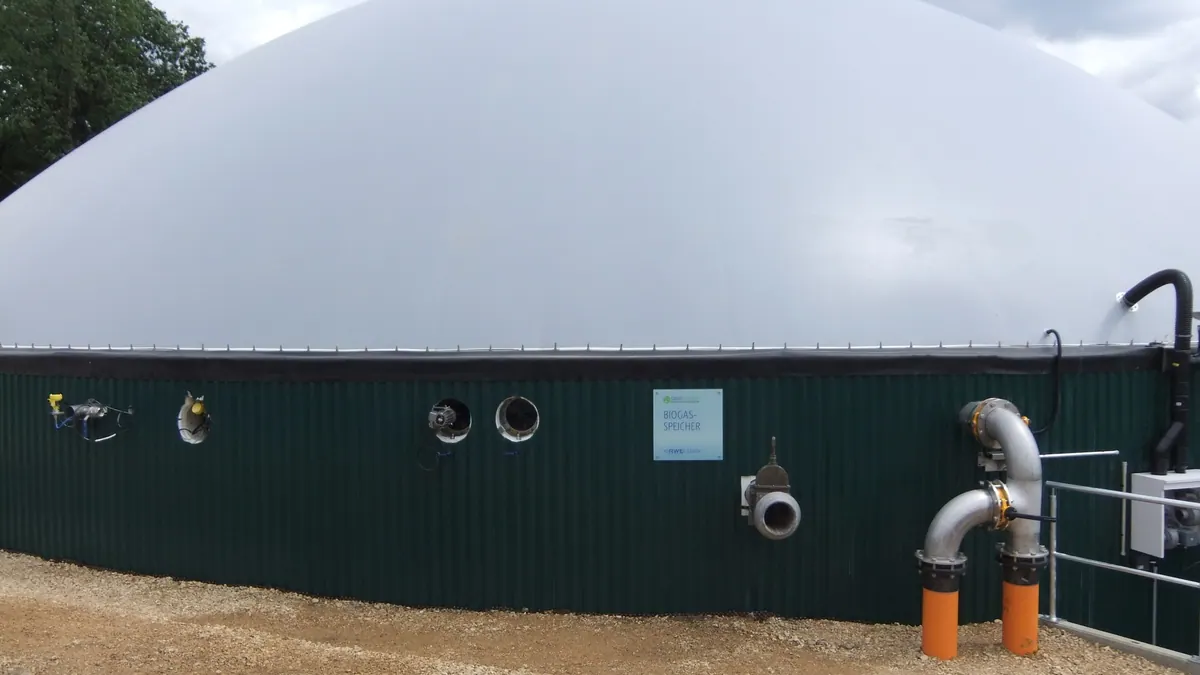
In a double-membrane roof there is air between the inner and the outer membrane. Gas permeating the inner membrane collects in this space and can be vented from it, and the outer membrane also acts as a shield against weather and UV radiation, which extends the life of the inner one. This design does not eliminate methane emissions, but changes the way they are monitored: measuring the methane concentration in the inter-membrane space can be an indicator of the tightness of the inner membrane.
Regulatory context
Regulation (EU) 2024/1787 introduces obligations on measurement, reporting and reduction of methane emissions in the energy sector, with special provisions for oil, gas and coal, among others, and its scope with respect to biogas and biomethane must be read from the definitions and the specific provisions. The regulation has been in force since August 2024, and individual obligations have their own application dates. The scope of requirements for a specific biogas plant, e.g. for an installation producing electricity rather than biomethane, should be checked on the basis of the current text of the regulation and national regulations.
How to distinguish diffusion in a measurement
In practice it is not possible to separate diffusion from small leaks with a handheld detector alone. The balance of the whole installation shows the sum of all sources, and the share of diffusion can be inferred only after local leaks have been eliminated. Methods of measuring emissions are described in the article on measuring methane emissions from a biogas plant, and the sources of losses in the text on methane emissions from biogas plants. We describe membrane materials in the article on PVC, PE and EPDM membranes. EU regulations are discussed in a separate entry on the methane regulation 2024/1787.
What this means for the operator
- Diffusion is not a cause for concern compared with leaks, but choosing a membrane with low permeability is justified when ordering.
- Permeability data are worth including in the order specification, if the supplier has them.
- Ageing of the material increases permeability, so replacing the membrane also has an emissions aspect.
- Measuring the methane concentration between the membranes or at the perimeter is a cheaper assessment method than examining the entire balance.
- The most can be gained by eliminating local leaks, not by arguing over fractions of a percent of diffusion.
Sources
Related articles