Operation and failuresAnalysis
Power outage and digester heating: what happens to the process?
A large digester cools slowly, so temperature alone is rarely the first problem in a power outage. We estimate the cooling rate and discuss the real risks and safeguards.
Other language versions: Polski, Deutsch, Español, Français, Italiano, Nederlands.
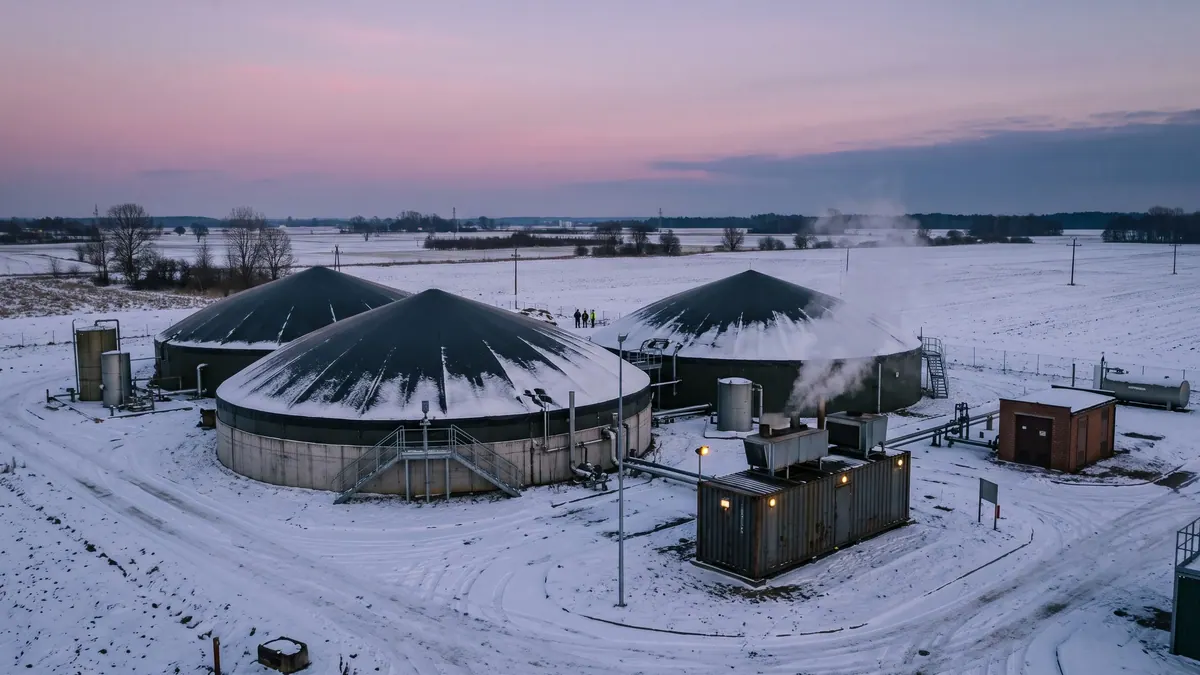
A power outage rarely means rapid cooling of the digester. The large mass of feed, several thousand cubic metres with a heat capacity close to that of water, has enormous thermal inertia. Much sooner than the process temperature, other consequences of the loss of power become the problem: the stopping of mixing, pumps and safety systems, and difficulties in managing the gas. The question "how quickly does the digester cool" is therefore important, but it is not the first one that has to be answered.
Estimating the cooling rate
The calculation below is illustrative and shows the order of magnitude, not a result for a specific plant. Let us assume a cylindrical tank with a diameter of 20 m and a shell height of 10 m, that is, a volume of the order of 3000 m³ (about 3000 tonnes of feed). The surface area of the side walls and roof is of the order of 940 m² (the bottom is neglected because it gives up heat to the ground). With a heat transfer coefficient of insulated walls of the order of 0.3 W/(m²·K) and a temperature difference of 45 K (inside about 40 °C, outside about −5 °C), the heat loss is about 940 · 0.3 · 45 ≈ 12.7 kW. The energy needed to lower the temperature of the feed by 1 K is about 3000 t · 4.0 MJ/(t·K), that is, about 12,000 MJ, which corresponds to 3.3 MWh. This means that a temperature drop of 1 K takes on the order of 260 hours, that is, more than 10 days.
The result must be treated with caution. Real losses are greater than this simplified calculation, because thermal bridges, contact of the bottom with the ground, wind, condensation, a membrane roof with poorer insulation, and pipes and fittings outside the tank all come into play. Even so, the conclusion is stable: in large tanks the temperature drop over a day is as a rule a fraction of a degree, or a few degrees in extremely unfavourable conditions. Small tanks, without insulation or with cold feed, cool much faster.
Sensitivity of the biology
Mesophilic consortia tolerate temperature fluctuations of a few degrees over a day, thermophilic ones much less so. In practice a short interruption of heating should not lead to permanent damage. Prolonged cooling or abrupt re-heating becomes the problem. After operation resumes, the temperature is raised gradually, as described in the article on starting up a digester after winter.
What actually poses a threat in a power outage
| System | Effect of loss of power | Risk |
|---|---|---|
| Agitators | mixing stops | stratification, sediment, scum layer, harder restart |
| Heating circuit pumps | no heat transport from the CHP or boiler | temperature fall over a longer time |
| Feed and digestate pumps | no transport | overfilling or inability to transfer |
| Gas detection, safety systems | loss of supervision | gas safety risk |
| Outer membrane blower | loss of envelope tension | sensitivity to wind and snow |
| Flare and fittings | no control | problem with emergency gas disposal |
In addition, the CHP unit may stop while gas production continues. The gas has no consumer, the pressure in the store rises and has to be managed in line with the design: through the emergency flare or safety valves. If these systems depend on electricity, emergency power is a condition of safety. See biogas plant emergency plan.
Emergency power: priorities
- Automation and gas safety systems (control systems, gas detection, shut-off valves, flare).
- Selected agitators and systems without which a safe state cannot be maintained.
- Heating circuit pumps, when the outage is long or the frost severe.
- Other loads as far as the generator allows.
The source may be a generator set, a UPS for critical automation and, in some arrangements, island operation of the CHP, if it is provided for and approved by the grid operator. The capacity and autonomy are determined on the basis of a risk analysis, and the procedures for starting emergency power should be described in the plant's instructions and rehearsed. When an outage is planned, during grid work, it is worth planning feeding and mixing so as to limit the effects.
Winter and freezing
In winter a long power outage carries an additional risk of freezing of condensate, pipes and fittings, especially if the anti-freeze heating is electric. This is described in the article on biogas plant operating procedures in winter conditions. Critical points of outdoor fittings are therefore worth supplying from a system with enhanced reliability or protecting in a way that does not depend on electricity.
After power is restored
- First check the condition of the safety systems and fittings, and only then start further loads.
- Switch on agitators in line with the instructions, because after a long standstill they may be loaded with sediment.
- Do not resume full feed rates at once; start from the assessed biological parameters (VFA, pH, alkalinity).
- Record the course of the event and the conclusions. If the event recurs, consider improving the emergency power or adding extra heat offtake.
Factors that change the calculation
The calculation changes with several parameters. Cold feed added in a large amount lowers the temperature faster than losses through the walls, because heating a cold mass requires a great deal of energy: adding several dozen tonnes of feed at a temperature close to zero may lower the temperature by a fraction of a degree to a few degrees, depending on the tank volume. Wind increases convective losses from outer surfaces, and a membrane roof has poorer insulation than a wall. Tanks with a smaller volume relative to surface area (the surface-to-volume ratio) cool faster. If there are pipes and exchangers nearby with a liquid that can freeze, they should be considered separately, because their heat capacity is negligible.
Conclusion
In a power outage a large digester has time in hand as far as temperature is concerned, but not as far as gas safety and auxiliary functions are concerned. An emergency plan should therefore protect above all the safety systems and gas management, and only secondarily the thermal comfort of the process.
Sources
Questions and answers
How long can a digester last without heating?
It depends on volume, insulation, ambient temperature and wind. Large, well-insulated tanks cool slowly, usually by fractions of a degree up to a few degrees per day, while small or poorly sheltered ones cool faster. The rate is best assessed from temperature records of previous winters or from a heat balance.
Related articles