

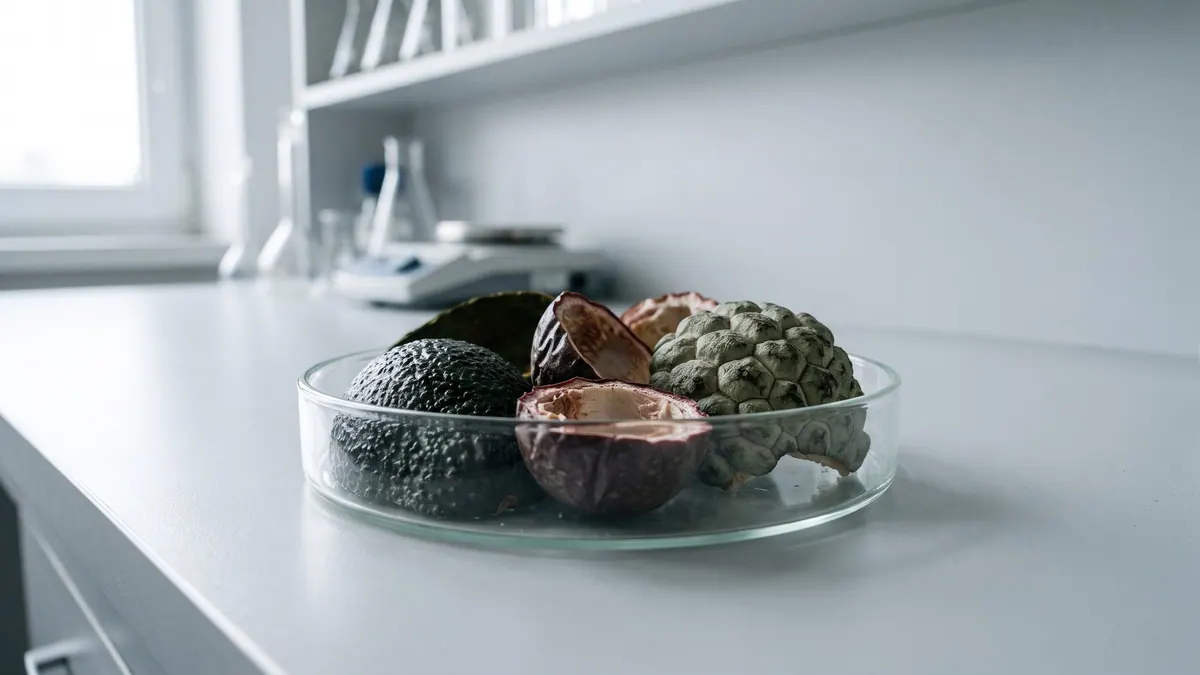
BMP testingFruit, vegetables and their residuessingle study (4 samples)
Tropical fruit peels (avocado, passion fruit, sugar-apple, mangosteen) — BMP: 4 studies, mean 102 m³ CH₄/t VS
Peels of avocado, passion fruit, sugar apple and mangosteen are four different materials from one study; their common feature is a higher share of dietary fibre and phenolic compounds.
Illustration: FeedstockData (AI, Google Gemini)
- Weighted mean
- 102m³ CH₄/t VS
- Range
- 35–195m³ CH₄/t VS
- Records
- 4single study (4 samples)
- Publications
- 1source
- Temperatures
- —of the test
Methane in biogas
Medium methane content · ≈ 5.2 kWh/m³ of biogas
estimate from the substrate type The collected studies contain no measurement. The interval follows from the approximate composition (protein from total nitrogen (N 1.4 % DM × 6.25)) and the yields of compound groups according to FNR.
Rating for biogas plants
not rated — editorial rating for biogas plants
Not rated: no dry matter or volatile solids in the data. We calculate the rating when the dry matter and volatile solids of the material are known.
Add to the co-digestion calculator CSV data
BMP curves from 4 studies
Weighted mean Individual records
Dashed lines are a model curve (first-order kinetics, B(t) = B₀·(1 − e−kt)); the end point comes from the publication. All curves are model curves.
Cumulative methane production over the test [m³ CH₄/t VS]. The thick line is the weighted mean of all records (102); dots mark the end values given in the publications. Point at the chart to read values; click a legend item to hide or show a record.
Records and sources
Download CSV| Source | BMP m³ CH₄/t VS | Temperature | Sample | Curve |
|---|---|---|---|---|
| Zhao et al. (2016) · 1 DOI | 35 | — | Mangosteen (Garcinia mangostana) – Shell | end point (model curve) |
| Zhao et al. (2016) · 2 DOI | 88 | — | Sugar-apple (Annona squamosa) – Peel | end point (model curve) |
| Zhao et al. (2016) · 3 DOI | 90 | — | Avocado (Persea americana) – Peel | end point (model curve) |
| Zhao et al. (2016) · 4 DOI | 195 | — | Passionfruit (Passiflora coerulea) – Peel | end point (model curve) |
| Weighted mean | 102 | arithmetic mean 102, SD 67 | ||
Typical composition
- Volatile solids (VS)
- 92.9 % DM (range 88.8–97.3)
- Nitrogen
- 1.4 % DM
- C/N ratio
- 39.7
Median and range of the determinations reported in the publications behind this substrate's BMP records (read from: BCBPD); dry matter: 0 determinations, volatile solids: 4 determinations. C/N was calculated as the ratio of C and N content (% DM) from the same source. No DM in the sources – the calculator has to ask for a value.
Sources: Zhao et al. (2016).
The composition of the raw material varies between batches — for plant calculations use an analysis of your own sample. The calculator inserts typical values automatically.
Process properties
Low confidence: the description is based on general characteristics of the substrate group, not on studies of this material. Treat it as a hint to be verified.
No published process studies
The literature we use does not describe the advantages or drawbacks of digesting this substrate beyond the BMP test results. Below are process characteristics assigned on the basis of the type of material — an editorial classification, not a study result.
- fibrous
- lignocellulose, long fibres → floating layer, harder mixing, slow degradation
- slowly degrading
- slow degradation, requires a long retention time
- seasonal
- seasonal availability — requires storage
- variable composition
- high variability of composition between batches
- dilutes the feed (low DM)
- low dry matter, dilutes the feed
Co-digestion — what to combine it with, what to watch out for
- combines well
substrates: easily degradable — e.g. Maize silage (whole crop), Food waste, Sorghum, whole crop, Whey, Beet leaves and tops
In BMP studies, easily degradable substrates increased the yield of the mixture with slurry (synergy in some mixtures).[1]
Dosing
No source limits on the dose for this substrate.
Sources of the process data
- Biochemical methane potential and biodegradability of complex organic substrates
- Bio-energy conversion performance, biodegradability, and kinetic analysis of different fruit residues during discontinuous anaerobic digestion
- Improvement of fruit and vegetable waste anaerobic digestion performance and stability with co-substrates addition
- Effects of size and thermophilic pre-hydrolysis of banana peel during anaerobic digestion, and biomethanation potential of key tropical fruit wastes
- Effect of particle size on biogas generation from biomass residues
The co-digestion calculator will assess a specific mixture containing this substrate.
What it is and where it comes from
Tropical fruit peels are a waste arising in the production of juices, pulps and preserves and in catering. The dataset groups four species studied in one paper: avocado (Persea americana), passion fruit (Passiflora), sugar apple (Annona squamosa) and mangosteen (Garcinia mangostana). These materials have very different structures: avocado peel is thin and flexible, passion fruit peel is hard, and the pericarp of mangosteen is thick and rich in tannins. The entry therefore does not describe a single feedstock, but several related ones.
Properties relevant to digestion
Fruit peels contain more cellulose, hemicelluloses and pectins than the pulp, and in many cases also polyphenols, including tannins (particularly mangosteen). At high concentration these compounds inhibit enzymes and may slow hydrolysis. Avocado peel additionally contains lipids and aromatic compounds. The protein content is low, so the risk of ammonia is small, and the high C/N ratio favours combining with nitrogen-rich wastes. Chopping eases contact with the inoculum.
How to read the spread of results
The records come from one study, and the differences between them mainly reflect the composition of the species, not laboratory variability. In addition, the temperature is not given in the dataset. The result is affected by variety, ripeness, the share of pulp remnants on the peel, chopping, moisture content and, above all, the content of phenolic compounds. The mean of four different species is not a sensible design parameter, so values for the specific feedstock should be used for planning.
In biogas plant practice
In Poland tropical fruit peels reach biogas plants sporadically, usually in a mixture of fruit wastes. For plants able to accept processing waste, it is important to sort out contaminants (packaging, plastic, labels) and to chop. The dose of tannin-rich peels is worth limiting. For a constant stream from a specific processing plant, a BMP test is recommended, because the proportions of peel and pulp remnants change the result.
Methodology in brief
BMP is the amount of methane obtained from volatile solids (VS) in a batch test, given in m³ CH₄ per tonne of VS (numerically the same as NmL CH₄/g VS in the publications) and converted to normal conditions (0 °C, 101.325 kPa). The weighted mean gives each publication a total weight of 1, split equally between its results for the substrate — a paper testing twenty varieties does not outweigh a paper with a single sample. In inter-laboratory programmes the unit is the laboratory (total weight 1), and within it the weight of a test grows with the number of bottles (replicates). Results after pretreatment (e.g. thermal, chemical, enzymatic) are shown separately and are not included in the mean.
Solid lines are curves measured in the tests. Where a publication gives only the final result, we draw a first-order kinetic model, B(t) = B₀·(1 − e−kt): only the end point comes from the publication, and the shape of the curve serves purely as visualisation — do not read the production on a particular day from it. For this substrate k = 0.245 d−1 was assumed (median of rate constants k reported in the sources and/or fitted to the mean measured curves).
The statistics describe the spread of published results — a descriptive compilation, not a meta-analysis or a guarantee of plant yield.
Bibliography
- Zhao, C.; Yan, H.; Liu, Y.; Huang, Y.; Zhang, R.; Chen, C.; Liu, G. (2016). Bio-energy conversion performance, biodegradability, and kinetic analysis of different fruit residues during discontinuous anaerobic digestion. Waste Management 52, 295–301. DOI: 10.1016/j.wasman.2016.03.028 DOI
All sources of the site: bibliography.
Other substrates in the group “Fruit, vegetables and their residues”
Dragon fruit (pitaya) peels — BMP: 3 studies, weighted mean 87 m³ CH₄/t VS
87 m³ CH₄/t VS weighted mean from 3 studies
≈53 %
Cauliflower — BMP: 2 studies, weighted mean 274 m³ CH₄/t VS
274 m³ CH₄/t VS weighted mean from 2 studies
≈59 %
Cassava peels — BMP: 4 studies, weighted mean 268 m³ CH₄/t VS
268 m³ CH₄/t VS weighted mean from 4 studies
≈52 %
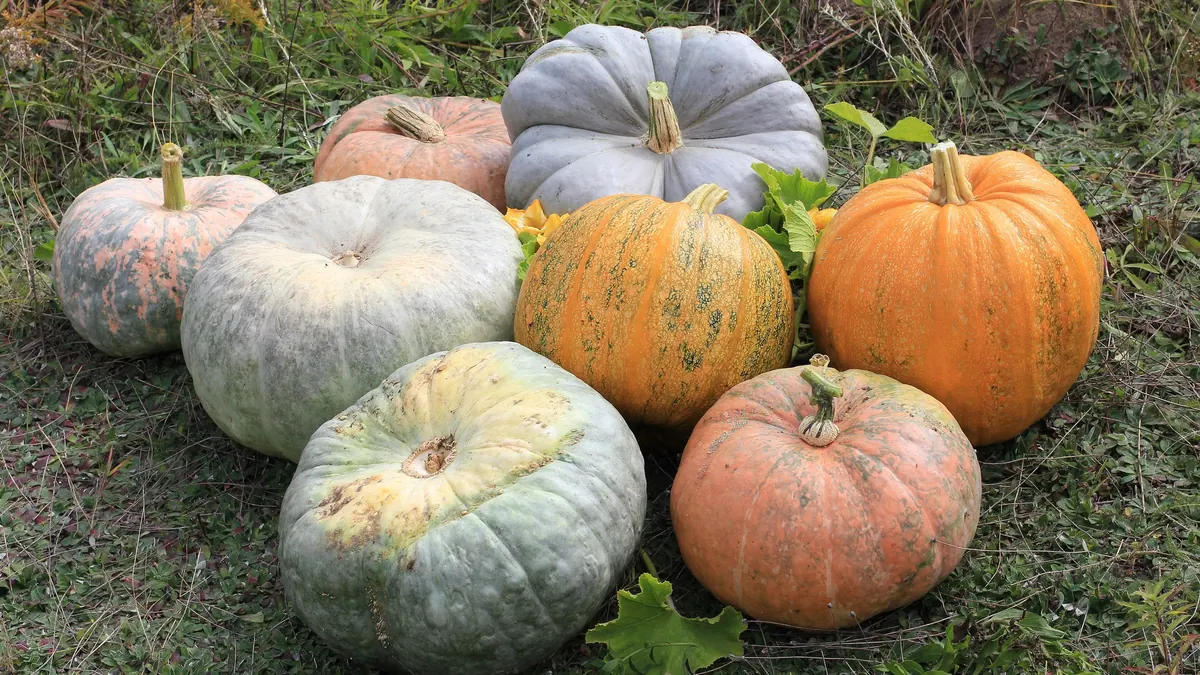
Pumpkin — BMP: 7 studies, weighted mean 341 m³ CH₄/t VS
341 m³ CH₄/t VS weighted mean from 7 studies
neutral — editorial rating for biogas plants≈52 %