
Technology and operationAnalysis
Emergency combustion of biogas, part 2: open and enclosed flares, efficiency, emissions and selection
How flare combustion efficiency is assessed, why an open flare is hard to measure reliably, what affects emissions and how to choose the type of flare.
Other language versions: Polski, Deutsch, Español, Français, Italiano, Nederlands.
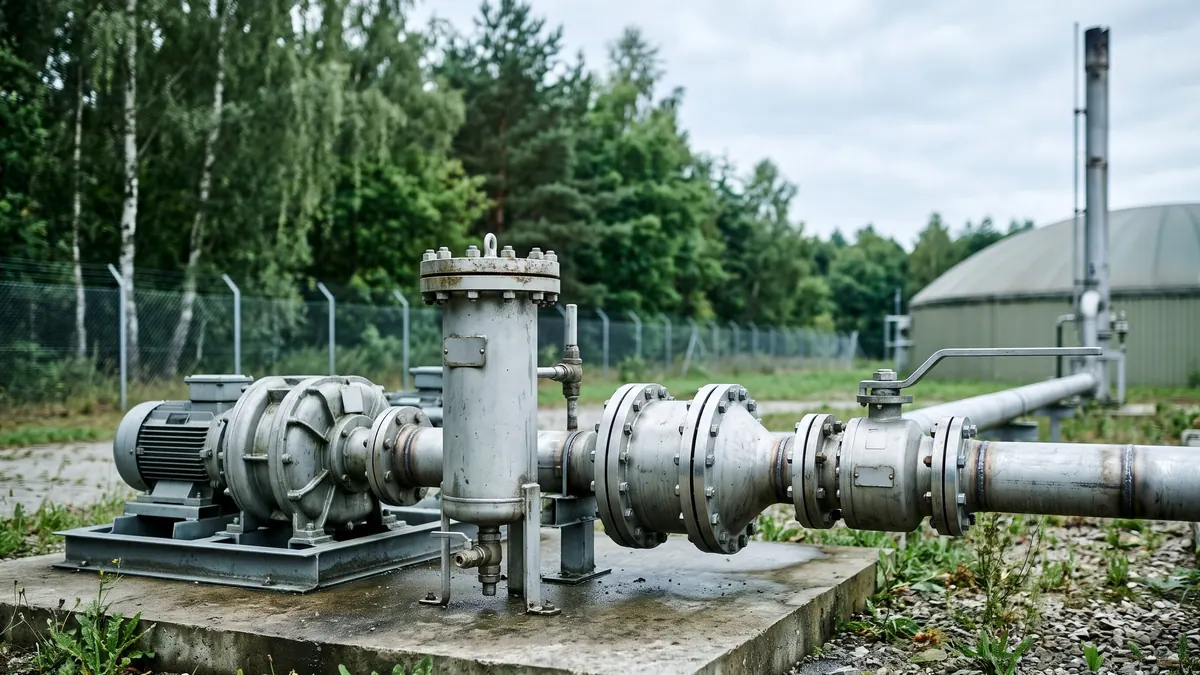
A flare burns excess biogas, but the quality of that combustion depends on the design and operating conditions. An enclosed flare makes it possible to control the temperature, mixing and residence time of the gas in the combustion zone, so its efficiency can be measured (by sampling the flue gas) and documented. In an open flare, dilution of the flue gas with air makes reliable measurement very difficult. This article is part of the series "Emergency combustion of biogas"; the basics of flare construction can be found in the text Flare in a biogas plant: construction, requirements and safe operation, and the context of requirements in part 1 of the series. Here we focus on comparing efficiency, emissions and selection.
How a flare works and what efficiency depends on
A flare oxidises methane and other combustible components to CO₂ and water. Efficiency depends on three things that recur in American and international materials: flame temperature, the residence time of the gas in the combustion zone, and turbulence, that is, mixing with air. The EPA cost manual states that a flare designed to promote mixing gives almost complete (on the order of 98%) destruction of combustible components, and US regulations (40 CFR 60.18) require a flare stream heating value of at least 300 Btu per cubic foot (about 11 MJ/m³). For biogas this means that a very low methane content (start-up, process disturbances) can reduce flame stability.
Default efficiencies in accounting methodologies
The UNFCCC AMT-004 methodology (Article 6.4), concerning project emissions from flaring, assumes for an open flare a default methane destruction efficiency of 50%, provided a flame is detected; for an open flare it provides no measurement, only the default value. For an enclosed flare the project participant may apply the default value of 90% if the temperature and gas flow are within the manufacturer's specification and a flame is detected, or may measure the efficiency. For low enclosed flares (a combustion chamber with a height of two to ten enclosure diameters) 10 percentage points are subtracted from the default value. These figures are conservative accounting values in a specific methodology, not measurement results or general normative values for every installation. In an open flare ambient air mixes with the flue gas, which in practice makes a representative measurement impossible. Suppliers of open flares usually quote higher values, but these should be treated as manufacturer declarations, not as measured parameters of a specific installation.
Comparison of types
| Feature | Open flare | Enclosed flare |
|---|---|---|
| Control of temperature and air | limited | designed, measured |
| Measurement of efficiency | practically impossible | possible (flue gas sampling) |
| Effect of wind | large | usually smaller |
| Flame visibility and noise | greater | smaller |
| Siting requirements | usually greater distances | usually smaller |
| Installation cost | usually lower | usually higher |
| Application | where permits allow | often specified in permits, especially near buildings |
The comparison in the table is indicative and depends on the design, capacity, local regulations and the decision of the authority. There is no single range of capital costs that would be true for every installation; they depend on capacity, equipment and the offer. The methodology for estimating flare costs is described in the chapter of the EPA cost manual (concerning mainly tall, steam-assisted flares), so do not transfer its figures directly to a biogas plant or to prices in PLN. More on the effect of combustion on emissions is given in the text Methane emissions from biogas plants.
Emissions: methane, CO and NOx
Combustion converts methane to CO₂ and is therefore preferable to releasing the gas into the air. Unburned methane (so-called slip) is the main climate loss of a flare, and efficiency determines its size. Emissions of CO and nitrogen oxides depend on temperature and burner design; we give no reliable numerical values for biogas flares because they result from measurement of a specific device. The measurement result should be in the device documentation or in the decision. The BAT conclusions for waste treatment (BAT 16) indicate techniques for limiting emissions from flares, including proper design and monitoring and recording, where its use is unavoidable, so it is worth agreeing the choice of type with the authority at the permitting stage.
Equipment important for operation
- automatic ignition and flame control, a shut-off valve that closes automatically,
- a compressor (blower) providing the required gas pressure upstream of the burner (according to SVLFG, the German agricultural social insurance body),
- a flame arrestor and drainage upstream of the burner,
- an operating range from minimum to maximum gas flow,
- integration of the flare into the emergency power concept,
- siting: distances from buildings and roads, shielding of hot elements and protection against vehicle impact.
The specific values of distance and height given in the 2013 German SVLFG material (including an outlet at least 5 m horizontally from buildings and roads and at least 3 m above ground, shielding of hot parts to a height of 2.70 m) are an example. In Poland the design documentation and fire regulations apply, and the scope is determined by the designer.
Choosing a manufacturer
Many manufacturers in Europe offer enclosed flares for biogas. When comparing offers, ask about the flow range, behaviour at low methane content and the time from signal to full operation, and verify the parameters in datasheets and references from operation on biogas.
How to choose
- Check what the permit says about the type of flare and about measurements.
- Assess the location: distance from buildings, noise, flame visibility.
- Define the flow range: maximum production and the lowest stable operation.
- Decide whether a measurement of efficiency or emissions is needed.
- Ask the manufacturer about the time from signal to full operation and about behaviour at low methane content.
- Take into account servicing, parts and the periodic test in line with the documentation.
The most common misconceptions
"An open flare is cheaper, so it is enough." A lower purchase price is sometimes true, but the permit may specify an enclosed type, and the inability to measure efficiency makes it harder to demonstrate compliance with requirements. It is good to establish this before purchase, not after acceptance.
"High temperature always means complete combustion." Temperature is one of three factors, alongside residence time and mixing. An enclosed flare provides tools for controlling these parameters, but requires correct operation: clean burners, working sensors and the right flow range.
"A flare sized for average production is enough." It is sized for the maximum flow that may occur, with a margin for peaks after a change of substrates or foaming. A flare that is too small will not burn all the gas and the safety valve will operate.
"A flare operation log is unnecessary." Data on hours and causes is the basis for investment decisions and may be required in the permit, so it is worth keeping from the outset.
This text does not replace a design. The flare parameters are chosen by the designer, taking into account the permit conditions and regulations.
Sources
Questions and answers
How does combustion efficiency differ in an open and an enclosed flare?
In an enclosed flare combustion takes place in a shroud, so temperature and air supply can be controlled and the flue gas measured, whereas in an open flare ambient air mixes with the flue gas and a reliable measurement of efficiency is practically impossible.
Must a biogas flare have its own blower?
German material from the agricultural accident insurer SVLFG (as of 12/2013) indicates that a flare needs a compressor (blower) to provide the required gas pressure ahead of the burner.
Related articles