
InnovationAnalysis
How much is biogenic CO₂ from biomethane plants worth: scale, purity and logistics decide profitability
Liquefying waste CO₂ from biogas upgrading is a commercial technology, but profitability is decided by scale, food-grade purity and distance to the customer. The mechanism and the conditions.
Other language versions: Polski, Deutsch, Español, Français, Italiano, Nederlands.
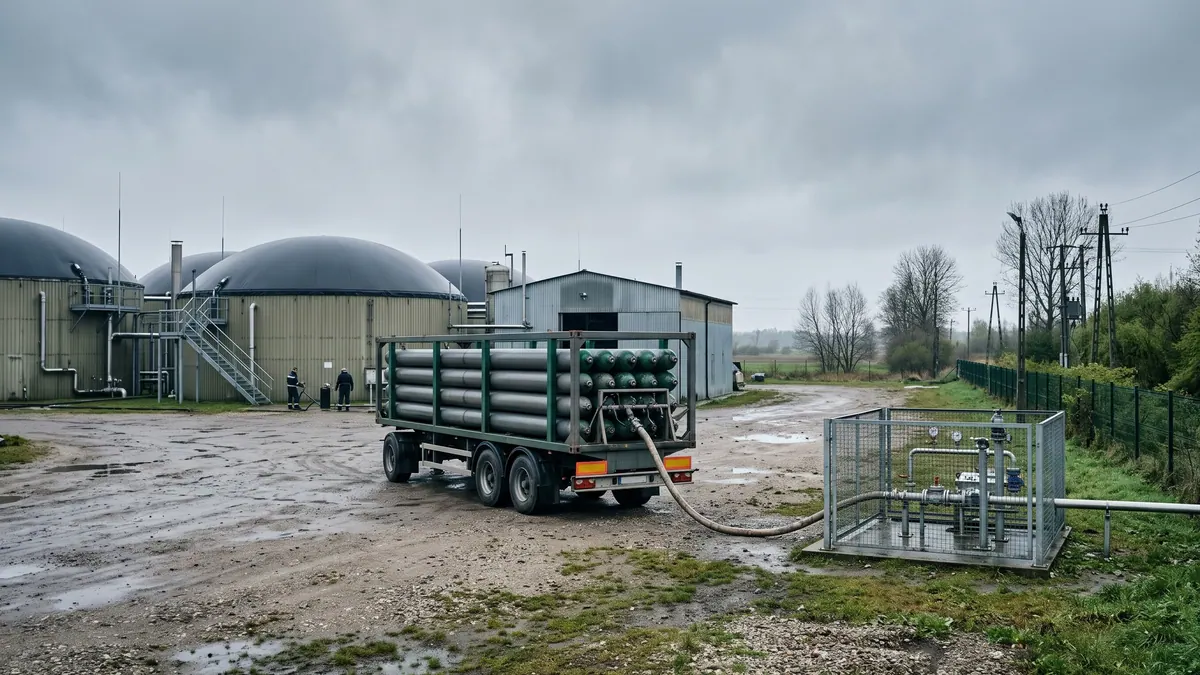
Raw biogas usually contains from a dozen or so to several tens of percent CO₂ by volume (most often around 30–50%), and upgrading to biomethane consists essentially of separating methane from this carbon dioxide. The CO₂ stream is therefore an unavoidable "second product" of every biomethane plant. For years it was simply vented to the atmosphere (after oxidation of residual methane). Liquefying and selling this gas is one of the few innovations at biogas plants that already has real commercial deployments. The question is not "does it work" but "when does it add up".
Where the CO₂ comes from and how pure it is
The composition of the stream depends on the upgrading technology. In an amine scrubber, CO₂ is desorbed during regeneration of the solution and comes out as a high-concentration stream. In membrane separation and in PSA, the off-gas contains CO₂ together with residual methane, which must be removed or oxidised before the gas goes to liquefaction. The review by Angelidaki et al. (2018) sets out these differences. Details of how individual methods work are described in earlier articles: membrane upgrading, amine scrubbing and cryogenic separation with bioLNG.
Regardless of the source, the gas is moist and carries trace impurities: sulphur compounds, volatile organic compounds and sometimes siloxanes. Removing them usually consists of drying, adsorption on activated carbon and additional polishing stages. The requirements for gas entering the liquefier are described in the article on gas parameters for CO₂ liquefaction.
How liquefaction works
The process has several stages: compression, drying, removal of trace impurities, cooling to liquefaction and storage in thermally insulated pressure tanks. The CO₂ is stored as a liquid at elevated pressure and at a temperature well below zero, and is carried away by tanker. The cost of electricity and cooling is a significant item in operation, so the efficiency of the whole system counts, not only the price of the equipment.
Where it already works
The best-described example in the industry literature is the plant in Nesselnbach in Switzerland, fed with biogas from food waste. According to the technology supplier (HZI) and the IEA Bioenergy Task 37 study, the liquefier, fed with off-gas from biogas upgrading, produces food-grade CO₂, and its capacity is given as up to 3,000 tonnes per year (supplier) or up to 4,000 tonnes per year (IEA Task 37) (the sources describe the design and declared values differently, so they are worth treating as an order of magnitude). An important sentence in these descriptions: according to the operator, the sale of CO₂ alone does not cover production costs, and additional revenue comes from the sale of CO₂ offset certificates (according to the operator, an important element of the model). This is the operator's statement, but it captures the market logic well: CO₂ is sometimes a low-margin commodity, and the "green" attribute decides the advantage.
Similar liquefaction projects have been described in North America and in Western Europe. Their technical and commercial details are usually company announcements, so in assessing them facts must be separated from claims.
Maturity and availability
CO₂ liquefaction is a fully commercial technology (TRL 8–9 in the editorial team's indicative assessment based on the described commercial deployments; see the overview of technology maturity). The equipment is offered by industrial gas suppliers and manufacturers of upgrading installations. What is new is not the technique itself but its application to the smaller streams produced by biomethane plants.
What determines profitability
| Factor | Why it matters |
|---|---|
| Annual mass of CO₂ | Fixed costs (compressors, cooling, tanks, staffing) are spread per tonne; small streams are clearly more expensive per tonne |
| Required purity | Food-grade CO₂ requires additional cleaning stages and analytics; industrial and greenhouse grades are sometimes less demanding |
| Distance to the customer | Tanker transport adds a tonne-kilometre cost; long routes can eat up the margin |
| Contract | A customer with a long contract and year-round offtake stabilises the investment |
| Climate attributes | Biogenic origin may have value if it is supported by a certification or accounting system |
| Energy | The price of electricity for compression and cooling |
There are several groups of customers: the food and beverage industry, greenhouses, dry ice production, industrial uses and, in the longer term, synthetic fuels from CO₂ and H₂ and geological storage (see uses of biogenic CO₂ and BECCS). Each of these groups has different requirements and a different ability to pay.
Barriers
The first barrier is scale: many installations, especially agricultural ones, produce too little CO₂ for a liquefier to make economic sense on its own. The second is purity: food-grade quality requires constant monitoring and documentation, and a rejected batch is costly. The third is the market: the customer must exist within logistical reach, and competing sources of CO₂ are sometimes streams from other industrial processes. The fourth is uncertainty about climate attributes: the value of biogenic CO₂ depends on rules that are changing, so it is worth checking them at the moment of decision rather than assuming them as permanent.
What this means for a Polish biomethane plant
A Polish biomethane plant should treat CO₂ like any by-product: first estimate the annual mass from the installation balance, then check who within a radius of several hundred kilometres buys liquid CO₂ and of what quality, and finally calculate the cost of energy and logistics. A well-designed upgrading installation leaves room for later connection of a liquefier (space for tanks, a connection point, a separated off-gas stream). For projects that are already planning shared infrastructure, e.g. a gas pipeline and CO₂ offtake (see the Ambassador project), the calculation is sometimes more favourable than for a single installation.
This article is informational: it does not recommend any technology supplier, and the figures cited from industry studies are the claims of their authors.
Sources
- IEA Bioenergy Task 37 — Case story: renewable CO₂ from food-waste-based biogas (Szwajcaria)
- Kanadevia Inova (HZI) — CO₂-Verflüssigung in Nesselnbach offiziell eröffnet (2023)
- Angelidaki et al. (2018), Biogas upgrading and utilization: Current status and perspectives — Biotechnology Advances
- EIGA — European Industrial Gases Association (dokumenty jakości CO₂)
Questions and answers
Can CO₂ from biogas upgrading be food-grade?
Yes, but it requires additional purification and constant quality control, because biogas carries trace contaminants. The CO₂ stream from biogas may contain sulphur compounds, volatile organic compounds and moisture, so drying, adsorption and polishing are applied before liquefaction, and the finished product is tested against the customer's specification, e.g. one based on industrial gas industry documents. The Nesselnbach plant is described in an IEA Bioenergy publication as one of the few in Europe supplying food-grade biogenic CO₂. A batch that fails to meet the requirements is costly, which is why food-grade quality is the most expensive option for utilising CO₂.
From what quantity of CO₂ is liquefaction at a biomethane plant worthwhile?
There is no single threshold figure, because everything depends on the cost of energy, the purity required by the customer and the distance to the customer. The fixed costs of a liquefier, that is, compressors, cooling, tanks and operation, are spread over each tonne of gas, so smaller streams are more expensive per unit. In the description of the Nesselnbach plant (Switzerland, a liquefier with a capacity of up to 4000 t of liquid CO₂ per year) it is stated that the sale of gas alone does not cover production costs, and the additional revenue comes from CO₂ compensation certificates. For this reason, before a decision the CO₂ balance from upgrading, the contract with the customer and the cost of tanker transport are calculated, rather than the tonnage threshold alone.
Related articles