
BMP testingAnalysis
Distillery stillage in a biogas plant: a complete guide to the substrate
Distillery stillage is a liquid residue of distillation with a high organic load. Properties, methane yield, process risks and logistics at a biogas plant.
Other language versions: Polski, Deutsch, Español, Français, Italiano, Nederlands.
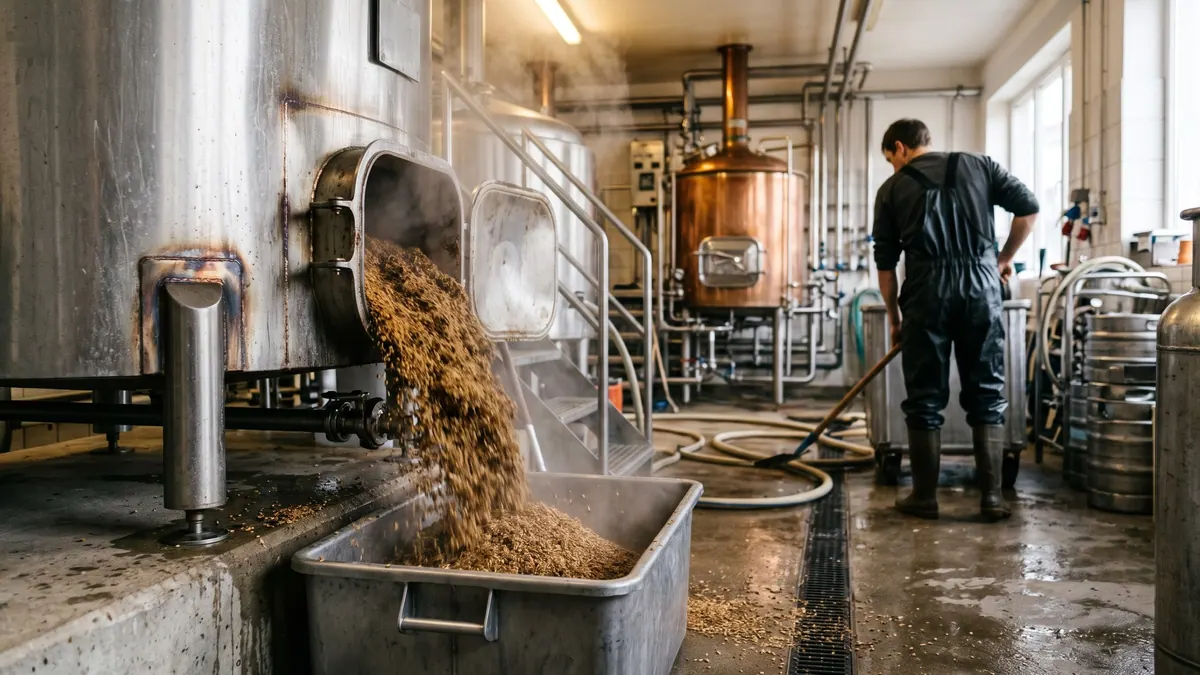
Distillery stillage is the liquid residue after the distillation of alcohol from fermented mash (grain, potato or other feedstocks), and at a biogas plant it is a valuable substrate because it contains easily degradable organic compounds (although it is heavily diluted with water). It does, however, require control of several characteristics: it is acidic, leaves the column hot, has a high content of nitrogen and sulphur and a lot of water, and its availability is tied to the distillery's campaign. Anyone planning to include it in the mix should start from BMP, not from values in the literature.
What stillage is
In a distillery, the mash after alcoholic fermentation goes to a distillation column, where the alcohol is separated. What remains is stillage: a solution or suspension of the mash components not used up in alcoholic fermentation (proteins, fats, complex carbohydrates, yeast, mineral salts). The composition depends on the feedstock (grain, potatoes, maize, molasses) and the technology. Stillage is often separated into a solid fraction (thick stillage) and a liquid fraction (thin stillage).
Properties relevant to a biogas plant
| Feature | Significance |
|---|---|
| Low pH (usually acidic) | Risk of lowering pH in the digester; a buffer is needed (e.g. slurry) |
| High temperature after the column | Requires cooling or controlled feeding; a change of temperature in the digester disturbs methanogenesis |
| High organic load (COD) | Large methane potential, but risk of overload |
| Nitrogen and protein content | Ammonia in the digester, see Ammonia in the digester |
| Sulphur content (sulphates) | Hydrogen sulphide, see Hydrogen sulphide in the digester |
| High water content | Low energy density, high transport cost |
| Campaign variability | Fluctuations in quantity and composition over the year |
Methane yield
The literature gives wide ranges of methane yield from stillage (in NmL CH₄/g VS), depending on the type of feedstock and on separation. For this reason the yield is assessed with a BMP test on a sample representative of deliveries and calculated in the balance with allowance for seasonality; the methodology is described in the text What is BMP. Planning of quantities is discussed in the text Planning substrate demand.
Process risks and how to limit them
Acidification. A large amount of easily degradable compounds and a low pH favour overproduction of VFA. This is prevented by gradually increasing the dose, using buffering substrates, and monitoring VFA, alkalinity and pH; see Digester acidification.
Ammonia and H₂S. Protein gives ammonia, sulphates give hydrogen sulphide. Both can inhibit the process and burden the desulphurisation system. They are assessed in the balance and through monitoring.
Micronutrient deficiency. With a large share of stillage, especially in mono-digestion, trace elements may be lacking; see Trace elements. Supplementation is chosen on the basis of analysis.
Temperature. Hot stillage is cooled in a heat exchanger (heat recovery) or in a buffer tank before being introduced into the chamber.
Foam. Protein substrates favour foaming; see Foaming in the digester.
Logistics and economics
Stillage is thin, so the transport cost per kilometre in terms of energy is high; profitability concentrates around biogas plants located close to a distillery, and sometimes installations built at the distillery. It also requires buffer tanks, because a distillery produces stillage in campaigns, while a biogas plant operates continuously. A common solution is to combine stillage with slurry or silages, which stabilises the process.
Digestate from stillage
Digestate from a mixture containing stillage is rich in nitrogen and potassium. Agricultural use is subject to the rules on fertilisers and the nitrates programme; see Storage and use of digestate.
Legal status and contracts
Stillage may be treated as a by-product or as waste depending on the situation; this affects the permits and documentation required. Before concluding a contract, the status must be established under the regulations and the permit conditions of both parties, together with the requirements for the quality and quantity of deliveries.
Checklist before including it in the mix
- BMP of a representative sample and analysis of composition (dry matter, pH, nitrogen, sulphur, COD).
- Establishing the delivery schedule and buffering.
- A plan for gradual introduction into the digester and for monitoring parameters.
- A plan for handling hot stillage (cooling, heat recovery).
- Assessment of the effect on desulphurisation, ammonia and foaming.
- Legal compliance: the status of the substrate and the entries in the permits.
An example plan for introducing stillage into the mix
A safe scheme consists in gradually increasing the share of stillage in the feed with frequent monitoring. First BMP and a composition analysis are carried out, then the maximum share in the mixture is set on the basis of the digester's buffering capacity, and then the dose is increased in stages, observing VFA, alkalinity, pH, ammonia and the H₂S content of the biogas. The next stage is increased only after the parameters have stabilised. Threshold values depend on the installation and are set by the laboratory or a process adviser.
Conclusions
Stillage is a valuable substrate where it is available nearby and regularly, and the installation is prepared for its characteristics: acidity, temperature, nitrogen and sulphur. The most common cause of problems is not the stillage itself, but too rapid an increase in its share and a lack of monitoring. Profitability depends on logistics, not only on the methane yield.
Sources
Questions and answers
Can stillage be used as the sole substrate of a biogas plant?
It is possible but risky: mono-digestion of stillage usually requires pH control, supplementation with trace elements and allowance for ammonia and hydrogen sulphide. It is more often combined with substrates of higher alkalinity, e.g. slurry.
How do we know how much methane a given batch of stillage will give?
From a BMP test carried out on a sample representative of the deliveries. The composition of stillage changes with the raw material and the distilling process, so the value from a single batch is not universal.
Related articles