
How to calculate digester volume for the planned plant capacity: a step-by-step balance
How to get from electrical capacity or biomethane flow to the amount of methane, the mass of substrate and the digester volume: CHP efficiency, calorific value, yield, HRT and OLR, with three examples.
Other language versions: Polski, Deutsch, Español, Français, Italiano, Nederlands.
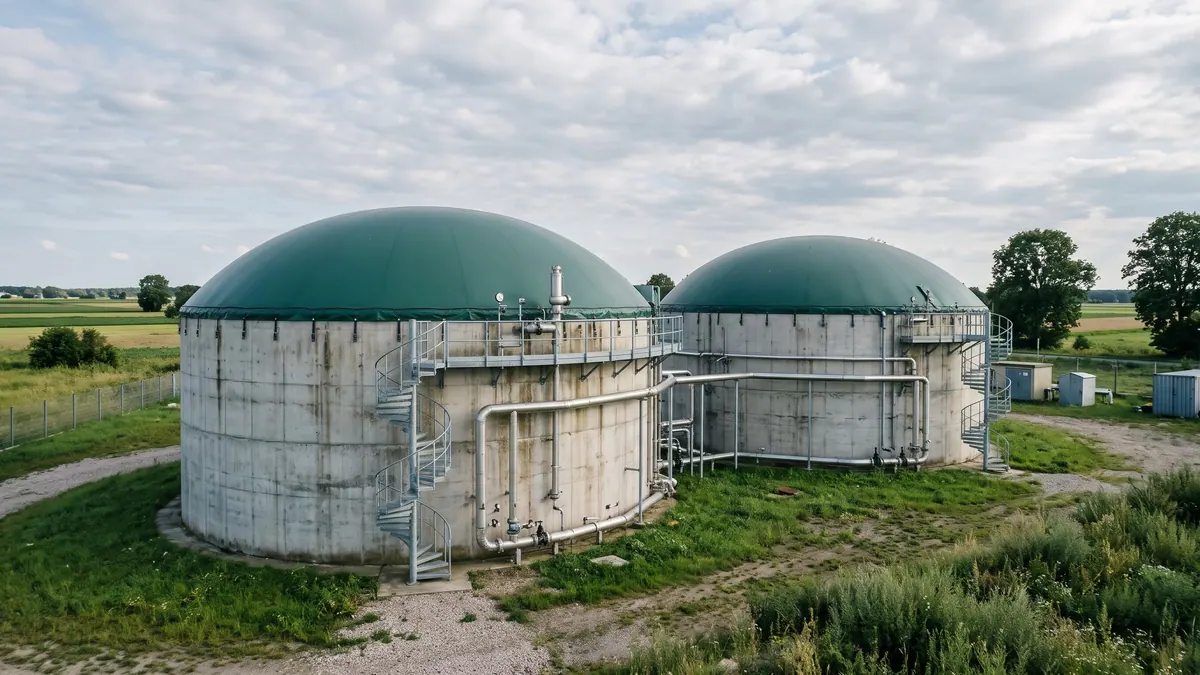
Digester volume for the planned plant capacity is calculated through a chain of balances: from electrical capacity (or biomethane flow), through equipment efficiency and the calorific value of methane, to the daily methane requirement, from there to the mass of substrate, and finally to the volume given by the chosen retention time (HRT). The result is checked against the organic loading rate (OLR). It is a preliminary calculation, but it quickly shows whether the intended feed and the tank fit together.
Step 1: capacity → energy in the fuel
For a plant with cogeneration, the starting point is the electrical capacity of the unit. It is divided by the electrical efficiency of the CHP (definitions and typical values are described in the article on CHP engine efficiency). The result is the fuel input, i.e. the energy flow that must enter the engine with the biogas.
For a biomethane plant, the starting point is the methane flow in the product (the biomethane flow times the CH₄ content), to which are added methane losses in upgrading (see methane slip) and methane burned in the boiler for the plant's own heat.
Step 2: energy → methane flow
The lower calorific value of methane is about 9.97 kWh/Nm³ (Nm³ at standard conditions: 0 °C, 101.325 kPa). The methane flow in Nm³/h is the fuel input in kW divided by this value; multiplied by 24 h it gives the daily flow. It is more convenient to calculate methane directly, because that is how substrate yields are given (e.g. in BMP tests, see theoretical methane potential).
Step 3: methane → mass of substrate
The feed mass is determined by the methane yield per tonne of fresh matter (FM). The values in the first three rows come from the yield table in the FNR Leitfaden Biogas (2013); the last row is an illustrative assumption. For a specific plant, the results of your own tests must be used:
| Substrate | Assumed dry matter | Assumed volatile solids (% TS) | CH₄ yield, Nm³/t FM |
|---|---|---|---|
| Maize silage | 33% | 95% | 106 |
| Cattle slurry | 10% | 80% | 14 |
| Cattle manure | 25% | 80% | 44 |
| Food waste (example) | 20% | 90% | 120 |
The yield from waste varies so widely that it is better to replace it with a BMP result (see How to read a BMP test report).
Step 4: mass → working volume
Working volume [m³] is the daily feed mass [t/d] times HRT [d], divided by density [t/m³] (about 1 for watery mixtures). HRT depends on the substrate and temperature; in agricultural plants with a high share of plant biomass it is usually several dozen days (see HRT and SRT). The result is verified with OLR, i.e. the mass of volatile solids per m³ per day (see OLR in practice). In agricultural biogas plants it is often in the range of about 2–4 kg VS/(m³·d) (depending on the plant); higher values require very good mixing and process control.
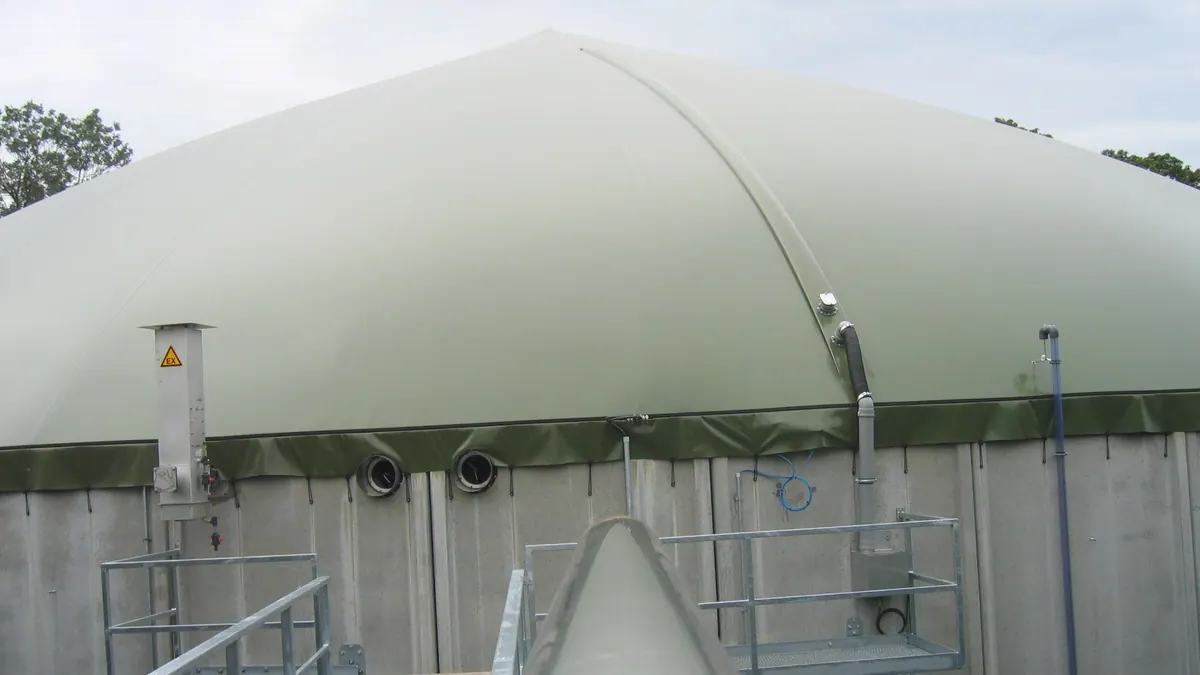
The total volume is determined by adding to the working volume the gas space and an allowance for foam and level fluctuations; in the examples the working volume is 85% of the total.
Example 1: 500 kW electrical, silage with slurry
Assumptions: CHP electrical efficiency 40%, continuous operation (an annual balance must take the actual operating time into account), HRT 60 days.
- Fuel input: 500 / 0.40 = 1250 kW.
- Methane flow: 1250 / 9.97 ≈ 125.4 Nm³/h, i.e. approx. 3009 Nm³/d.
- Mix: 30 t/d of slurry supplies 30 × 14 = 420 Nm³ CH₄/d. The remainder, 2589 Nm³/d, is covered by silage: 24.4 t/d gives approx. 2586 Nm³/d. Total approx. 3006 Nm³/d, i.e. practically the target.
- Feed mass: 24.4 + 30 = 54.4 t/d.
- Working volume: 54.4 × 60 / 1.0 ≈ 3264 m³; total 3264 / 0.85 ≈ 3840 m³.
- OLR check: VS = 24.4 × 0.33 × 0.95 + 30 × 0.10 × 0.8 ≈ 7.6 + 2.4 = 10.0 t/d; OLR = 10.0 / 3264 ≈ 3.1 kg VS/(m³·d), i.e. within the range found in agricultural plants.
Conclusion: with this mix, HRT and OLR give a similar result; with a larger share of slurry HRT would be the constraint, and with silage alone, OLR.
Example 2: 250 Nm³/h of biomethane, mixed substrates
Assumptions: biomethane at 97% CH₄, methane losses in upgrading of 1% of the methane in the raw biogas, 6% of that methane burned for the plant's own heat, HRT 70 days.
- Methane in the product: 250 × 0.97 = 242.5 Nm³/h.
- Methane in the raw biogas: 242.5 / (1 − 0.01 − 0.06) ≈ 260.8 Nm³/h, i.e. approx. 6258 Nm³/d (both losses are fractions of the same flow).
- Mix: 40 t/d of manure (40 × 44 = 1760 Nm³ CH₄) and 60 t/d of slurry (840) give 2600 Nm³/d. The missing 3658 Nm³/d is covered by 34.5 t/d of silage.
- Feed mass: 134.5 t/d. Working volume: 134.5 × 70 ≈ 9415 m³; total approx. 11,100 m³ (e.g. two tanks of approx. 5500 m³ each).
- OLR: VS = 34.5 × 0.33 × 0.95 + 40 × 0.25 × 0.8 + 60 × 0.10 × 0.8 ≈ 10.8 + 8.0 + 4.8 = 23.6 t/d; OLR ≈ 2.5 kg VS/(m³·d).
The plant's own heat and upgrading losses increase the required production, and hence the digester volume, by approx. 7% (1/0.93).
Example 3: food waste, volume set by OLR
Assumptions: 250 kW electrical, efficiency 40%, waste with 20% TS and a yield of 120 Nm³ CH₄/t FM, permissible OLR of 2.5 kg VS/(m³·d) adopted conservatively because of the risk of acidification and ammonia (see Chen et al. 2008).
- Fuel input 625 kW; methane: 625 / 9.97 ≈ 62.7 Nm³/h ≈ 1505 Nm³/d.
- Mass of waste: 1505 / 120 ≈ 12.54 t/d; VS = 12.54 × 0.20 × 0.90 ≈ 2.26 t/d.
- Volume from OLR: 2260 kg/d / 2.5 kg/(m³·d) ≈ 900 m³ working volume.
- HRT check: without dilution 900 / 12.54 ≈ 72 days. However, if the substrate has to be diluted to a pumpable content of approx. 12% TS (dry matter 12.54 × 0.20 = 2.51 t/d, feed 2.51 / 0.12 ≈ 20.9 t/d), HRT falls to approx. 43 days. That may still be sufficient, but it requires verification of the kinetics and the risk of inhibition.
For substrates with a high yield and a small share of water, volume is determined by OLR, and HRT has to be checked after adding the process water.
In conclusion
Take yields from tests of your own substrates, add process water and recirculate, check HRT, OLR and ammonia at the same time, and leave a margin for poorer batches of substrate. A full mass and energy balance of a biogas plant is shown in the calculation example, and the choice of substrates is described in the article on co-digestion mix planning.
Sources
Questions and answers
Is the total volume of a digester equal to its working volume?
No. The working volume is the part of the tank in which the fermenting liquid resides. The total volume also includes the gas space under the roof or membrane and a reserve for foam and level fluctuations, so the total volume is usually larger by a dozen or so per cent.
Where should you start when calculating digester capacity?
With the target capacity of the installation and converting it into a daily methane flow. Only then are the substrate mix and the retention time (HRT) selected and the organic loading rate (OLR) checked. The reverse order, i.e. guessing the volume, leads to an installation that is not matched to the feed.