
Operation and failuresAnalysis
Freezing of foam protection systems: designing for winter
Foam in a digester is detected, retained or suppressed by systems with liquids and sensors. Where they freeze, how to limit this through design and how to supervise them.
Other language versions: Polski, Deutsch, Español, Français, Italiano, Nederlands.
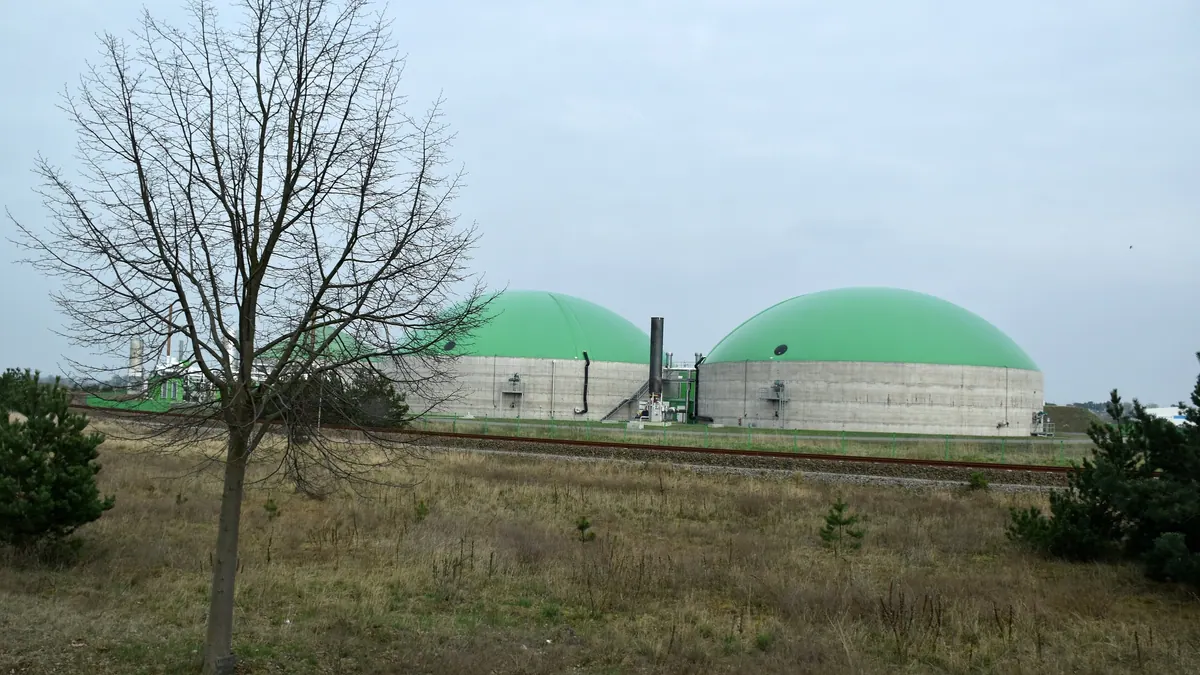
Foam-related systems at a biogas plant, that is, sensors detecting foam, traps and siphons retaining it before the gas line, and antifoam dosing lines, contain liquids, condensate or viscous media. In winter each of these places can freeze or thicken, and the failure is dangerous because it cannot be noticed in normal operation: the system "stands" on standby and turns out to be inoperative only when foam appears. Designing for winter therefore means limiting the number of points exposed to frost and ensuring that the remaining ones are heated, insulated and supervised.
Why foam is a safety problem
Foam in the digester chamber (its causes and control are described in the text Foaming in the digester) can fill the gas space and reach the gas line, fittings, drains and the over- and under-pressure protection devices. A blocked vent or a jammed safety valve is a situation of great safety significance. Installations therefore have systems that detect foam and limit its effects.
Where it freezes
| Element | Freezing mechanism |
|---|---|
| Sensor impulse line | Water or condensate trapped in the line |
| Level probe (capacitive, conductometric) | Ice and moisture change the reading |
| Siphon or drain of a trap | Condensate freezes in the bend |
| Antifoam dosing line | Thickening or freezing; the dosing pump loses capacity |
| Antifoam tank | Thickening at low temperature |
| Valves and stubs | Ice in seats and seals |
Design principles
1. Limit the number of points with liquid. Every dead leg and every water "pocket" increases the risk. The system should have falls that drain condensate, and impulse lines that are as short as possible.
2. Move sensitive elements to a warm place. Control cabinets, dosing pumps and the antifoam tank stand in a heated enclosure or container. This solution is cheaper and more reliable than heating pipework along the whole route.
3. Insulate and heat the remaining points. Insulation with a moisture barrier, a heating cable selected for the lowest design temperature, and regulation. Details of selection are given in the text Will a heating cable protect the system from frost.
4. Choose the right medium. Antifoams differ in viscosity and solidification temperature; the safety data sheet and the manufacturer's recommendations are treated as design data. Changing a product to another requires checking compatibility with the dosing system.
5. Use redundancy. Two independent foam sensors, or a foam sensor and an independent level measurement, make it possible to detect an error in one of them. Safety should not depend on a single point that can freeze.
6. Ensure power supply and alarms. Heating circuits with monitoring of current draw and a temperature sensor at the coldest point send an alarm to the control room. A signal of heating failure must reach a person.
7. Take explosion hazard zones into account. Elements in Ex zones (sensors, heating cables, pump motors) must have appropriate certification and temperature class in line with the explosion protection document; see ATEX at the biogas plant.
Maintenance and inspections
- Pre-season inspection: insulation, heating cables, sensor calibration, condition of the antifoam.
- Functional test: simulating a foam signal and checking the system's response (stopping substrate feeding, alarm, antifoam dosing).
- Periodic checks of drain points and the patency of siphons.
- An event log: whether the system acted, when and why; the data make it possible to assess effectiveness. The over- and under-pressure protection of the tank, which is also exposed to freezing, is described in the text on anti-freeze heating of overpressure protection.
- Training of operators: who responds to a freezing alarm and what they do.
What to do when the system is inoperative
An inoperative antifoam system in frost is treated as a limitation of the safeguards: the dosing of substrates that favour foaming is limited, operator supervision is increased and the problem is reported to the service provider, in line with the site's instructions. Work on frozen elements, especially inside an Ex zone or in enclosed spaces, is carried out under permits and procedures; see Work in confined spaces. Thawing with an open flame or with uncertified heaters is unacceptable.
Summary
Winter reliability of foam-related systems results above all from design: few points with liquid, warm enclosures, insulation and redundancy. Heating is a supplement that must be monitored. A general picture of heat on the site in winter is given by the text Heat balance of a biogas plant in winter.
An example approach to risk analysis
For each foam-related system it is worth drawing up a simple table: element, function, consequence of its failure, freezing mechanism, means of protection, means of detecting failure, and inspection frequency. Such an analysis shows which elements are critical (their failure is not noticeable) and which are merely inconvenient. For the first group, redundancy or independent supervision is required, and for the second a periodic inspection is enough. The conclusions are attached to the site's safety documentation and updated after every modification of the system.
Sources
Questions and answers
Is it enough to heat only the foam sensor?
No. In winter the problem affects the entire chain: the sensor, the impulse line, the fittings and the outlet. One missed point is enough for the system to stop working.
What most often freezes in foam-related systems?
Impulse lines and nozzles of level or foam sensors, trap siphons and drains, and the dosing lines for antifoam agents. High-viscosity agents thicken at low temperature before they freeze.