Process biology and start-upAnalysis
Hydrogenotrophic methanogens in biological methanation: hydrogen transfer, pH and culture stability
Hydrogenotrophic methanogens combine hydrogen with CO2 into methane. We describe the biology of the process, in situ and ex situ variants, mass transfer, pH and the state of the technology.
Other language versions: Polski, Deutsch, Español, Français, Italiano, Nederlands.
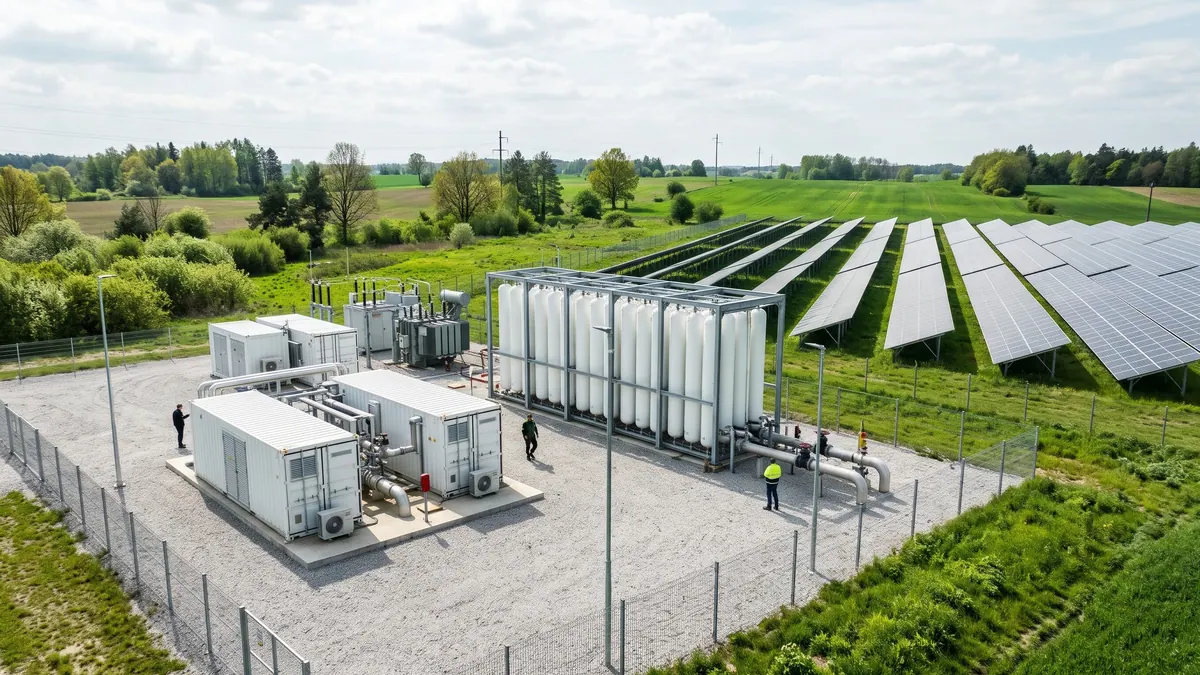
Biological methanation is the use of hydrogenotrophic methanogens to convert hydrogen and carbon dioxide into methane and water, according to the reaction 4H2 + CO2 → CH4 + 2H2O. It makes it possible to treat a digester or a separate reactor as an element of a power-to-gas system. A comparison of the biological method with the catalytic one (Sabatier) and the energy balance for biomethane plants is described in the article on methanation and power-to-gas; here we concentrate on the biological side. The same microorganisms work in every digester as the last stage of degradation (see pH in the digester), but in methanation they become the main process.
Reaction and balance
For standard conditions the enthalpy of the reaction is about −253 kJ per mole of methane (liquid water); for water as vapour it is about −165 kJ/mol. The standard free energy in the biochemical formulation is about −131 kJ/mol CH4, so the reaction is thermodynamically favourable and supplies energy to the microorganisms.
Stoichiometry:
- 4 mol of H2 per 1 mol of CO2 gives 1 mol of CH4, i.e. 4 m3N H2 → 1 m3N CH4,
- by mass: approx. 0.5 kg of H2 per 1 kg of CH4,
- in energy terms (calorific values, H2 approx. 3.0 kWh/m3N, CH4 approx. 9.97 kWh/m3N): 12.0 kWh in hydrogen gives 9.97 kWh in methane, i.e. a chemical efficiency of approx. 83%; the rest is the heat of reaction.
What this means for the biology
With 4 mol of H2 per 1 mol of CO2, the organisms must handle large gas streams, and the solubility of hydrogen is low. The key parameter is therefore not the growth rate of the culture, but the rate at which H2 is transferred into the liquid. A numerical example of the mass and energy balance can be found in the article on methanation cited above; we do not repeat it here.
Who does the work: groups of microorganisms
In an ordinary digester, hydrogenotrophic methanogens consume the hydrogen produced by fermentative and syntrophic bacteria. They keep its partial pressure low enough that the oxidation of propionate and butyrate to acetate is possible. If an excess of hydrogen is introduced into the digester, this mechanism stops working: the high partial pressure of H2 inhibits the syntrophic bacteria, acids begin to accumulate, and the share of acetate processed by acetoclastic methanogens falls. This is why in in situ methanation the hydrogen dose is increased gradually, observing VFA and pH.
In ex situ reactors a selected culture works, most often of hydrogenotrophic methanogens from genera such as Methanothermobacter (in the thermophilic range) or Methanobacterium and Methanoculleus (in the mesophilic range). Such a culture is simpler than a full digestion community, because it does not have to break down complex compounds, but it is also more sensitive to nutrients and to gas impurities.
Technology variants
In situ. Hydrogen is dosed directly into the digester. Advantages: no separate reactor, use of the existing biomass and of the CO2 formed in the digester. Disadvantages: competition with other processes, disturbance of the pH balance and the risk of inhibition of the syntrophic breakdown of acids if the partial pressure of hydrogen rises too much.
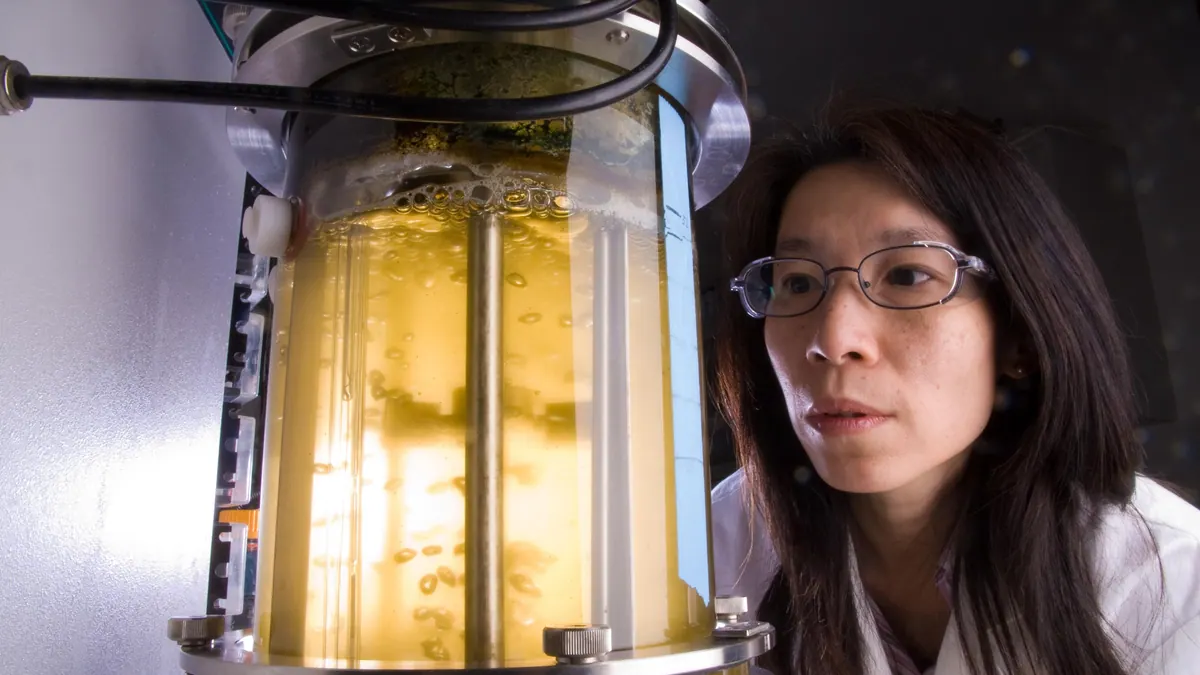
Ex situ. Hydrogen and CO2 (from biogas or from another source) are introduced into a separate reactor with a selected hydrogenotrophic culture. Stirred reactors, bubble columns, trickle-bed bioreactors and membrane systems are found. Advantage: control of conditions (temperature, pH, nutrients) and higher purity of the product. Disadvantage: higher investment cost.
Main limitations
- Solubility of hydrogen. H2 dissolves in water much less well than CO2 (of the order of several times less per unit of pressure). The reaction rate is therefore limited by mass transfer from the gas phase to the liquid, not by the growth of microorganisms.
- Rise in pH. Consumption of CO2 reduces the amount of carbonic acid in the liquid; alkalinity remains, so the pH rises, in in situ systems even above values favourable for methanogenesis. Control requires dosing CO2 or acid, or limiting the hydrogen dose. The relationship is explained in the article on the carbonate buffer.
- Residual hydrogen and CO2. Incomplete conversion leaves H2 in the product, which limits the possibility of injection into the grid without further treatment.
- Nutrients and trace elements. Ex situ cultures require the supply of nitrogen, phosphorus and traces of metals.
- Feeding dynamics. Hydrogen from renewable sources is intermittent, and the biomass must tolerate interruptions and load changes; hydrogenotrophic methanogens tolerate standstills fairly well, but restart takes time.
- Temperature. Work is done in the mesophilic and thermophilic ranges; higher temperature increases the reaction rate and reduces the solubility of gases.
State of the technology
Biological methanation has been developed for years; the literature and publications of industry organisations describe laboratory work, pilots and first demonstration installations in several European countries. The scale is so far small compared with market needs, and experience from long-term operation (stability, operating effort, costs) is limited. We do not decide here which solution will prove dominant; in practice the choice depends on the local availability of cheap energy, CO2 and gas infrastructure.
Relation to upgrading and policy
Classical biogas upgrading (membranes, scrubbers, adsorption) removes CO2 and releases it to the atmosphere or utilises it. Methanation converts this CO2 into additional methane, increasing the methane yield from the same biomass at the cost of electricity. For a biogas plant with upgrading this is an idea for raising production with the same substrate, provided that the price of electricity and hydrogen is suitable.
In EU policy, renewable hydrogen and fuels made from it (so-called renewable fuels of non-biological origin, RFNBO) are covered by Directive 2018/2001 (RED II), amended by Directive (EU) 2023/2413 (RED III), and by delegated acts, including Delegated Regulation (EU) 2023/1184 setting out the methodology for RFNBO. Methane from the methanation of renewable hydrogen may therefore qualify under these rules, but the detailed conditions (origin of the electricity, source of CO2) have to be checked in the current acts and national regulations.
Conclusions
- The reaction is simple and thermodynamically favourable; the difficulties lie in mass transfer and pH control.
- In situ is cheaper in investment but riskier for stability; ex situ gives better control, at the cost of investment.
- The economics are determined by the cost of electricity and the utilisation of the electrolyser; electricity accounts for a significant part of the product cost.
- The technology should be treated as under development, with each offer to be assessed on the basis of data from long-term operation, not just the results of short tests.
Sources
- IEA Bioenergy Task 37 - Energy from Biogas
- European Biogas Association - materiały o biogazie i biometanie
- Dyrektywa (UE) 2018/2001 w sprawie promowania stosowania energii ze źródeł odnawialnych (RED II)
- Rozporządzenie delegowane Komisji (UE) 2023/1184 - metodyka dla odnawialnych paliw pochodzenia niebiologicznego (RFNBO)
Related articles