InnovationExplainer
Biological methanation of hydrogen: in situ or ex situ, that is, where to add H₂ to a biogas plant
Hydrogenotrophic archaea turn CO₂ and H₂ into methane. How the in-digester variant differs from a separate reactor, what limits each of them, and at what stage deployments are.
Other language versions: Polski, Deutsch, Español, Français, Italiano, Nederlands.
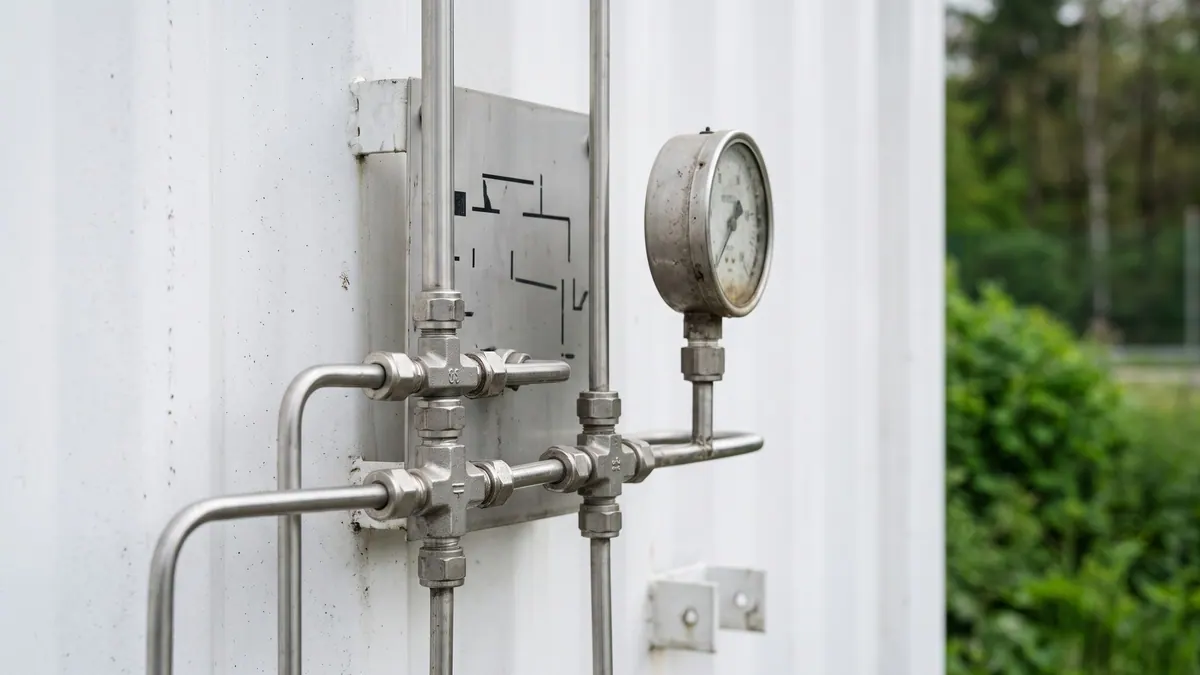
Raw biogas usually contains about 40% CO₂ and 60% methane, and classic upgrading removes the CO₂. Biological methanation goes in the opposite direction: it turns this CO₂ into additional methane by supplying hydrogen. The hydrogen comes from electrolysis, so in practice this is a way of "turning electricity into gas" (power-to-gas) using microorganisms rather than a catalyst.
Mechanism
Hydrogenotrophic archaea, which in every digester are responsible for part of the methane production, use the reaction CO₂ + 4 H₂ → CH₄ + 2 H₂O. The stoichiometry matters: for every molecule of CO₂, four molecules of hydrogen are needed, so hydrogen is the main cost of the process. Another limitation is the low solubility of hydrogen in water: the gas must pass from the gas phase to the liquid where the microorganisms live, and the rate of this transfer often determines reactor performance. The reaction is exothermic, so it releases heat that can be utilised.
In situ: hydrogen into the digester
In the in situ variant, hydrogen is introduced directly into the digester or into its recirculation loop. The advantage is obvious: there is no need to build a separate reactor, and the archaea population already exists. The drawback is that the process is shared with the whole biology. Consumption of CO₂ lowers the concentration of carbonic acid in the liquid, which raises the pH. Too high a pH inhibits some microorganisms, including acetoclastic methanogens. A high partial pressure of hydrogen, in turn, disrupts syntrophy, that is, the cooperation of bacteria breaking down acids, which requires a very low hydrogen concentration. As a result, the amount of hydrogen that can be supplied without risk to the process is sometimes limited, and start-up requires caution. The review by Voelklein et al. (2019) describes these limitations and ways of mitigating them (e.g. better gas dispersion).
Ex situ: a separate reactor
In the ex situ variant, hydrogen and CO₂ (from biogas or from upgrading off-gas) go into a separate reactor with a selected hydrogenotrophic culture. Here temperature, pH and reactor design can be chosen for this one process, and its disturbances do not affect the digester. The price is paid in complexity and capital expenditure. Reactors come in various designs (stirred tank, columns, biofilm beds), and their common problem is transferring hydrogen into the liquid.
An example of an ex situ solution is the technology of Electrochaea: according to the company's materials, the microorganisms (a strain of archaea) work in a stirred solution at a temperature of about 65 °C, and the declared CO₂ conversion is 98.5%. This is a manufacturer's claim, with no measurement conditions given, so we treat it as indicative. Demonstration plants have also been described in industry materials; their scale and results are worth checking at the source.
Comparison
| Feature | In situ | Ex situ |
|---|---|---|
| Investment | lower (no separate reactor) | higher |
| Risk to fermentation | pH rise, disruption of syntrophy | no effect on the digester |
| Process control | limited, shared with the whole biology | full, tailored to a single process |
| CO₂ conversion rate | usually limited | higher |
| Maturity | mainly research and pilots | demonstrations and first installations |
Maturity and availability
According to the editorial team's indicative assessment (see the TRL scale for innovations), ex situ biological methanation is at the level of demonstration and first installations (TRL 6–8), and in situ is closer to research and pilots. There are suppliers offering installations commercially, but the number of references remains small.
Conditions for profitability and barriers
The cost calculation rests on hydrogen. The efficiency of the whole path from electricity to methane is clearly lower than 100%: part of the energy remains in the heat, and electrolysis and compression also have losses, so it is usually stated that about half or slightly more of the electrical energy is recovered in the methane (the range depends on the system and assumptions). Profitability therefore depends on: cheap, low-emission electricity, use of the oxygen from electrolysis and the heat from methanation, access to CO₂ and to the gas grid, and on the legal status of the product. Methane from electrolysis hydrogen can be a renewable fuel of non-biological origin (RFNBO), but under the conditions set out in delegated regulation 2023/1184 (including those concerning the source of electricity). The wider background is given in the article on methanation and power-to-gas with biogenic CO₂, on the difference between electrolysis and biohydrogen and on the JRC report on e-methane.
The barriers are the cost of the electrolyser, the volatility of the energy price (the reactor likes continuous operation, and cheap energy is sometimes intermittent), the need to manage the hydrogen, certification rules and the small number of reference installations.
What this means for a Polish biogas plant or biomethane plant
For most Polish agricultural installations, this is today a subject to watch, not to buy. It makes the most sense at a biomethane plant that already has a CO₂ stream from upgrading, access to cheap renewable energy and to the gas grid. In that case ex situ biological methanation is an alternative to CO₂ liquefaction (see the previous article in the series). Before any decision, it is worth checking the current definitions of RFNBO and the requirements for hydrogen, and, if hydrogen is to be introduced into the installation, carrying out an explosion risk assessment (ATEX) with qualified persons. The earlier article on biohydrogen shows where biohydrogen ends and electrolysis hydrogen begins.
Sources
- Voelklein, Rusmanis, Murphy (2019), Biological methanation: strategies for in-situ and ex-situ upgrading in anaerobic digestion — Applied Energy
- Electrochaea — opis technologii (materiał firmy)
- Rozporządzenie delegowane Komisji (UE) 2023/1184 (RFNBO) — EUR-Lex
- Angelidaki et al. (2018), Biogas upgrading and utilization — Biotechnology Advances
Questions and answers
Why does adding hydrogen to a digester raise pH?
Because hydrogenotrophic archaea consume dissolved CO₂, which reduces acidity and buffering in the liquid. In the reaction CO₂ + 4 H₂ → CH₄ + 2 H₂O, carbon dioxide disappears, which in water forms carbonic acid and helps form the bicarbonate buffer. When there is less of it, the pH rises, and a pH that is too high inhibits some microorganisms, including acetoclastic methanogens. In addition, a high partial pressure of hydrogen thermodynamically inhibits the breakdown of acids (e.g. propionic and butyric) by syntrophic bacteria. For this reason, in the in situ variant the hydrogen dose is often limited, while the ex situ variant in a separate reactor makes it possible to control conditions independently of the digester.
Related articles