InnovationGuide
Measuring digestate composition during application: NIR sensors on the tanker and nitrogen dosing
How an NIR sensor in the spreader line measures the dry matter and nitrogen of digestate, and how to use the reading to set the dose. With calibration and laboratory verification.
Other language versions: Polski, Deutsch, Español, Français, Italiano, Nederlands.
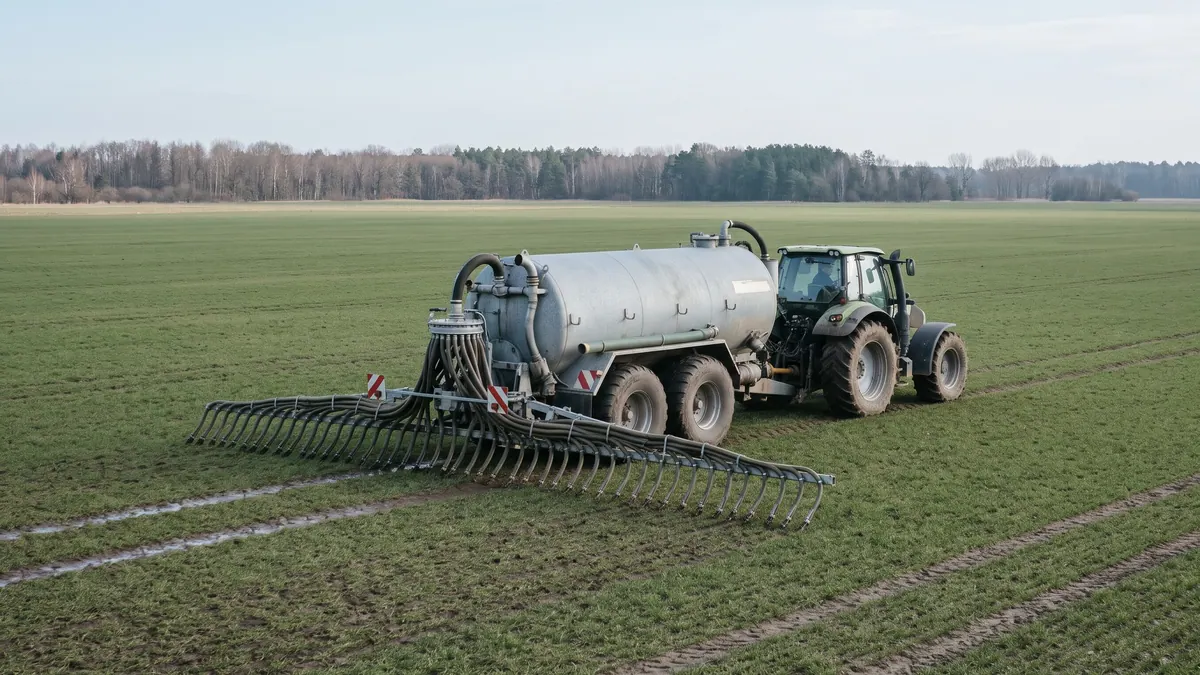
An NIR sensor mounted in the spreader line measures the composition of digestate or slurry during application, so that the nitrogen dose can be matched to the actual content rather than to an average value from tables. Below is a guide for the farmer and the contractor. The principles of NIR spectroscopy are described separately in the article NIR spectroscopy of substrates; here we focus on practice in the field.
Step 1. What the sensor measures
A near-infrared light sensor analyses the liquid stream in the line. On the basis of the spectrum and a calibration model, it gives: dry matter (DM), ammonium nitrogen (N-NH₄), total nitrogen, phosphorus (P₂O₅) and potassium (K₂O); some devices also give magnesium. Organic compounds and water are measured directly; mineral elements are estimated from correlations, so accuracy for ammonium nitrogen is usually better than for phosphorus and potassium. Typical relative errors are from a few to a dozen or so percent, depending on the material and the calibration.
Step 2. Calibrate for your material
Factory models are built on typical slurries (cattle, pig) and digestate. Digestate from a biogas plant with an unusual mix, lots of silage, added waste, separation, has a different matrix, so local calibration is needed:
- take a dozen or so samples of varied composition (different tanks, dates),
- test them in an accredited laboratory (DM, total N, N-NH₄, P, K),
- compare the sensor readings with the results and correct the model,
- repeat after a change in the substrate mix or in separation.
Without calibration the device "shows numbers", but it is not known how wrong they are.
Step 3. Prepare the tank
The contents of the tank must be homogeneous. A measurement at the start of emptying often differs from the end because of the settling of dry matter. Therefore:
- mix the digestate before and during work,
- remove sediments from the end of the tank, if possible,
- check that the sensor is free of build-up and air bubbles in the line,
- match the flow to the range of the sensor.
Step 4. Set the target dose
The dose is determined on the basis of the fertilisation plan: crop needs, soil fertility, the previous crop and legal limits. In Poland the rule of 170 kg N/ha per year from natural fertilisers applies, including from digestate containing slurry, as well as application periods and bans arising from the nitrate programme implementing Directive 91/676/EEC. Details and examples are given in the article Applying digestate to fields: doses, periods, the 170 kg N limit, and calculations in nitrogen balance and digestate doses. The sensor does not change these rules, it only allows them to be followed more accurately.
Step 5. Control the dose
The spreader controller compares the target N dose with the nitrogen content from the sensor and changes the flow or the driving speed. A simple calculation: if the digestate contains 4.5 kg N/m³ and the target dose is 90 kg N/ha, 20 m³/ha must be applied; when the reading is 3.6 kg N/m³, the volumetric dose rises to 25 m³/ha. The changes must fall within the working range of the pump and the boom. Make sure the limit values do not lead to the limit being exceeded: the dose per hectare should not go beyond the plan, even if the controller "sees" low nitrogen.
For ammonium nitrogen the application technique (trailing hoses, injection) and the weather conditions also matter, because ammonia losses reduce efficiency. The issue is discussed in the post on ammonia emissions from digestate.
Step 6. Document and verify
Record the sensor readings with GPS location, the dose, the date and the field. Such documentation helps with inspections and with yield analysis. In addition:
- take control samples to the laboratory at regular intervals (e.g. every few tanks),
- compare the sensor averages with the laboratory results,
- if the difference exceeds a dozen or so percent, recalibrate,
- keep the results as part of the fertilisation plan.
Limitations
- Variability: digestate from different tanks has a different composition; the sensor shows the state at a given moment, not for the whole field.
- Sediments and fibres: can disturb the measurement.
- Change of mix: a new substrate ration requires verification of the calibration.
- Cost: the sensor and control are an investment that pays back faster for contractors with a large area than on a small farm.
- Law: a dose calculated from a reading does not release you from complying with limits and periods.
Practical benefits: a more even distribution of nitrogen, a lower risk of exceedances, better documentation and savings of mineral fertiliser thanks to more accurate accounting for the nitrogen from the digestate.
Sources
Related articles