Emergency flaring of biogas, part 4: gas holder buffer, supply control and an emergency biogas boiler
How large a gas store and what substrate control reduce emergency flaring, and when a biogas boiler is a sensible outlet for surplus.
Other language versions: Polski, Deutsch, Español, Français, Italiano, Nederlands.
A gas store and supply control are the cheapest ways to limit emergency flaring, because they add no new consumers, but only smooth the difference between production and offtake. A biogas boiler is the next step: it converts surplus gas into heat, if someone takes that heat. This article is part of the series “Emergency flaring of biogas”. Earlier we discussed the requirements and hierarchy of solutions, open and enclosed flares and a second CHP unit and a microturbine.
The gas buffer: what it gives and what it does not
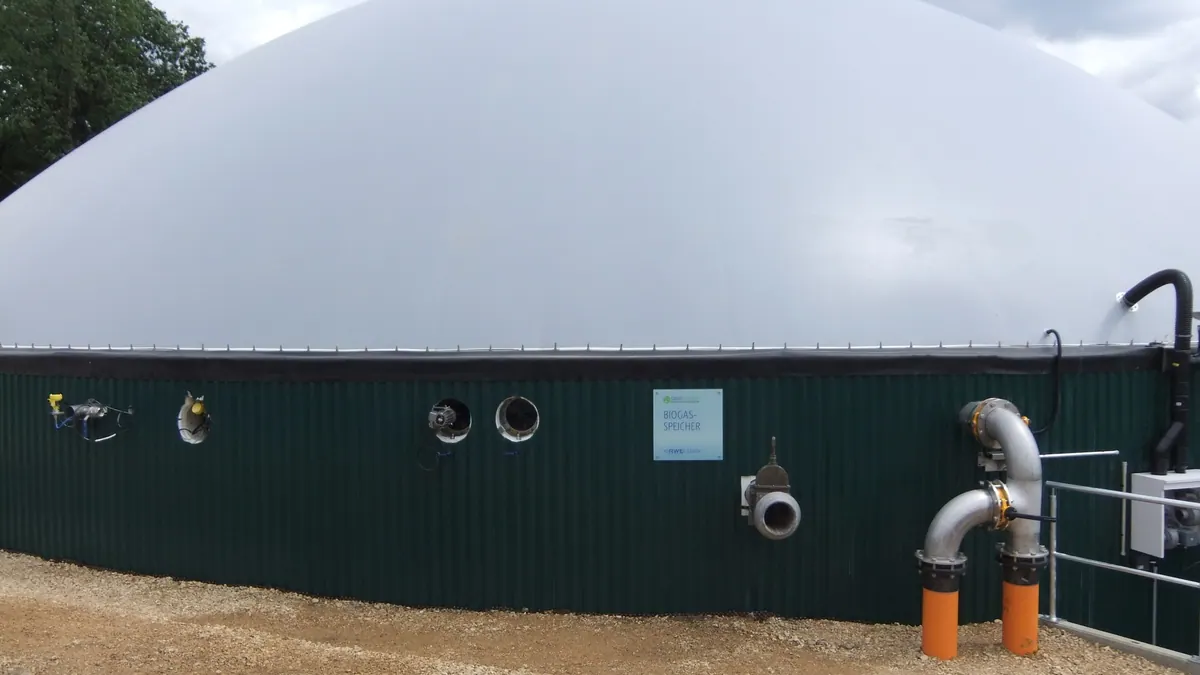
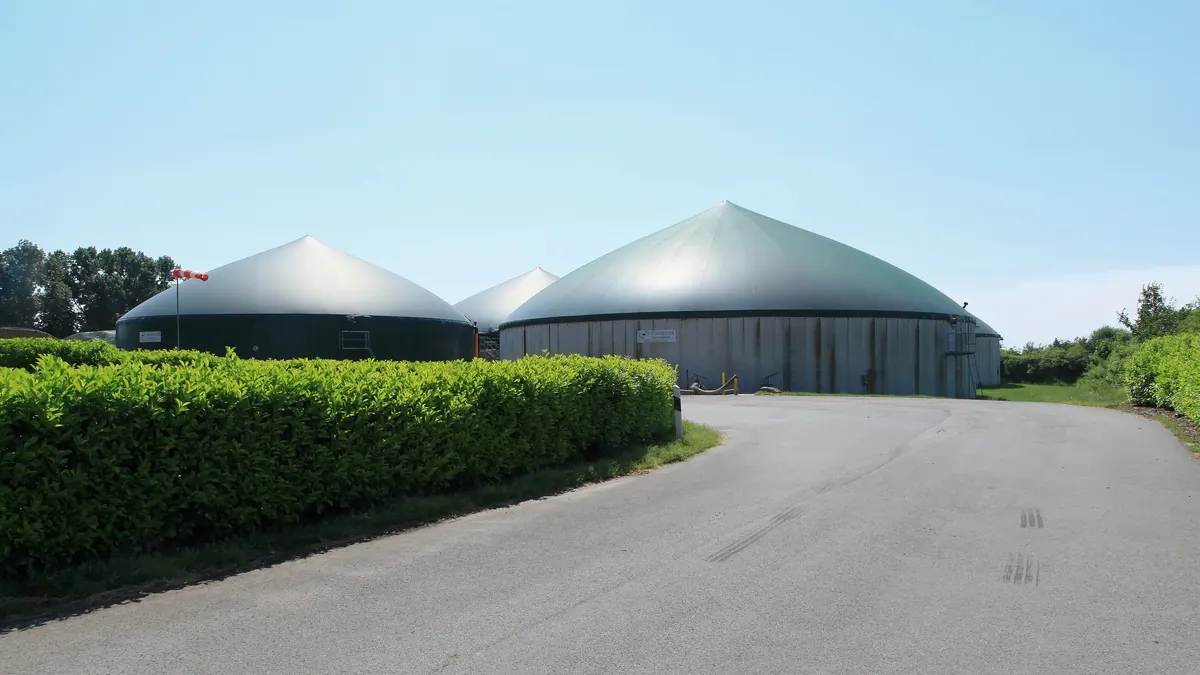
A store under a membrane has a flexible wall, so its volume changes with the fill level. When production exceeds offtake, gas accumulates. When the store is almost full, protection begins to operate: the flare and, as a last resort, the pressure relief valve. The design of the store and its protection is described in the article Biogas store: double-membrane roof and safety.
The store capacity is chosen on the basis of several data: gas production and methane content, seasonal changes in heat demand and the minimum operating limit of the boiler and generating set. A spreadsheet with an hourly balance is enough for this. A buffer will not solve the problem if the interruption in offtake lasts longer than the store capacity allows, and so it does not replace the flare during failures lasting many hours.
When the buffer is too small
Cases are described of plants that inject biomethane into the grid and have a small gas store. When the grid operator limits capacity, the gas has nowhere to go and is burned in the flare. The solution is sometimes a larger store, another gas consumer or better management of the installation, including reliable pressure measurement. This is a general conclusion, not a rule for all plants; the scale has to be established from your own data.
Substrate supply control
Since the biology produces gas with a delay relative to dosing, controlling the doses can smooth production. A German study (Schäfer et al., 2017) analyses an approach in which a reduced digester loading provides additional gas store capacity and engine power without capital expenditure, but requires economic compensation. An approach is also known in which the digester itself serves as a heat store and the process temperature is adjusted to the operation of the generating set. The limits, however, are biological: sudden changes in doses and temperature can disturb the process. The range of safe changes is set by the process engineer on the basis of process indicators, not by a general rule. We discuss the principles of the indicators in the texts on the biology of the process.
In practice, supply control includes:
- reducing doses before a planned service of the generating set,
- dosing according to the fill level of the gas store,
- avoiding large one-off doses of easily degradable substrates,
- coordinating the service schedule with the dosing schedule.
The biogas boiler
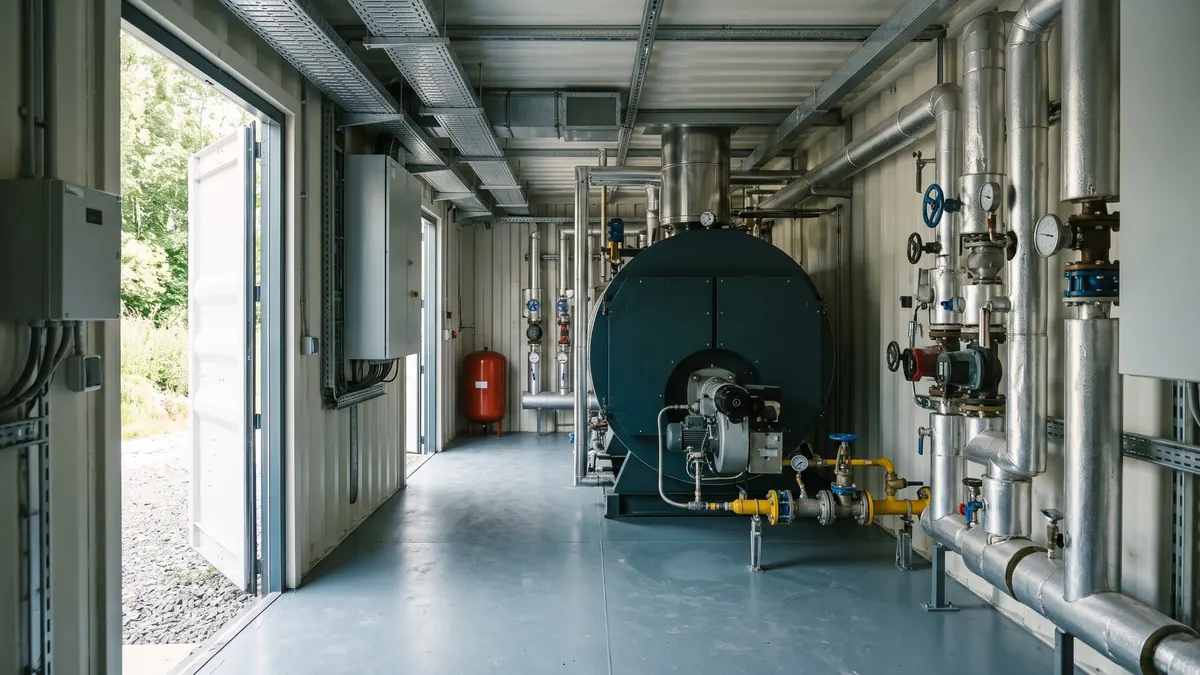
A water boiler with a biogas burner burns surplus gas and gives off heat, which can heat the digester, buildings or an external customer. According to a guide on biogas heating, a boiler can also produce steam for industrial customers, and indirect heating of the digester is preferred to injecting hot water, because it does not dilute the digestate. For the same quantity of gas a boiler gives off more heat than a cogeneration set, because the set converts part of the energy into electricity. A boiler does, however, compete with the set for gas, so the controls must establish the order of priority.
Replacing the flare with a boiler is a design solution, not a requirement. It must always be checked whether the permit and the design allow such an arrangement, and it should be agreed with the competent authority.
Advantages and disadvantages of the boiler
| Feature | Biogas boiler |
|---|---|
| Energy use | heat, if there is offtake; no electricity |
| Flexibility | wide power range, depending on the burner |
| Emissions | combustion in the boiler chamber, usually easier to control than in an open flare |
| Limitation | requires heat offtake and reliable supply |
| Use as protection | uncertain; the flare is described as a separate device |
Industrial biogas boilers, including those with dual-fuel burners, are offered by many manufacturers; price ranges are given only in an offer.
Checklist before a decision
- Collect data: flare operating hours, causes, the fill level of the store at the moment of start-up.
- Calculate how many minutes or hours of capacity the store gives at full production.
- Check whether the controls have a store fill-level signal and whether they limit dosing.
- Check whether there is a steady heat customer for the boiler.
- Agree the role of the boiler relative to the flare with the designer and the authority.
Typical mistakes
- Sizing the store “by eye”. The capacity should follow from an hourly balance that takes into account the longest typical interruption in offtake.
- Control without a fill-level signal. If the dosing automation does not know the fill level of the store, it will not limit supply before the peak.
- A boiler without heat offtake. A boiler whose heat has nowhere to go will stop in the same way as the generating set.
- No switching-on sequence. When the generating set and the boiler compete for gas, without an established order it is hard to predict the behaviour of the system at the moment of a failure.
- Pressure measurement without checks. Pressure and store fill-level sensors require calibration; a wrong reading can start the flare too early, so they deserve attention before a larger investment.
Winter is harder
In winter the demand for heat rises, so the boiler and generating set draw more gas, and the buffer empties faster. At the same time low temperature makes the gas supply system harder to operate: condensate can freeze, and membranes stiffen. It is therefore worth checking the store balance separately for winter and summer, and treating the heating and drainage of pipes as part of the system that limits flaring.
The role of the operator
Even the best automation needs an operator who understands why gas is accumulating. It is worth setting store fill thresholds at which the operator receives a warning before the flare operates, and describing in the manual which actions may be taken independently and which require consultation with the process engineer. The manual should not contain bypassing of protections; changes to safety system settings belong to authorised persons.
What to record
To assess the effectiveness of these measures, data are needed: store fill level over time, operating hours of the generating set and the boiler, flare operating hours with the cause of start-up, and substrate doses. Only putting them on a single time axis shows whether the control actually smooths production.
This article is general in nature and does not replace a design.
Sources
Questions and answers
Can a biogas boiler replace the flare?
Not as a safeguard. A boiler will use up excess gas only if it has a heat offtake and is running, and when there is no offtake, the boiler will also stop and the gas will have to be safely discharged.
Which gas holder limits the emergency flaring of biogas?
One whose capacity is enough to ride out a typical interruption in gas offtake, for example an inspection or a short engine failure, without starting the flare.
Related articles