Process biology and start-upAnalysis
Two-stage digestion in an agricultural biogas plant: is separating hydrolysis and methanogenesis worth it
Separating the acid and methane phases has a biological rationale, but rarely pays off in a typical agricultural biogas plant. We compare configurations and selection criteria.
Other language versions: Polski, Deutsch, Español, Français, Italiano, Nederlands.
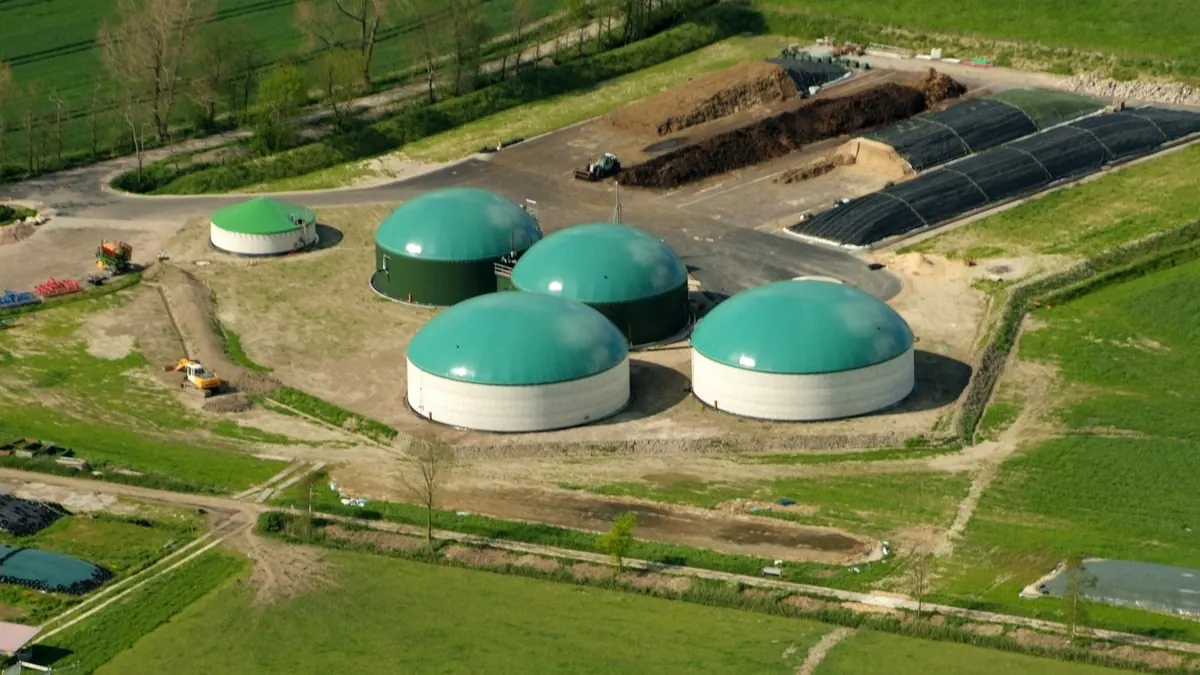

Two-stage digestion is a system in which hydrolysis and acidogenesis take place in a separate tank from acetogenesis and methanogenesis, so that each phase has its own optimal conditions. The idea is old, and in the practice of agricultural biogas plants it is still rare. It should not be confused with the main and secondary digester arrangement, which we discuss below.
Biological rationale
The organisms responsible for the first stages (hydrolysis, acidogenesis) grow quickly, doubling within hours, and work optimally at a pH of approx. 5.0–6.5. Methanogens have a much longer generation time (days) and need a pH close to neutral, as a guide 6.8–7.5. In a single-stage system both communities live in one tank, and the pH settles as a compromise, maintained mainly by the ammonium-carbonate buffer. A description of the stages can be found in the article on the four stages of fermentation.
Separating the phases therefore makes it possible to: shorten the retention time in the acid phase (e.g. to 1–5 days, compared with several dozen days in the whole system), protect the methanogens from a sudden influx of acids, and better break down difficult polymers (cellulose, lignocelluloses) thanks to a longer time and controlled pH. In the methane phase the process is also more predictable, because the reactor receives acids at a more even concentration.
Configurations found in practice
- Acid hydrolysis + methane reactor. The first tank, small (usually a few to a dozen or so percent of the total volume), operates with a short HRT and low pH; the liquid product goes to the main digester. It can be fed with quickly acidifying or difficult substrates (straw, lignocellulosic waste).
- Main and secondary digester (post-digestion). A common arrangement in agricultural biogas plants, where the mass flows from the main chamber to the secondary chamber and then to the digestate tank. This is a series arrangement, but both chambers work at the same pH conditions; the secondary phase picks up the remaining potential and does not achieve phase separation. In such an arrangement, how the volumes and retention times are divided matters.
- Systems with recirculation of liquid from the methane phase to hydrolysis, which helps buffer the pH in the first tank.
- Seasonal solutions, in which hydrolysis works periodically, when particular substrates are available in the season.
Advantages
- Stability. The methane phase is protected from acid shock; disturbances in the first stage do not immediately cause problems in the second.
- Work with difficult substrates. Substrates poor in buffer or quickly acidifying (sugar-rich, beet pulp, food waste) are easier to process when the acid phase is controlled.
- Better breakdown of lignocellulose. A longer and better-chosen hydrolysis increases the availability of polymers for the later stages, although the gain depends on the substrate.
- Control flexibility. Retention time and temperature can be regulated independently in each phase.
- Possibility of obtaining intermediate products (e.g. hydrogen or acids) with suitable designs, more on which in the article on two-stage fermentation with hydrogen.
Disadvantages and limitations
- Cost. An additional tank, agitators, pumps, measurement systems and controls mean a clear rise in capital expenditure and servicing.
- Emissions from the acid phase. A gas of different composition is formed (more CO₂, hydrogen, trace methane, often hydrogen sulphide). If the phase is not tightly closed, these are emissions to the atmosphere and odour nuisance.
- Managing the gas from hydrolysis. The gas from the acid phase with a low methane content must be removed and utilised (fed into the system or flared), which complicates the plant.
- Energy losses. Part of the organic matter is converted to CO₂ in the acid phase instead of to methane; with improper management the net yield does not rise.
- Risk of disturbances at the interface of the phases. An uneven flow of acids to the methane phase can cause overload there instead of avoiding it.
- Operating rigour. Two tanks mean two sets of parameters to control.
The safety of the gas from the acid phase (hydrogen, hydrogen sulphide) must be taken into account in the explosion risk assessment and in the hazardous zones.
When to choose a two-stage system
As supporting criteria (not rigid rules) the following can be adopted:
| Situation | Does phase separation make sense |
|---|---|
| A stable silage + slurry mix, one supplier | usually not, a single-stage with a secondary digester is enough |
| A large share of difficult lignocellulose (straw, grasses) | possible, after an economic analysis |
| Quickly acidifying food waste of variable composition | often yes, if the load regime is not constant |
| The aim is to obtain hydrogen or acids | yes, as part of the concept |
| Limited budget, small plant | usually not |
The decision is worth preceding with laboratory or pilot-scale trials with real substrates and an analysis of the indicators described in the guide on FOS/TAC and monitoring. An alternative is substrate pretreatment, e.g. thermal hydrolysis, if the difficulty concerns mainly the availability of polymers.
Conclusions
For a typical agricultural biogas plant running on maize silage and slurry, a two-stage system rarely pays back. The stability advantage can often be achieved more cheaply: through even feeding, a proper OLR, monitoring and sufficient capacity of the secondary chamber. Separating the phases is worth considering when the main problem lies in the nature of the substrate (difficult or variable), not in the quality of process management. In other cases it is better to invest in feeding stability and measurements.
Sources
Related articles