Emissions and climateExplainer
Without biogas plants: what happens to organic waste without controlled fermentation
Uncontrolled decomposition of organic waste emits methane, nitrous oxide and ammonia. A biogas plant can reduce these emissions, but only if it is itself tight and well run.
Other language versions: polski.


Without controlled fermentation, organic waste, slurry and manure decompose in an uncontrolled way, emitting methane, nitrous oxide and ammonia; a biogas plant captures methane and turns it into energy, provided it is tight and well run. The climate benefit is therefore not automatic, but results from a comparison with a specific reference scenario.
Greenhouse gases
Methane (CH₄) is formed in the anaerobic decomposition of organic matter, for example in landfills and slurry tanks. According to the IPCC Fifth Assessment Report, its warming potential is about 28 times that of CO₂ over a 100-year horizon and about 84 times over a 20-year horizon. Nitrous oxide (N₂O) has a potential of about 265. N₂O is formed mainly in nitrification and denitrification processes, including during the storage and application of natural fertilisers. In subsequent reports the values were slightly modified. Details on emissions from natural fertilisers: Emissions from natural fertilisers: methane, N₂O and ammonia.
What uncontrolled decomposition risks
- Landfills: bio-waste decomposes anaerobically, producing landfill gas which, without degassing, escapes into the atmosphere (Landfill gas).
- Slurry and manure: in open tanks they emit methane and ammonia.
- Leachate: from food waste it contains fats, proteins and carbohydrates, which can pollute soil and water.
- Odours and sanitary risks.
Burning waste in the open is prohibited in Poland and constitutes a misdemeanour, so the main alternatives to fermentation are landfilling, composting or thermal treatment in facilities with flue gas cleaning.
What a biogas plant offers
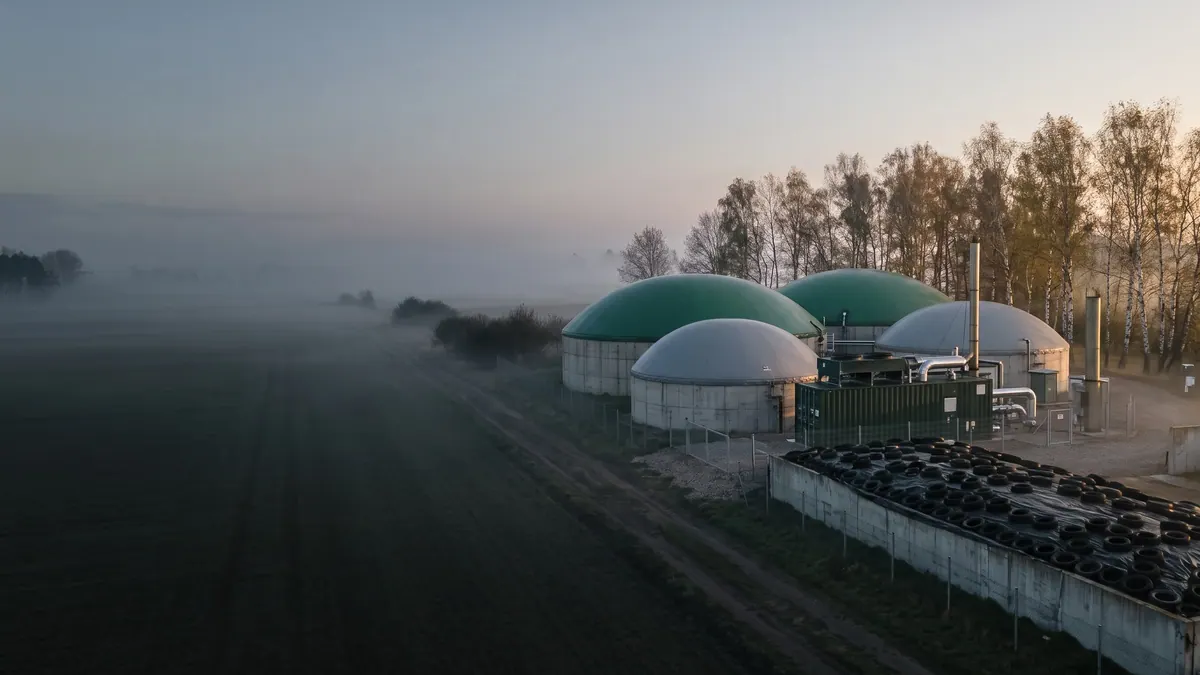
Fermentation in a sealed reactor captures methane, which, burned in cogeneration, yields electricity and heat or, after upgrading, becomes biomethane. Digestate is less of an odour nuisance and is a fertiliser if it meets legal requirements. The emission reduction concerns both the climate (less methane) and the air (less ammonia with proper storage and application).
Limits of the benefit
- Tightness: methane leaks from the installation, tanks and seals can reduce the benefit; this is why leak detection and closed digestate stores are important (Digestate: storage in closed tanks).
- Reference scenario: avoided emissions depend on what would happen to the substrate without the biogas plant; the same value cannot be assigned to every installation.
- Hygienisation: fermentation reduces the number of pathogens but does not replace the hygienisation required for animal by-products (Regulation 1069/2009, including pasteurisation).
- Dedicated substrates: energy crops require the emissions from their production to be taken into account.
Solutions
- Invest in tight infrastructure, emission monitoring and periodic leak measurements.
- Plan separate collection of bio-waste and direct it to composting plants or biogas plants instead of landfills.
- Use low-emission digestate application techniques (Ammonia emissions from digestate).
- Consider upgrading biogas to biomethane where there is an offtaker.
The climate case for biogas is strong, but it requires a reliable calculation and tight implementation.
The importance of tightness and monitoring
For a biogas plant to actually reduce emissions, the operator should regularly check the tightness of gas holders, pressure relief valves, pipelines and cogeneration units, and measure unburned methane in the engine exhaust. Leaks and incomplete combustion are the main routes of methane loss within the installation itself. Good practices such as covering digestate stores, recovering gas from digestate and regular inspections reduce these losses (Methane losses and fugitive emissions at a biogas plant).
Summary
A biogas plant is not a remedy for all the problems of organic waste, but where the alternative is landfilling or storage in open tanks, controlled fermentation makes it possible to capture methane and obtain energy and fertiliser. The climate value depends on the quality of construction and operation, so the assessment should be based on measurements, not on general claims. In addition, it is worth noting that reducing odours and leachate improves quality of life in the vicinity of farms and processing plants, which can be as important a local argument as the greenhouse gas balance. Comparisons of reference scenarios for specific projects require data on the type of substrate, the way it was previously managed and transport distances, and on whether the installation uses closed digestate stores.
Sources
Questions and answers
Does a biogas plant always reduce methane emissions?
Only if the waste and slurry would otherwise be landfilled or stored in a way that emits methane, and the biogas plant is gas-tight. Leaks from the installation and from open digestate stores can reduce or cancel out the benefit.
Related articles