

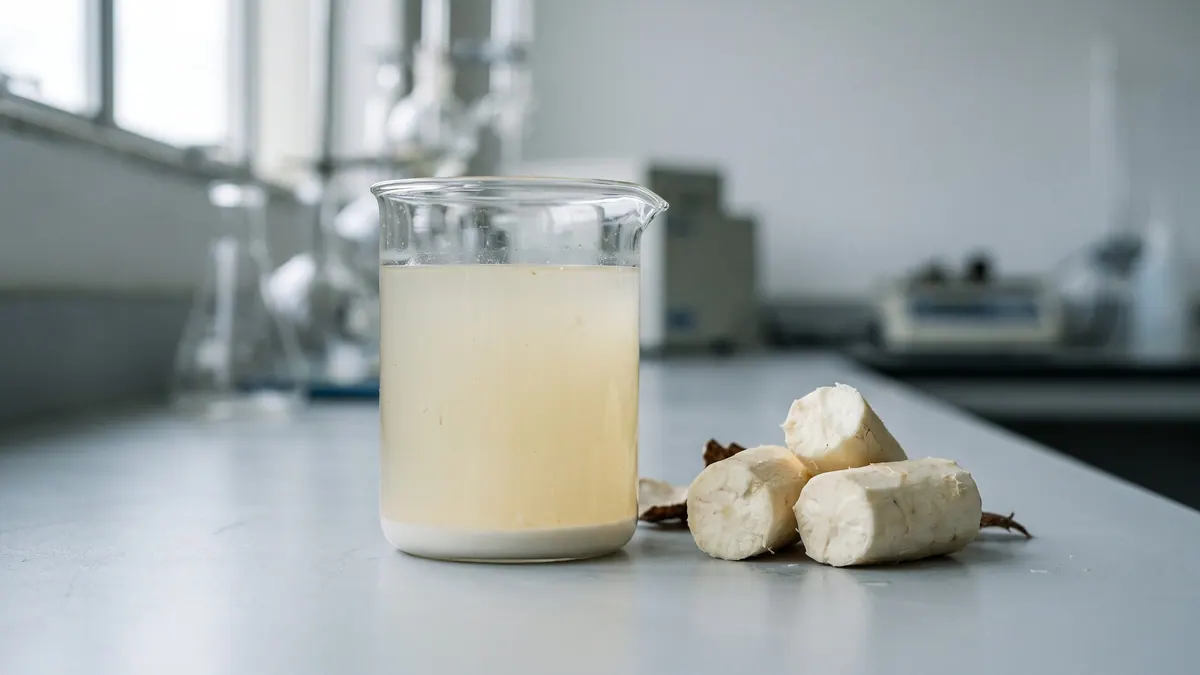
BMP testingBy-products of the agri-food industry
Cassava processing wastewater — BMP: 2 studies, weighted mean 494 m³ CH₄/t VS
Cassava processing wastewater (manipueira) is a dilute, acidic liquid rich in starch and sugars; two studies report very different values (368 and 620 m³ CH₄/t VS), and processing is associated with cyanides.
rating: negativeCH₄ ≈ 52 % (estimate)
Illustration: FeedstockData (AI, Google Gemini)
- Weighted mean
- 494m³ CH₄/t VS
- Range
- 368–620m³ CH₄/t VS
- Records
- 2studies
- Publications
- 2sources
- Temperatures
- 35 °Cof the test
Methane in biogas
Medium methane content · ≈ 5.2 kWh/m³ of biogas
estimate from the substrate type The collected studies contain no measurement. The interval follows from the approximate composition (carbohydrate-dominated (no protein or fat characteristics)) and the yields of compound groups according to FNR.
Rating for biogas plants
negative — editorial rating for biogas plantsMay endanger process stability — not worth taking even with a large payment
Potential per tonne of fresh matter: very low (9 m³ CH₄/t); process risk: inhibitors, acidification. No additional handling requirements. Low potential combined with process risk and handling costs.
Why? Rating factors
Potential per tonne −1
- −1potential 9 m³ CH₄/t fresh matter (BMP 494 × DM 1.8 % × VS 97.2 %)
Process stability −1.5
- −1inhibitors: natural or residues (e.g. limonene, polyphenols, antibiotics, metals)
- −0.5acidification: rapid degradation / acidic pH, risk of VFA accumulation, needs buffering
Handling and costs 0
- 0no factors
Total points: −2.5 · thresholds: ≥ 2.5 very good, ≥ 1 good, below — neutral; negative with cumulative process risk.
Low potential combined with process risk and handling costs.
Add to the co-digestion calculator CSV data
BMP curves from 2 studies
Weighted mean Individual records
Dashed lines are a model curve (first-order kinetics, B(t) = B₀·(1 − e−kt)); the end point comes from the publication. All curves are model curves.
Cumulative methane production over the test [m³ CH₄/t VS]. The thick line is the weighted mean of all records (494); dots mark the end values given in the publications. Point at the chart to read values; click a legend item to hide or show a record.
Records and sources
Download CSV| Source | BMP m³ CH₄/t VS | Temperature | Sample | Curve |
|---|---|---|---|---|
| Ahou et al. (2021) DOI | 368 | — | cassava wastewater (CWW) | end point (model curve) |
| Achi et al. (2020) DOI | 620 | 35 °C · mesophilic | CW-only (cassava wastewater alone, 48 d) | end point (model curve) |
| Weighted mean | 494 | arithmetic mean 494, SD 178 | ||
Typical composition
- Dry matter (DM)
- 1.8% (range 1.8–1.8)
- Volatile solids (VS)
- 97.2 % DM (range 97.2–97.2)
Median and range of the determinations reported in the publications behind this substrate's BMP records (read from: tabele, tekst lub zbiór danych publikacji); dry matter: 1 determination, volatile solids: 1 determination. DM from a single determination – indicative value.
Sources: Achi et al. (2020).
The composition of the raw material varies between batches — for plant calculations use an analysis of your own sample. The calculator inserts typical values automatically.
Process properties
Advantages
- Methane potential in the compendium: 368-620 m³ CH₄/t VS, 2 records from 2 papers (mean 494, SD 178); the spread is very large, so the mean is only indicative (Ahou et al. 2021; Achi et al. 2020).
- The organic matter (97.2% DM) is mainly starch and sugars, which degrade quickly; in the study by Achi et al. (2020) the wastewater sample without additives produced 19% methane in the first 15 days of 48, and the greatest shortening of the lag phase was given by the variant with poultry manure and biochar (84.8% methane after 15 days).
- Adding manure (poultry or cattle) shortened the lag phase of methane production, and zeolite or biochar reduced its length in mixtures with wastewater (Achi et al. 2020).
- A liquid with a COD of approx. 30-34 g/L and a very low fibre content needs no size reduction and can be pumped (Achi et al. 2020).
Drawbacks and risks
- Very low dry matter (17.8 g/kg): per unit of fresh matter only approx. 10.7 m³ CH₄/t was obtained, so the substrate dilutes the feed and lowers the energy per m3 of digester (Achi et al. 2020).
- Low pH (5.5) and low nitrogen content (C:N approx. 27.8) favour rapid acidification and early inhibition of the process (Ahou et al. 2021; Achi et al. 2020).
- Cyanogenic glycosides from cassava release cyanide: in starch production wastewater up to 200 mg/L; at pH 5 and below cyanide accumulated, and pre-acidification failed (Siller and Winter 1998).
- The results of the two papers differ by more than 70%, and the value of 620 m³/t VS exceeds the typical potential of carbohydrates (approx. 415); determining VS by drying may lose volatile compounds and inflate the result expressed per VS (Kreuger et al. 2011, silages) - with regard to this paper it is a hypothesis.
Co-digestion — what to combine it with, what to watch out for
- combines well
substrates: high alkalinity (buffer) — e.g. Cattle manure, Pig slurry, Cattle slurry, Duck slurry, Rumen and digestive tract content
Poultry or cattle manure supplies nitrogen and alkalinity; in the study it shortened the lag phase of wastewater with a pH of 5.5 and low nitrogen (Achi et al. 2020).[1]
- caution
substrates: acidic — e.g. Whey, Citrus peels, Apples, Cauliflower leaves and stems, Olive pomace / olive mill solid waste
Accumulation of acidification: the wastewater has a pH of 5.5, and at pH 5 and below cyanide accumulated (Siller and Winter 1998).[2][3]
- caution
substrates: easily degradable — e.g. Maize silage (whole crop), Food waste, Sorghum, whole crop, Whey, Beet leaves and tops
Combining with another rapidly degradable substrate increases the risk of overloading and acidification; cassava wastewater is itself readily degradable and low in nitrogen (Ahou et al. 2021).[3]
Dosing
No source-based share limits. In the study by Achi et al. (2020) the wastewater was digested on its own (48 days, 35 °C) and in mixtures with manure at 1:1 and 2:1; co-digestion with manure shortened the lag phase but did not increase the yield per VS. Because of the acidic pH and low nitrogen, gradual introduction and monitoring of pH, VFA and cyanide concentration are recommended. In co-digestion of cassava pulp with pig slurry, stable operation was maintained up to 6 kg VS/m3 d, and cyanide was degraded (Glanpracha and Annachhatre 2016) - this is a result for pulp, not wastewater.
Introduce gradually, starting with a small dose and monitoring the process (e.g. FOS/TAC, pH, gas composition).
Practical requirements
- Determine pH, COD and cyanide concentration in every batch; wastewater from starch production could contain up to 200 mg CN/L (Siller and Winter 1998).
- Keep the reactor pH above 5, because at pH 5 and below cyanide accumulated (Siller and Winter 1998).
- Acclimatise the sludge to cyanide before increasing the load (Glanpracha and Annachhatre 2016).
- Also express yield per volume of wastewater, because the VS determination at such a low DM is uncertain (Achi et al. 2020; Kreuger et al. 2011).
Sources of the process data
- Achi, Hassanein, Lansing (2020). Enhanced Biogas Production of Cassava Wastewater Using Zeolite and Biochar Additives and Manure Co-Digestion. Energies 13(2), 491
- Siller, Winter (1998). Degradation of cyanide in agroindustrial or industrial wastewater in an acidification reactor or in a single-step methane reactor by bacteria enriched from soil and peels of cassava. Appl. Microbiol. Biotechnol.
- Ahou et al. (2021). Lab-scale anaerobic digestion of cassava peels: the first step of energy recovery from cassava waste and water hyacinth. Environ. Technol. 42(9)
- Glanpracha, Annachhatre (2016). Anaerobic co-digestion of cyanide containing cassava pulp with pig manure. Bioresour. Technol.
- Kreuger et al. (2011). Ensiling of crops for biogas production: effects on methane yield and total solids determination. Biotechnol. Biofuels 4, 44
The co-digestion calculator will assess a specific mixture containing this substrate.
What it is and where it comes from
Wastewater from cassava processing (cassava, Manihot esculenta), called manipueira in Brazil, arises from the grating, pressing and washing of tubers and from the production of starch and flour. Cassava processing is an important branch of industry in Africa, Latin America and Asia; in 2017 the African region supplied 55% of world production (121 million tonnes), and 25-37% of the yield ends up as waste in the form of peelings and pulp (Achi et al. 2020). This substrate does not occur in Poland, so the entry is of informational character and concerns projects in tropical countries. The dataset covers two studies: wastewater from Benin (Ahou et al. 2021) and wastewater produced in the laboratory from tubers bought in Maryland, USA (Achi et al. 2020).
Properties relevant to digestion
The liquid is very dilute: in the study by Achi et al. the dry matter was 17.8 g/kg (about 1.8%), of which 97.2% was organic matter, with a COD of 30-34 g/L and a pH of 5.5. The organic matter is mainly starch and sugars, so it degrades quickly, and the problems indicated in the literature are low nitrogen content and rapid acidification (Ahou et al. 2021; Achi et al. 2020). The wastewater therefore contributes neither fibre nor lignin, but also contains almost no buffer. The addition of manure (co-digestion) shortened the lag phase, but in the study by Achi et al. it did not increase methane yield expressed per VS. Apart from this, the classic hazard is cyanogenic glycosides: during starch production they are released enzymatically and give cyanide in the wastewater at concentrations of up to 200 mg/L, and at pH 5 or lower cyanide accumulated in the reactor and pre-acidification failed (Siller and Winter 1998). On the other hand, in the co-digestion of cassava pulp with pig slurry, suitably acclimatised sludge degraded cyanide without an inhibitory effect, with stable operation up to a load of 6 kg VS/m3 d (Glanpracha and Annachhatre 2016).
How to read the spread of results
The two records are 368 m³ CH₄/t VS (Ahou et al. 2021, a value from the abstract, no temperature stated) and 620 m³ CH₄/t VS (Achi et al. 2020, 48 days, 35 °C, result at 20 °C and 1 atm). The difference is very large, and the higher value exceeds the typical theoretical potential of carbohydrates alone (about 415 m³ CH₄/t VS). The data from the study by Achi et al. show that the COD of the wastewater (about 30 g/L) is clearly higher than would be expected with a VS of 17.3 g/kg for carbohydrate matter; this suggests that VS may have been underestimated. A mechanism has been described in the literature that could explain this: determining dry matter by drying causes losses of volatile compounds, and the lack of correction overstates yield expressed per VS (Kreuger et al. 2011, using silages as an example). However, there is no evidence that this artefact applies to the study in question, so it should be treated as a hypothesis. All that is certain is that the results of the two studies differ considerably, and that conversion to VS for such a dilute liquid is subject to great uncertainty. The mean (494 m³/t) is therefore merely the arithmetic midpoint of the two values.
In biogas plant practice
Because of the low DM content, it is worth stating the yield also per volume of wastewater: in the study by Achi et al. this was about 10.7 m³ CH₄/t of fresh matter of wastewater. The feed is therefore more a diluent and a source of readily available carbon than an energy substrate; reactors designed for liquids (e.g. UASB) or co-digestion with a substrate of higher alkalinity are sometimes more sensible. The pH, VFA and cyanide concentration must be monitored. Investment planning requires your own BMP test, including determination of COD, pH and cyanides, carried out on wastewater from the specific plant.
Methodology in brief
BMP is the amount of methane obtained from volatile solids (VS) in a batch test, given in m³ CH₄ per tonne of VS (numerically the same as NmL CH₄/g VS in the publications) and converted to normal conditions (0 °C, 101.325 kPa). The weighted mean gives each publication a total weight of 1, split equally between its results for the substrate — a paper testing twenty varieties does not outweigh a paper with a single sample. In inter-laboratory programmes the unit is the laboratory (total weight 1), and within it the weight of a test grows with the number of bottles (replicates). Results after pretreatment (e.g. thermal, chemical, enzymatic) are shown separately and are not included in the mean.
Solid lines are curves measured in the tests. Where a publication gives only the final result, we draw a first-order kinetic model, B(t) = B₀·(1 − e−kt): only the end point comes from the publication, and the shape of the curve serves purely as visualisation — do not read the production on a particular day from it. For this substrate k = 0.091 d−1 was assumed (no kinetic data for the group – the median of all available rate constants k (93 values) was used).
The statistics describe the spread of published results — a descriptive compilation, not a meta-analysis or a guarantee of plant yield.
Bibliography
- Ahou, Y.S.; Bautista Angeli, J.R.; Awad, S.; Baba-Moussa, L.; Andres, Y. (2021). Lab-scale anaerobic digestion of cassava peels: the first step of energy recovery from cassava waste and water hyacinth. Environmental Technology 42(9), 1438–1451. DOI: 10.1080/09593330.2019.1670266 DOI
- Achi, C.G.; Hassanein, A.; Lansing, S. (2020). Enhanced Biogas Production of Cassava Wastewater Using Zeolite and Biochar Additives and Manure Co-Digestion. Energies 13(2), 491. DOI: 10.3390/en13020491 DOI
All sources of the site: bibliography.
Other substrates in the group “By-products of the agri-food industry”
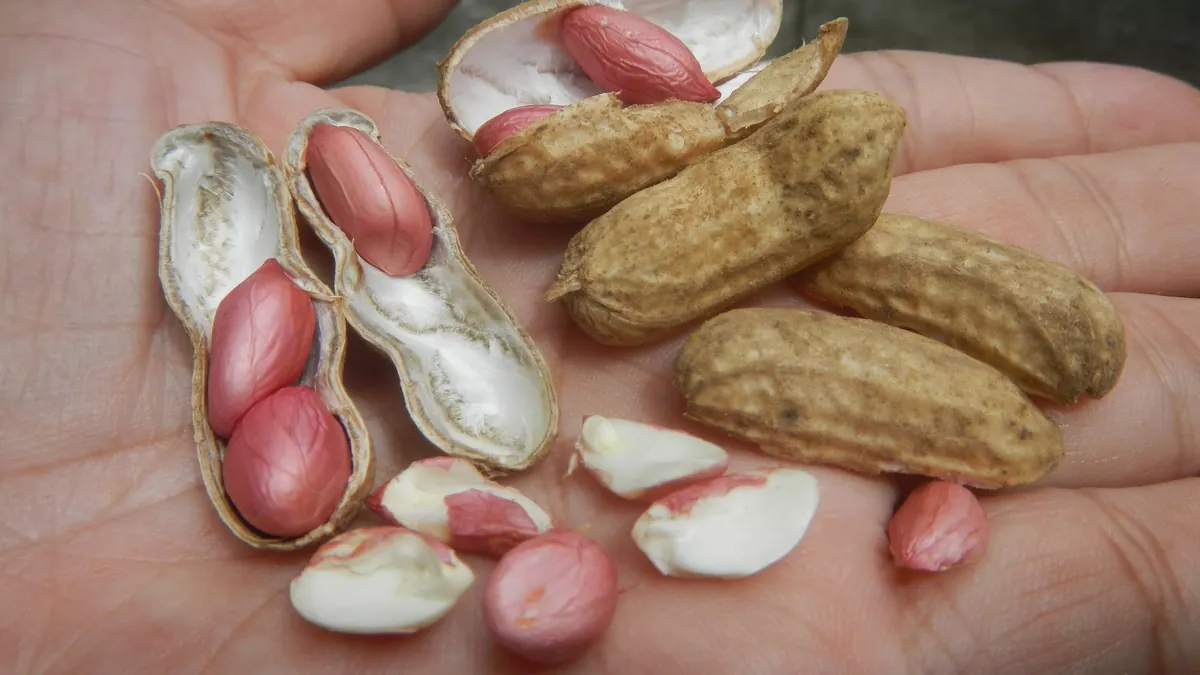
Peanut shells — BMP: 2 studies, weighted mean 50 m³ CH₄/t VS
50 m³ CH₄/t VS weighted mean from 2 studies
neutral — editorial rating for biogas plants≈52 %
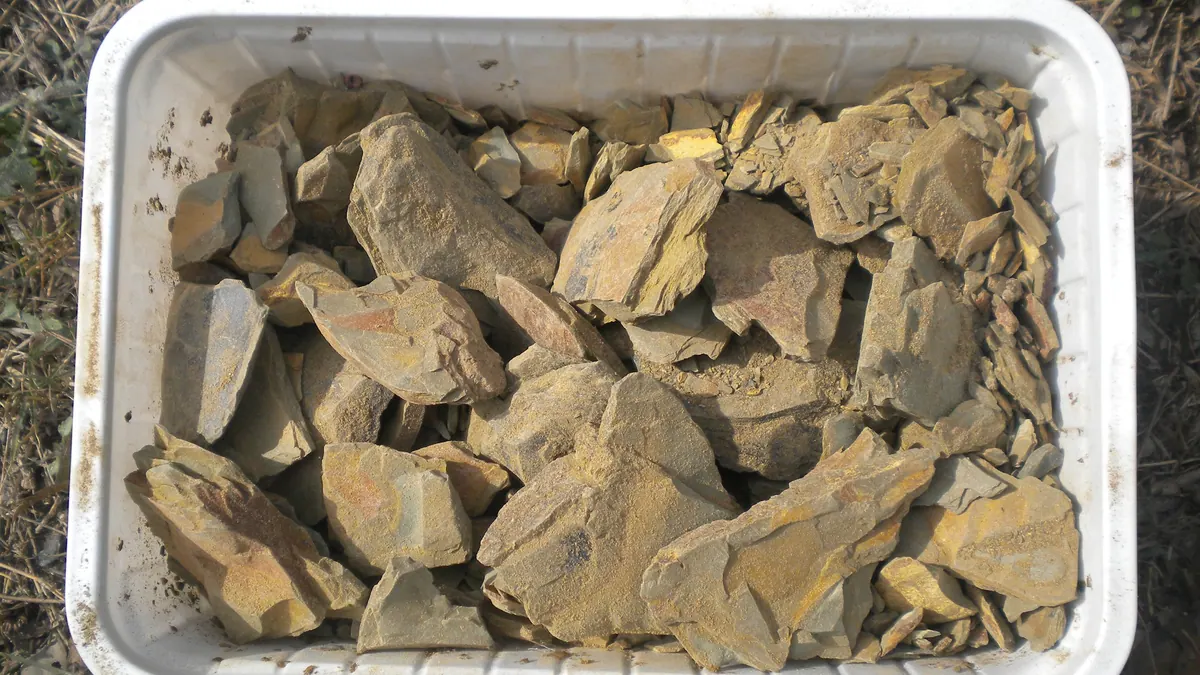
Oil refining residues (gums, condensates, spent earth) — BMP: 5 studies, weighted mean 714 m³ CH₄/t VS
714 m³ CH₄/t VS weighted mean from 5 studies
≈63 %
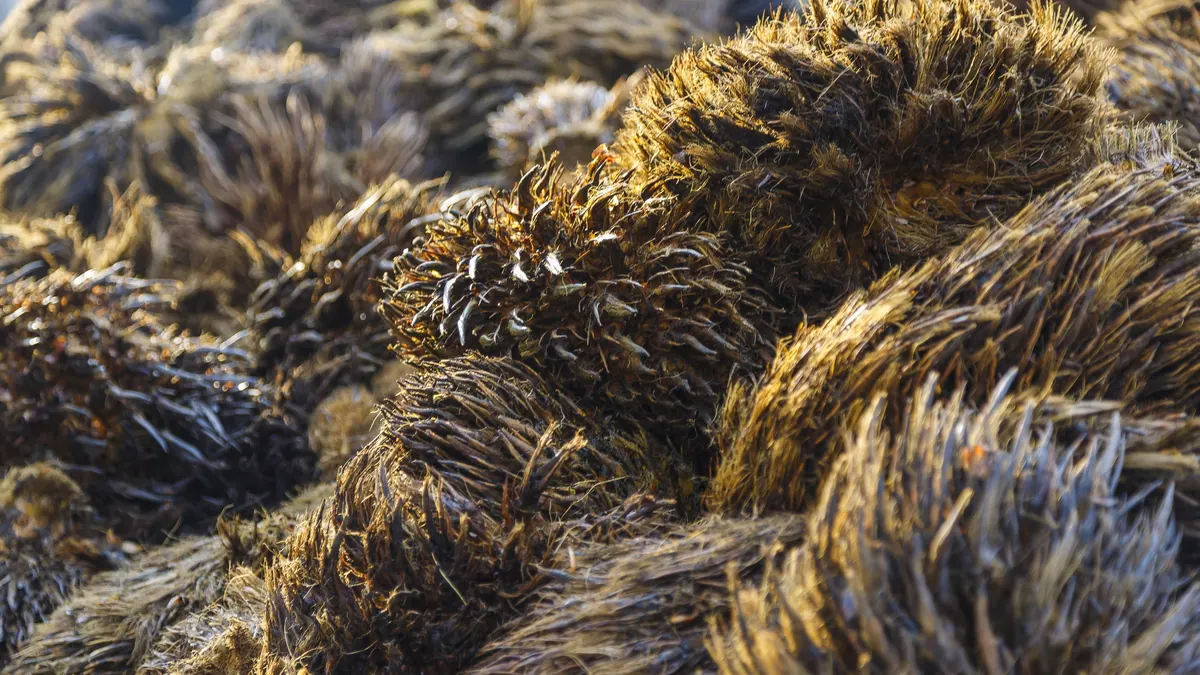
Oil palm empty fruit bunches — BMP: 2 studies, weighted mean 179 m³ CH₄/t VS
179 m³ CH₄/t VS weighted mean from 2 studies
≈52 %
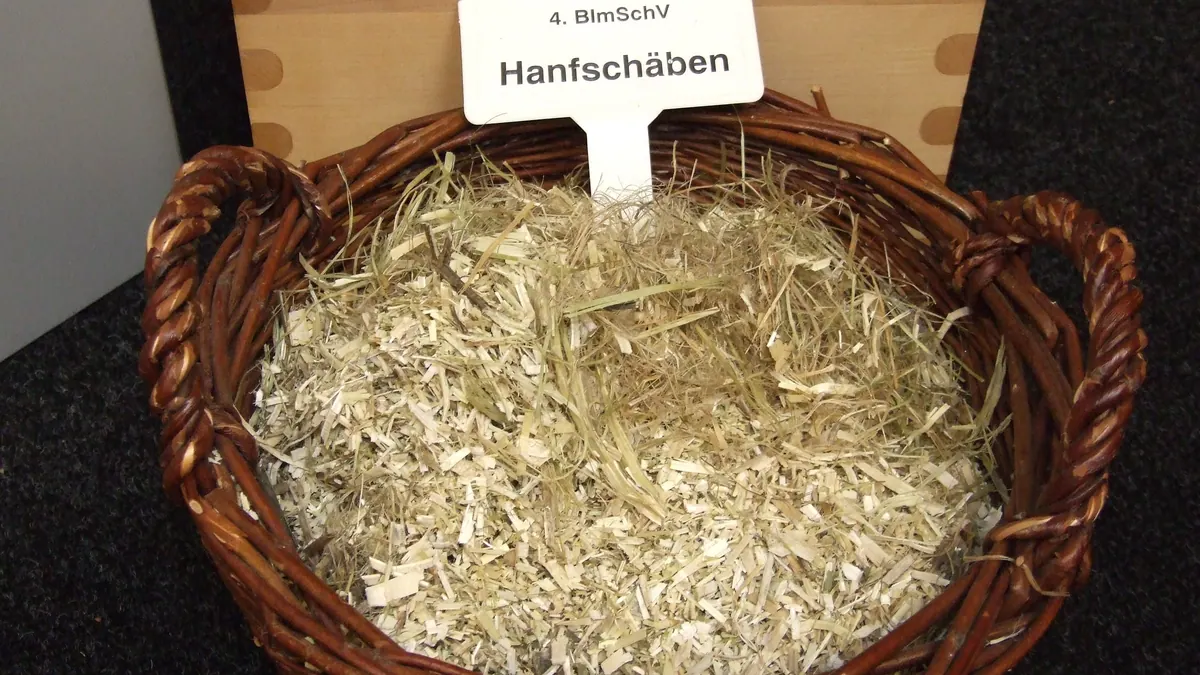
Hemp hurds and dust — BMP: 2 studies, weighted mean 212 m³ CH₄/t VS
212 m³ CH₄/t VS weighted mean from 2 studies
good — editorial rating for biogas plants≈52 %