

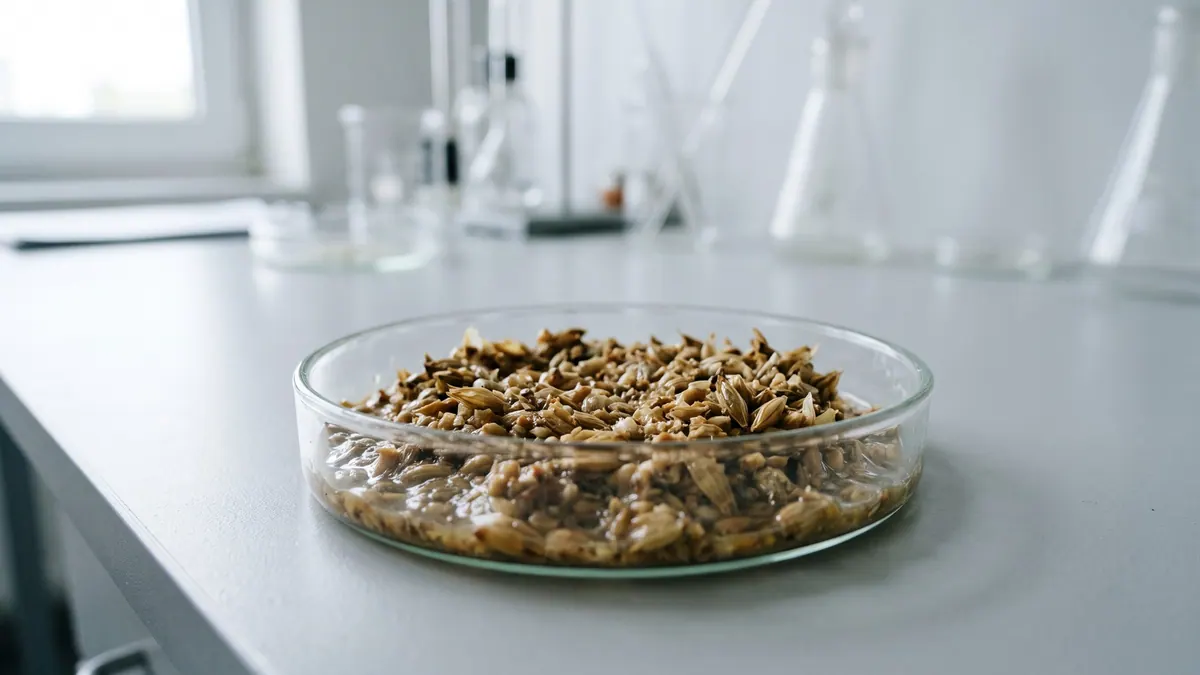
BMP testingBy-products of the agri-food industry
Brewers' spent grain — BMP: 6 studies, weighted mean 347 m³ CH₄/t VS
Brewers' spent grain is a protein- and fibre-rich by-product of beer production with high availability; valued as feed, and in a biogas plant it requires ammonia control.
rating: neutralCH₄ ≈ 58 % (estimate)
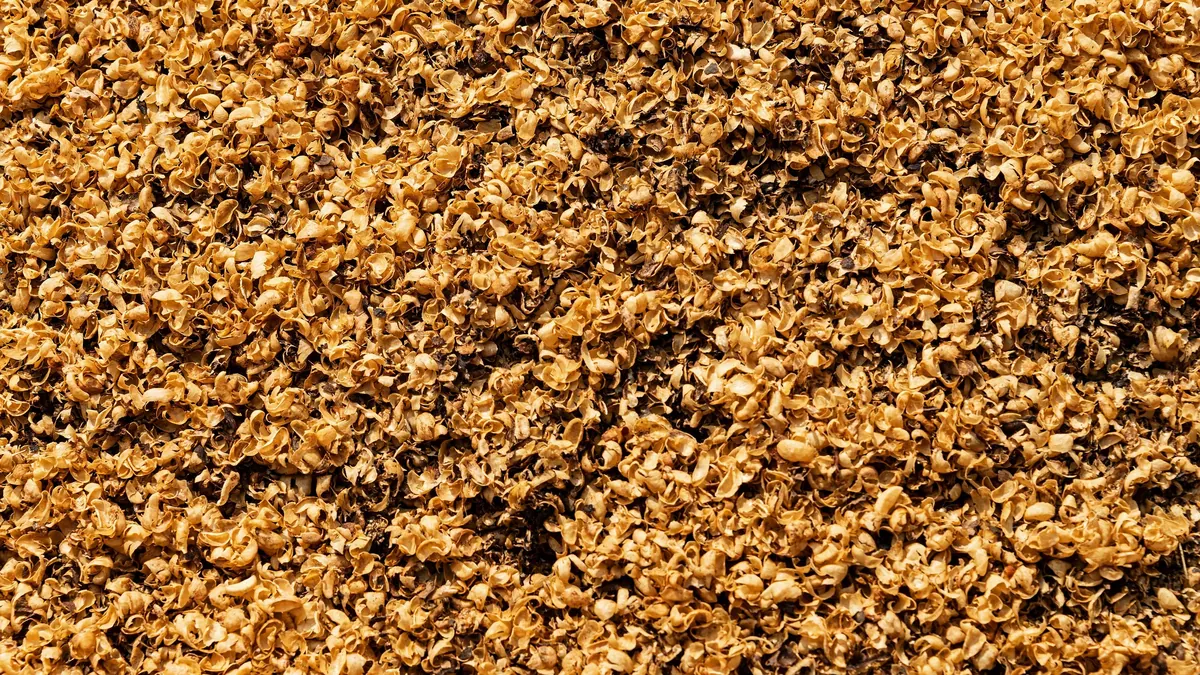
Illustration: FeedstockData (AI, Google Gemini)
- Weighted mean
- 347m³ CH₄/t VS
- Range
- 268–464m³ CH₄/t VS
- Records
- 6studies
- Publications
- 3sources
- Temperatures
- 37 °Cof the test
Methane in biogas
Medium methane content · ≈ 5.8 kWh/m³ of biogas
estimate from the substrate type The collected studies contain no measurement. The interval follows from the approximate composition (protein-rich (process classification)) and the yields of compound groups according to FNR.
Rating for biogas plants
neutral — editorial rating for biogas plantsNo clear advantages — worth charging a fee for accepting it
Potential per tonne of fresh matter: high (60 m³ CH₄/t); process risk: protein / nitrogen. Handling costs: fibres, floating layer.
Why? Rating factors
Potential per tonne +2
- +2potential 60 m³ CH₄/t fresh matter (BMP 347 × composition per FNR (2013), Guía sobre el Biogás, Tabla 4.9: brewer's spent grain (granos residuales; DM 23 %, VS 75 % DM))
Process stability −1
- −1protein / nitrogen: risk of ammonia inhibition at higher shares
Handling and costs −0.5
- −0.5fibres, floating layer — shredding and intensive mixing
Total points: 0.5 · thresholds: ≥ 2.5 very good, ≥ 1 good, below — neutral; negative with cumulative process risk.
Add to the co-digestion calculator CSV data
BMP curves from 6 studies
Weighted mean Individual records
Dashed lines are a model curve (first-order kinetics, B(t) = B₀·(1 − e−kt)); the end point comes from the publication. All curves are model curves.
Cumulative methane production over the test [m³ CH₄/t VS]. The thick line is the weighted mean of all records (347); dots mark the end values given in the publications. Point at the chart to read values; click a legend item to hide or show a record.
Records and sources
Download CSV| Source | BMP m³ CH₄/t VS | Temperature | Sample | Curve |
|---|---|---|---|---|
| Edunjobi et al. (2024) DOI | 268 | 37 °C · mesophilic | brewers spent grain (BSG) + inoculum BWWS (D2) | end point (model curve) |
| Syguła et al. (2023) · 1 DOI | 302 | 37 °C · mesophilic | brewer's spent grain (control reactor, trial with lime) | end point (model curve) |
| Syguła et al. (2023) · 2 DOI | 312 | 37 °C · mesophilic | brewer's spent grain (control reactor, trial with porous ceramic) | end point (model curve) |
| Syguła et al. (2023) · 3 DOI | 316 | 37 °C · mesophilic | brewer's spent grain (control reactor, trial with iron) | end point (model curve) |
| Llanos-Lizcano et al. (2024) · 1 DOI | 461 | — | Brewery waste (BW), ISR 2 | end point (model curve) |
| Llanos-Lizcano et al. (2024) · 2 DOI | 464 | — | Brewery waste (BW), ISR 1 | end point (model curve) |
| Weighted mean | 347 | arithmetic mean 354, SD 86 | ||
Process properties
Advantages
- Methane potential in the Substraty.pl BMP dataset: weighted mean 346.7 m³ CH₄/t VS (SD 85.7; 6 records, 3 sources).
- Mono-digestion of brewer's spent grain in a two-stage process is described (Panjicko et al. 2017).
- High protein and hemicellulose content provides N.
Drawbacks and risks
- At high shares, protein gives ammonia (Rajagopal et al. 2013).
- Husk lignin limits hydrolysis (Hendriks and Zeeman 2009).
Co-digestion — what to combine it with, what to watch out for
- combines well
substrates: high alkalinity (buffer) — e.g. Cattle manure, Pig slurry, Cattle slurry, Duck slurry, Rumen and digestive tract content
Slurry supplies N and alkalinity, balancing the high C/N of the material.[1][2]
- caution
substrates: protein-rich — e.g. Food waste, Municipal sewage sludge (mixed), Poultry manure, Organic fraction of municipal solid waste, Grass clippings
Spent grain + protein-rich waste: ammonia.[3]
Dosing
No source-based % in co-digestion; monitor NH4-N and use size reduction. Start with a low dose.
Introduce gradually, starting with a small dose and monitoring the process (e.g. FOS/TAC, pH, gas composition).
Practical requirements
- Ensiling makes it possible to store seasonal biomass; properly ensiled plants (in the study maize, sorghum, forage rye, triticale) can be stored for up to a year without loss of methane production (Herrmann et al. 2011).
Sources of the process data
- Hagos et al. (2017). Anaerobic co-digestion process for biogas production: progress, challenges and perspectives. Renew. Sustain. Energy Rev.
- Weiland, P. (2010) Biogas production: current state and perspectives. Applied Microbiology and Biotechnology
- Rajagopal, Masse, Singh (2013). A critical review on inhibition of anaerobic digestion process by excess ammonia. Bioresour. Technol.
- Panjicko et al. (2017). Biogas production from brewery spent grain as a mono-substrate in a two-stage process. J. Clean. Prod.
- Hendriks, Zeeman (2009). Pretreatments to enhance the digestibility of lignocellulosic biomass. Bioresour. Technol.
- Herrmann et al. (2011). Effects of ensiling, silage additives and storage period on methane formation of biogas crops. Bioresour. Technol.
The co-digestion calculator will assess a specific mixture containing this substrate.
What it is and where it comes from
Brewers' spent grain is the solid residue after the mashing of barley malt, arising in large quantities in every brewery. It contains husks, endosperm residues and protein that were not extracted into the wort. In Poland, a large beer producer, spent grain is available near breweries. It is wet and spoils quickly, so it goes mainly to cattle feed; however, in the event of surpluses or a lack of buyers it is sometimes considered as a biogas substrate.
Properties relevant to digestion
The dry matter of spent grain contains a lot of protein, hemicellulose (arabinoxylans), cellulose and lignin from the husks, as well as small amounts of fat and sugars. The high protein content means that at large shares the ammonia concentration rises, which can inhibit microorganisms, particularly under thermophilic conditions. The lignin and the structure of the husks limit hydrolysis, so comminution or pretreatment improves the yield. Spent grain is hot when it comes out of mashing and is wet, so it quickly spoils; preservation by ensiling is possible.
How to read the spread of results
The dataset contains several records from several sources, all under mesophilic conditions. Some records are control reactors from series of experiments in which additives were studied, so the results for spent grain without additives are replicates in different series. One of the studies used an inoculum from brewery wastewater treatment sludge. The spread also results from the beer recipe (type of malt), the proportion of husks, moisture, comminution and test conditions.
In biogas plant practice
Spent grain is a valued substrate provided that ammonia is controlled: the dose should be balanced with carbohydrate material, and pH and ammonium nitrogen monitored. Comminution or blending is advisable. Because the material is available all year round and of constant quality, it is convenient logistically. Its economics depend on the feed price. As a by-product of the food industry it may be treated as a by-product or as waste, depending on the arrangements and the entries in the plant's documents.
In some breweries spent grain is passed to farmers under feed contracts, so before planning deliveries to a biogas plant it must be checked whether the brewery has quantities available and whether the price exceeds the benefits of biogas production.
Methodology in brief
BMP is the amount of methane obtained from volatile solids (VS) in a batch test, given in m³ CH₄ per tonne of VS (numerically the same as NmL CH₄/g VS in the publications) and converted to normal conditions (0 °C, 101.325 kPa). The weighted mean gives each publication a total weight of 1, split equally between its results for the substrate — a paper testing twenty varieties does not outweigh a paper with a single sample. In inter-laboratory programmes the unit is the laboratory (total weight 1), and within it the weight of a test grows with the number of bottles (replicates). Results after pretreatment (e.g. thermal, chemical, enzymatic) are shown separately and are not included in the mean.
Solid lines are curves measured in the tests. Where a publication gives only the final result, we draw a first-order kinetic model, B(t) = B₀·(1 − e−kt): only the end point comes from the publication, and the shape of the curve serves purely as visualisation — do not read the production on a particular day from it. For this substrate k = 0.091 d−1 was assumed (no kinetic data for the group – the median of all available rate constants k (93 values) was used).
The statistics describe the spread of published results — a descriptive compilation, not a meta-analysis or a guarantee of plant yield.
Bibliography
- Edunjobi, T.D.; Agbede, O.O.; Aworanti, O.A.; Adebayo, A.O.; Agarry, S.E.; Ogunkunle, O.; Laseinde, O.T. (2024). Enhanced anaerobic digestion of brewers’ spent grain: effect of inoculum, poultry manure application and iron (iii) chloride supplementation on biogas production and its kinetics. Biomass Conversion and Biorefinery 14(23), 29561–29577. DOI: 10.1007/s13399-023-04813-6 DOI
- Syguła, E.; Rasaq, W.A.; Świechowski, K. (2023). Effects of Iron, Lime, and Porous Ceramic Powder Additives on Methane Production from Brewer’s Spent Grain in the Anaerobic Digestion Process. Materials 16(15), 5245. DOI: 10.3390/ma16155245 DOI
- Llanos-Lizcano, R.; Senila, L.; Modoi, O.C. (2024). Evaluation of Biochemical Methane Potential and Kinetics of Organic Waste Streams for Enhanced Biogas Production. Agronomy 14(11), 2546. DOI: 10.3390/agronomy14112546 DOI
All sources of the site: bibliography.
Other substrates in the group “By-products of the agri-food industry”
Soapstock — BMP: 3 studies, weighted mean 516 m³ CH₄/t VS
516 m³ CH₄/t VS weighted mean from 3 studies
≈63 %
Crude glycerol — BMP: 2 studies, weighted mean 426 m³ CH₄/t VS
426 m³ CH₄/t VS weighted mean from 2 studies
good — editorial rating for biogas plants≈52 %
Spent coffee grounds — BMP: 18 studies, weighted mean 262 m³ CH₄/t VS
262 m³ CH₄/t VS weighted mean from 18 studies
neutral — editorial rating for biogas plants≈65 %
Coffee husk — BMP: 3 studies, weighted mean 152 m³ CH₄/t VS
152 m³ CH₄/t VS weighted mean from 3 studies
≈52 %