

BMP testingFats, oils and animal by-products
Slaughterhouse blood — BMP: 2 studies, weighted mean 496 m³ CH₄/t VS
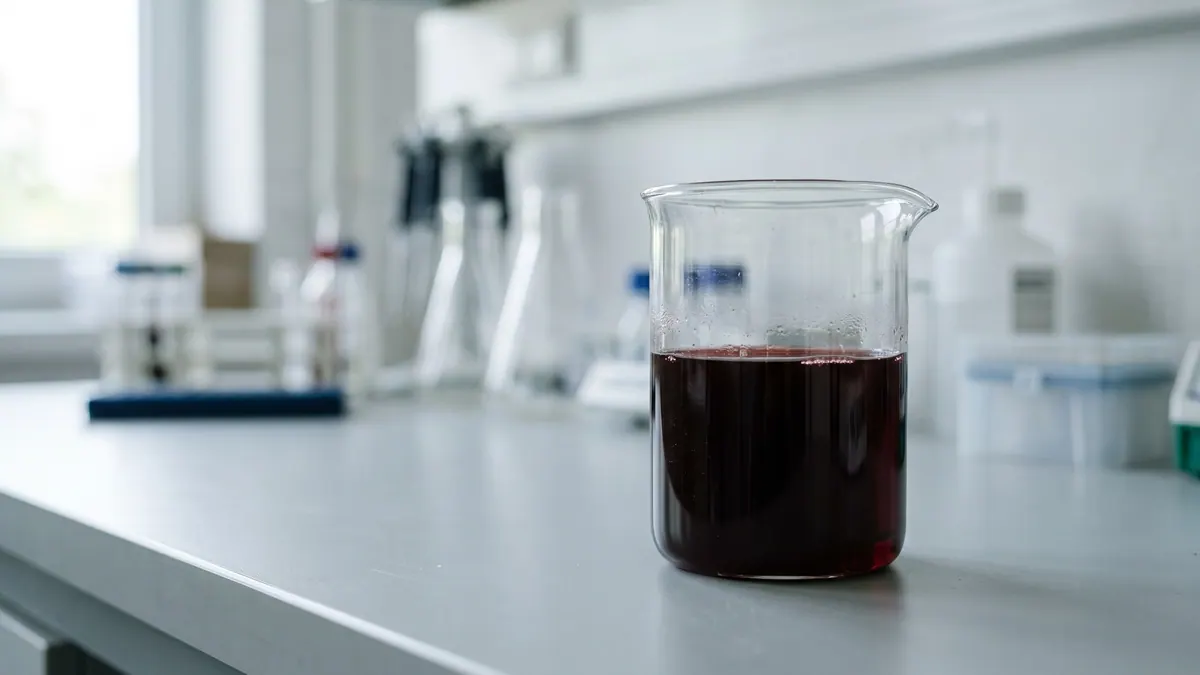
Slaughter blood is an animal by-product (ABP), very rich in protein; the records concern poultry and pig blood from different studies.
Illustration: FeedstockData (AI, Google Gemini)
- Weighted mean
- 496m³ CH₄/t VS
- Range
- 491–500m³ CH₄/t VS
- Records
- 2studies
- Publications
- 2sources
- Temperatures
- 38 °Cof the test
Methane in biogas
Medium methane content · ≈ 5.8 kWh/m³ of biogas
estimate from the substrate type The collected studies contain no measurement. The interval follows from the approximate composition (protein-rich (process classification)) and the yields of compound groups according to FNR.
Rating for biogas plants
not rated — editorial rating for biogas plants
Not rated: no dry matter or volatile solids in the data. We calculate the rating when the dry matter and volatile solids of the material are known.
Add to the co-digestion calculator CSV data
BMP curves from 2 studies
Weighted mean Individual records
Dashed lines are a model curve (first-order kinetics, B(t) = B₀·(1 − e−kt)); the end point comes from the publication. All curves are model curves.
Cumulative methane production over the test [m³ CH₄/t VS]. The thick line is the weighted mean of all records (496); dots mark the end values given in the publications. Point at the chart to read values; click a legend item to hide or show a record.
Records and sources
Download CSV| Source | BMP m³ CH₄/t VS | Temperature | Sample | Curve |
|---|---|---|---|---|
| Salminen et al. (2003) DOI | 500 | — | Poultry blood | end point (model curve) |
| Yoon et al. (2014) DOI | 491 | 38 °C · mesophilic | Blood (piggery slaughterhouse) | end point (model curve) |
| Weighted mean | 496 | arithmetic mean 496, SD 6 | ||
Process properties
Low confidence: the description is based on general characteristics of the substrate group, not on studies of this material. Treat it as a hint to be verified.
Advantages
- Methane potential in the Substraty.pl BMP set: weighted mean 495.5 m³ CH₄/t VS (SD 6.4; 2 records, 2 sources).
- Slaughter blood was studied as one of the slaughterhouse by-product components with a high gas potential in co-digestion (Hejnfelt and Angelidaki 2009).
Drawbacks and risks
- Protein degradation releases ammonia: at higher pH and temperature the share of free NH3, which inhibits methanogenesis, rises (Rajagopal et al. 2013; Hansen et al. 1998).
- Sulphur from proteins increases H2S in the biogas (Chen et al. 2008).
Co-digestion — what to combine it with, what to watch out for
- combines well
substrates: carbon-rich — e.g. Wheat straw, Maize silage (whole crop), Cereal straw (unspecified), Willow (short rotation), Cardboard and paperboard
Carbon substrates (bread, silages, pulp) lower the C/N of the feed and reduce the ammonia risk.[1][2]
- caution
substrates: protein-rich — e.g. Food waste, Municipal sewage sludge (mixed), Poultry manure, Organic fraction of municipal solid waste, Grass clippings
Blood + other protein (feathers, meat, press cakes): nitrogen loads and ammonia add up.[2][3]
- caution
substrates: fat-rich — e.g. Food waste, Spent coffee grounds, Primary sludge, Sunflower seeds, Olive pomace / olive mill solid waste
Blood + slaughter fat: two inhibitors at once.[4]
Dosing
No source threshold for blood alone. Be guided by monitoring of NH4-N/NH3 and pH: use in a small share with slurry of low N concentration, without introducing into a thermophilic reactor without adaptation. Start from a low dose.
Introduce gradually, starting with a small dose and monitoring the process (e.g. FOS/TAC, pH, gas composition).
Practical requirements
- ABP cat. 3 (Art. 10 of Reg. 1069/2009; admitted to biogas plants by Art. 14): hygienisation before the digester in a mandatory unit: shredding to a maximum of 12 mm, temperature throughout the mass of at least 70 °C for at least 60 min without interruption (Reg. 142/2011, Annex V Ch. I Section 1 and Ch. III Section 1); the installation requires approval by the competent authority (Art. 24(1)(g) of Reg. 1069/2009).
- Do not feed hygienised substrate into the digester hot (FNR 2010, Ch. 3: hygienisation).
Sources of the process data
- Hagos et al. (2017). Anaerobic co-digestion process for biogas production: progress, challenges and perspectives. Renew. Sustain. Energy Rev.
- Rajagopal, Masse, Singh (2013). A critical review on inhibition of anaerobic digestion process by excess ammonia. Bioresour. Technol.
- Hansen, Angelidaki, Ahring (1998). Anaerobic digestion of swine manure: inhibition by ammonia. Water Res.
- Palatsi et al. (2011). Anaerobic digestion of slaughterhouse waste: main process limitations and microbial community interactions. Bioresour. Technol.
- Hejnfelt, Angelidaki (2009). Anaerobic digestion of slaughterhouse by-products. Biomass Bioenergy
- Chen, Cheng, Creamer (2008). Inhibition of anaerobic digestion process: A review. Bioresour. Technol.
- Salminen, Rintala (2002). Anaerobic digestion of organic solid poultry slaughterhouse waste - a review. Bioresour. Technol.
- Rozporządzenie (WE) nr 1069/2009 określające przepisy sanitarne dotyczące produktów ubocznych pochodzenia zwierzęcego (art. 9, 10, 12–14, 24)
- Rozporządzenie Komisji (UE) nr 142/2011 wykonujące rozporządzenie (WE) nr 1069/2009 (zał. IV rozdz. III, zał. V rozdz. I i III)
- FNR (2010). Guía sobre el Biogás – Desde la producción hasta el uso (hiszp. wydanie „Leitfaden Biogas”, GIZ 2013)
The co-digestion calculator will assess a specific mixture containing this substrate.
What it is and where it comes from
Blood obtained in slaughterhouses is a liquid by-product of the slaughter of animals for meat, including poultry and pigs. In the European Union it is an animal by-product (ABP) within the meaning of Regulation (EC) No 1069/2009. Depending on its origin and veterinary control, it falls into a particular category of material, and if classified as Category 3 it can be processed in a biogas plant. The condition is approval of the installation by the veterinary authorities and compliance with hygienisation requirements. The dataset contains several records: poultry blood and pig blood.
Properties relevant to digestion
Blood contains mainly water and proteins (haemoglobin, albumins), with a small amount of fat and carbohydrates, so its degradation leads to strong ammonia release. It also contains iron and sulphur (in proteins), which can increase the amount of hydrogen sulphide in the biogas. A high nitrogen load poses a risk of inhibition of methanogenesis, particularly under thermophilic conditions and at high pH. Blood coagulates easily and can form clots that hinder mixing.
How to read the spread of results
The records come from different animal species and different studies, so they are not replicates. One was read from an abstract with no temperature stated, the other from a table in a study on a processing plant. The water content, storage time and method (protein breakdown), the addition of anticoagulants, the substrate-to-inoculum ratio and adaptation of the sludge to ammonia all have an effect. A high result in a batch test need not be repeated in a continuous installation, where the ammonia concentration builds up.
In biogas plant practice
Blood is best used as a small additive to a larger quantity of carbon-rich substrates of high buffering capacity, for example slurry. Dosing should be gradual and the ammonium nitrogen concentration monitored. The installation must have approval for processing ABP, apply the required hygienisation parameters and keep commercial documents. Digestate from Category 3 materials is subject to additional rules on use.
Methodology in brief
BMP is the amount of methane obtained from volatile solids (VS) in a batch test, given in m³ CH₄ per tonne of VS (numerically the same as NmL CH₄/g VS in the publications) and converted to normal conditions (0 °C, 101.325 kPa). The weighted mean gives each publication a total weight of 1, split equally between its results for the substrate — a paper testing twenty varieties does not outweigh a paper with a single sample. In inter-laboratory programmes the unit is the laboratory (total weight 1), and within it the weight of a test grows with the number of bottles (replicates). Results after pretreatment (e.g. thermal, chemical, enzymatic) are shown separately and are not included in the mean.
Solid lines are curves measured in the tests. Where a publication gives only the final result, we draw a first-order kinetic model, B(t) = B₀·(1 − e−kt): only the end point comes from the publication, and the shape of the curve serves purely as visualisation — do not read the production on a particular day from it. For this substrate k = 0.091 d−1 was assumed (no kinetic data for the group – the median of all available rate constants k (93 values) was used).
The statistics describe the spread of published results — a descriptive compilation, not a meta-analysis or a guarantee of plant yield.
Bibliography
- Salminen, E.; Einola, J.; Rintala, J. (2003). The methane production of poultry slaughtering residues and effects of pre‐treatments on the methane production of poultry feather. Environmental Technology 24(9), 1079–1086. DOI: 10.1080/09593330309385648 DOI
- Yoon, Y.M.; Kim, S.H.; Shin, K.S.; Kim, C.H. (2014). Effects of Substrate to Inoculum Ratio on the Biochemical Methane Potential of Piggery Slaughterhouse Wastes. Asian-Australasian Journal of Animal Sciences 27(4), 600–607. DOI: 10.5713/ajas.2013.13537 DOI
All sources of the site: bibliography.
Other substrates in the group “Fats, oils and animal by-products”
Fats, oils and grease (FOG) — BMP: 5 studies, weighted mean 488 m³ CH₄/t VS
488 m³ CH₄/t VS weighted mean from 5 studies
≈63 %
Flotation sludge (DAF skimmings) — BMP: 3 studies, weighted mean 600 m³ CH₄/t VS
600 m³ CH₄/t VS weighted mean from 3 studies
neutral — editorial rating for biogas plants≈61 %
Meat and meat waste — BMP: 2 studies, weighted mean 295 m³ CH₄/t VS
295 m³ CH₄/t VS weighted mean from 2 studies
neutral — editorial rating for biogas plants≈66 %

Slaughterhouse waste (cattle, pigs, poultry) — BMP: 7 studies, weighted mean 607 m³ CH₄/t VS
607 m³ CH₄/t VS weighted mean from 7 studies
neutral — editorial rating for biogas plants≈66 %