

BMP research: the substrate atlas
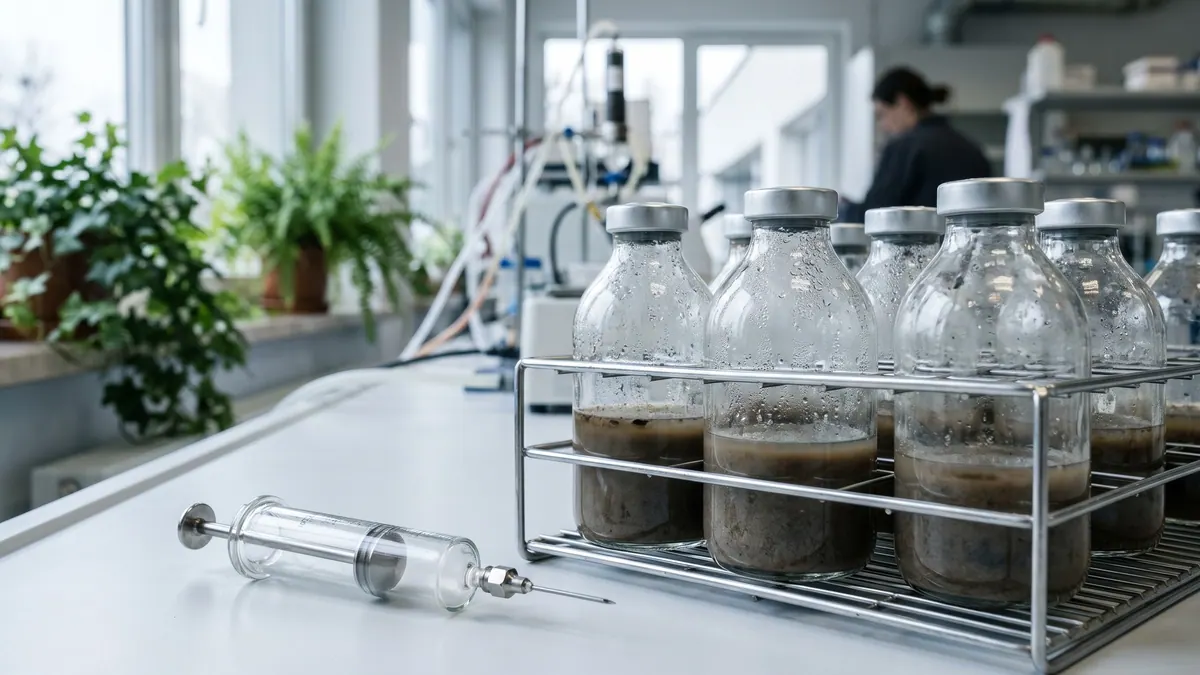
BMP (biochemical methane potential) is the amount of methane obtained per gram of organic matter of a substrate in a batch test. For each of the 270 substrates we compile the results of many publications — 1,866 records from 245 sources in total.
- 270 substrates
- 1,866 records
- 245 publications
- Download data
Atlas A–Z
Click a substrate to see its multi-BMP chart, record table and sources. Column headers sort the table; the bar shows the range of results and the marker the weighted mean. Values in m³ CH₄/t VS; the CH₄ and Rating columns are editorial indicators (described in the methodology).
| Substrate | Group | Records | Sources | Weighted mean m³ CH₄/t VS | Median | Min | Max | Range min–max and weighted mean | CH₄ % of biogas | Rating editorial |
|---|---|---|---|---|---|---|---|---|---|---|
| Albizia wood chips and leavessingle study (2 samples) | Wood and woody biomass | 2 | 1 | 137 | 137 | 113 | 161 | ≈54 % — Methane share of the biogas: estimate from the substrate type 53–56.2 % (midpoint 54.5 %) — medium methane content (52–60 %). | neutral | |
| Aleman grasssingle study (2 samples) | Wild, invasive and medicinal plants | 2 | 1 | 296 | 296 | 293 | 298 | ≈52 % — Methane share of the biogas: estimate from the substrate type 51–54.2 % (midpoint 52.3 %) — medium methane content (52–60 %). | — not rated (too little data) | |
| Almond shells | By-products of the agri-food industry | 3 | 3 | 40 | 45 | 20 | 55 | ≈52 % — Methane share of the biogas: estimate from the substrate type 50.8–52.5 % (midpoint 51.5 %) — low methane content (below 52 %). | neutral | |
| Animal fats | Fats, oils and animal by-products | 3 | 3 | 690 | 656 | 639 | 776 | ≈63 % — Methane share of the biogas: estimate from the substrate type 58.9–67.5 % (midpoint 63.1 %) — high methane content (60 % and more). | neutral | |
| Apples | Fruit, vegetables and their residues | 8 | 5 | 357 | 350 | 317 | 478 | ≈52 % — Methane share of the biogas: estimate from the substrate type 51–54.2 % (midpoint 52.3 %) — medium methane content (52–60 %). | — not rated (too little data) | |
| Banana peels | Fruit, vegetables and their residues | 17 | 5 | 330 | 322 | 243 | 409 | ≈52 % — Methane share of the biogas: estimate from the substrate type 51–54.2 % (midpoint 52.3 %) — medium methane content (52–60 %). | good | |
| Banana stalks and leaves | Straws and crop residues | 2 | 2 | 262 | 262 | 256 | 269 | ≈52 % — Methane share of the biogas: estimate from the substrate type 51–54.2 % (midpoint 52.3 %) — medium methane content (52–60 %). | — not rated (too little data) | |
| Bananas (fruit, pulp) | Fruit, vegetables and their residues | 6 | 4 | 336 | 350 | 289 | 367 | ≈52 % — Methane share of the biogas: estimate from the substrate type 51–54.2 % (midpoint 52.3 %) — medium methane content (52–60 %). | — not rated (too little data) | |
| Barley straw | Straws and crop residues | 8 | 4 | 238 | 234 | 189 | 370 | ≈52 % — Methane share of the biogas: estimate from the substrate type 51.2–53.2 % (midpoint 52.1 %) — medium methane content (52–60 %). | good | |
| Barley, whole crop | Energy crops and whole-crop plants (WCS) | 6 | 2 | 419 | 450 | 353 | 658 | 61 % — Methane share of the biogas: 61.1 % (measured, 6 studies, range 57–68 %) — high methane content (60 % and more). | very good | |
| Beach-cast macroalgae (mix) | Algae and aquatic plants | 5 | 2 | 70 | 71 | 27 | 96 | ≈56 % — Methane share of the biogas: estimate from the substrate type 53.1–58.3 % (midpoint 55.6 %) — medium methane content (52–60 %). | — not rated (too little data) | |
| Beet leaves and tops | Straws and crop residues | 18 | 7 | 308 | 319 | 210 | 470 | 68 % — Methane share of the biogas: 67.7 % (measured, 2 studies, range 66.4–68.9 %) — high methane content (60 % and more). | neutral | |
| Beet roots (sugar/fodder beet) | Energy crops and whole-crop plants (WCS) | 4 | 2 | 397 | 365 | 300 | 450 | ≈52 % — Methane share of the biogas: estimate from the substrate type 51–54.2 % (midpoint 52.3 %) — medium methane content (52–60 %). | good | |
| Bermuda grasssingle study (5 samples) | Wild, invasive and medicinal plants | 5 | 1 | 202 | 214 | 137 | 228 | ≈52 % — Methane share of the biogas: estimate from the substrate type 51–54.2 % (midpoint 52.3 %) — medium methane content (52–60 %). | good | |
| Bigleaf lupinesingle study (2 samples) | Wild, invasive and medicinal plants | 2 | 1 | 335 | 335 | 310 | 360 | ≈52 % — Methane share of the biogas: estimate from the substrate type 51–54.2 % (midpoint 52.3 %) — medium methane content (52–60 %). | — not rated (too little data) | |
| Bird feed (seed mix)single study (10 samples) | Grain, bran, feed and fodder | 10 | 1 | 387 | 377 | 342 | 427 | ≈52 % — Methane share of the biogas: estimate from the substrate type 51–54.2 % (midpoint 52.3 %) — medium methane content (52–60 %). | — not rated (too little data) | |
| Bread and bakery waste | Food and catering waste | 7 | 3 | 370 | 335 | 295 | 459 | 48 % — Methane share of the biogas: 48.3 % (measured, 5 studies, range 44.9–50.9 %) — low methane content (below 52 %). | — not rated (too little data) | |
| Brewers' spent grain | By-products of the agri-food industry | 6 | 3 | 347 | 314 | 268 | 464 | ≈58 % — Methane share of the biogas: estimate from the substrate type 55.1–62.3 % (midpoint 58.5 %) — medium methane content (52–60 %). | neutral | |
| Cabbage outer leaves and stems | Fruit, vegetables and their residues | 5 | 3 | 320 | 309 | 291 | 382 | 68 % — Methane share of the biogas: 67.6 % (measured, 2 studies, range 67.2–67.9 %) — high methane content (60 % and more). | neutral | |
| Cardboard and paperboard | Municipal and green waste, paper and textiles | 14 | 7 | 278 | 253 | 172 | 388 | ≈51 % — Methane share of the biogas: estimate from the substrate type 50.6–52.1 % (midpoint 51.2 %) — low methane content (below 52 %). | good | |
| Carrot tops (leaves and petioles)single study (2 samples) | Fruit, vegetables and their residues | 2 | 1 | 275 | 275 | 241 | 309 | ≈52 % — Methane share of the biogas: estimate from the substrate type 51–54.2 % (midpoint 52.3 %) — medium methane content (52–60 %). | — not rated (too little data) | |
| Carrots (roots) | Fruit, vegetables and their residues | 4 | 4 | 341 | 344 | 291 | 388 | ≈52 % — Methane share of the biogas: estimate from the substrate type 51.2–53.2 % (midpoint 52.1 %) — medium methane content (52–60 %). | — not rated (too little data) | |
| Cassava peelssingle study (4 samples) | Fruit, vegetables and their residues | 4 | 1 | 268 | 266 | 263 | 279 | ≈52 % — Methane share of the biogas: estimate from the substrate type 51–54.2 % (midpoint 52.3 %) — medium methane content (52–60 %). | — not rated (too little data) | |
| Cassava processing wastewater | By-products of the agri-food industry | 2 | 2 | 494 | 494 | 368 | 620 | ≈52 % — Methane share of the biogas: estimate from the substrate type 51–54.2 % (midpoint 52.3 %) — medium methane content (52–60 %). | negative | |
| Cassava residue | By-products of the agri-food industry | 4 | 3 | 170 | 229 | 34 | 363 | ≈52 % — Methane share of the biogas: estimate from the substrate type 51.5–53.7 % (midpoint 52.5 %) — medium methane content (52–60 %). | neutral | |
| Cattail (Typha spp.) | Algae and aquatic plants | 11 | 3 | 154 | 172 | 24 | 249 | ≈52 % — Methane share of the biogas: estimate from the substrate type 51–54.2 % (midpoint 52.3 %) — medium methane content (52–60 %). | — not rated (too little data) | |
| Cattle manure | Animal excreta (slurry, manure, poultry litter) | 27 | 14 | 149 | 191 | 51 | 322 | ≈52 % — Methane share of the biogas: estimate from the substrate type 51.1–53.3 % (midpoint 52.5 %) — medium methane content (52–60 %). | good | |
| Cattle slurry | Animal excreta (slurry, manure, poultry litter) | 14 | 5 | 236 | 229 | 156 | 481 | ≈54 % — Methane share of the biogas: estimate from the substrate type 51.9–54.9 % (midpoint 54.1 %) — medium methane content (52–60 %). | very good | |
| Cauliflower | Fruit, vegetables and their residues | 2 | 2 | 274 | 274 | 250 | 299 | ≈59 % — Methane share of the biogas: estimate from the substrate type 56.4–61.8 % (midpoint 59 %) — medium methane content (52–60 %). | — not rated (too little data) | |
| Cauliflower leaves and stems | Fruit, vegetables and their residues | 8 | 3 | 336 | 355 | 190 | 423 | 68 % — Methane share of the biogas: 67.7 % (measured, 2 studies, range 67.6–67.7 %) — high methane content (60 % and more). | neutral | |
| Celery (leaves and stalks)single study (2 samples) | Fruit, vegetables and their residues | 2 | 1 | 236 | 236 | 196 | 275 | ≈55 % — Methane share of the biogas: estimate from the substrate type 53.4–56.9 % (midpoint 55 %) — medium methane content (52–60 %). | — not rated (too little data) | |
| Cellulose-based films and packaging | Bioplastics and compostable packaging | 10 | 3 | 355 | 389 | 266 | 437 | ≈51 % — Methane share of the biogas: estimate from the substrate type 50.6–52.1 % (midpoint 51.2 %) — low methane content (below 52 %). | good | |
| Cereal flakes (oat, corn)single study (2 samples) | Grain, bran, feed and fodder | 2 | 1 | 376 | 376 | 363 | 390 | ≈52 % — Methane share of the biogas: estimate from the substrate type 51–54.2 % (midpoint 52.3 %) — medium methane content (52–60 %). | — not rated (too little data) | |
| Cereal grain and flour | Grain, bran, feed and fodder | 4 | 3 | 350 | 352 | 247 | 386 | ≈52 % — Methane share of the biogas: estimate from the substrate type 51–52.8 % (midpoint 51.7 %) — low methane content (below 52 %). | very good | |
| Cereal residues (screenings, dust, silo losses) | Grain, bran, feed and fodder | 10 | 5 | 324 | 307 | 250 | 402 | ≈53 % — Methane share of the biogas: estimate from the substrate type 51.7–54 % (midpoint 52.7 %) — medium methane content (52–60 %). | good | |
| Cereal straw (unspecified) | Straws and crop residues | 25 | 4 | 268 | 278 | 183 | 333 | ≈51 % — Methane share of the biogas: estimate from the substrate type 50.7–52.3 % (midpoint 51.3 %) — low methane content (below 52 %). | good | |
| Cereal/pea and camelina mixturessingle study (5 samples) | Grasses, green forage and fodder plants | 5 | 1 | 282 | 279 | 252 | 318 | ≈52 % — Methane share of the biogas: estimate from the substrate type 51–54.2 % (midpoint 52.3 %) — medium methane content (52–60 %). | good | |
| Chinese cabbage | Fruit, vegetables and their residues | 2 | 2 | 148 | 148 | 129 | 167 | ≈60 % — Methane share of the biogas: estimate from the substrate type 56.8–62.6 % (midpoint 59.6 %) — medium methane content (52–60 %). | — not rated (too little data) | |
| Chlamydomonas reinhardtii | Algae and aquatic plants | 2 | 2 | 346 | 346 | 306 | 387 | ≈58 % — Methane share of the biogas: estimate from the substrate type 55.1–62.3 % (midpoint 58.5 %) — medium methane content (52–60 %). | — not rated (too little data) | |
| Chlorella kessleri | Algae and aquatic plants | 2 | 2 | 193 | 193 | 168 | 218 | ≈58 % — Methane share of the biogas: estimate from the substrate type 55.1–62.3 % (midpoint 58.5 %) — medium methane content (52–60 %). | — not rated (too little data) | |
| Chlorella sp. | Algae and aquatic plants | 4 | 4 | 229 | 226 | 123 | 339 | ≈58 % — Methane share of the biogas: estimate from the substrate type 55.1–62.3 % (midpoint 58.5 %) — medium methane content (52–60 %). | — not rated (too little data) | |
| Chlorella vulgaris | Algae and aquatic plants | 9 | 3 | 278 | 230 | 91 | 440 | ≈58 % — Methane share of the biogas: estimate from the substrate type 55.1–62.3 % (midpoint 58.5 %) — medium methane content (52–60 %). | — not rated (too little data) | |
| Citrus fruit (whole, pulp) | Fruit, vegetables and their residues | 5 | 4 | 353 | 312 | 288 | 494 | ≈52 % — Methane share of the biogas: estimate from the substrate type 51–54.2 % (midpoint 52.3 %) — medium methane content (52–60 %). | neutral | |
| Citrus peels | Fruit, vegetables and their residues | 12 | 6 | 313 | 435 | 48 | 696 | ≈52 % — Methane share of the biogas: estimate from the substrate type 51–52.8 % (midpoint 51.8 %) — low methane content (below 52 %). | neutral | |
| Citrus pressingssingle study (3 samples) | Fruit, vegetables and their residues | 3 | 1 | 469 | 473 | 433 | 502 | ≈52 % — Methane share of the biogas: estimate from the substrate type 51–54.2 % (midpoint 52.3 %) — medium methane content (52–60 %). | — not rated (too little data) | |
| Citrus seeds | Fruit, vegetables and their residues | 3 | 2 | 676 | 658 | 581 | 732 | ≈52 % — Methane share of the biogas: estimate from the substrate type 51–54.2 % (midpoint 52.3 %) — medium methane content (52–60 %). | good | |
| Clover | Grasses, green forage and fodder plants | 5 | 2 | 394 | 384 | 280 | 558 | 59 % — Methane share of the biogas: 59.3 % (measured, 3 studies, range 57.7–62 %) — medium methane content (52–60 %). | neutral | |
| Clover-grass silage | Grasses, green forage and fodder plants | 2 | 2 | 296 | 296 | 256 | 335 | ≈52 % — Methane share of the biogas: estimate from the substrate type 51–54.2 % (midpoint 52.3 %) — medium methane content (52–60 %). | — not rated (too little data) | |
| Coconut meal / oil cake | By-products of the agri-food industry | 3 | 2 | 296 | 277 | 262 | 383 | ≈66 % — Methane share of the biogas: estimate from the substrate type 60.5–69 % (midpoint 65.9 %) — high methane content (60 % and more). | — not rated (too little data) | |
| Coffee husksingle study (3 samples) | By-products of the agri-food industry | 3 | 1 | 152 | 157 | 140 | 159 | ≈52 % — Methane share of the biogas: estimate from the substrate type 51–54.2 % (midpoint 52.3 %) — medium methane content (52–60 %). | — not rated (too little data) | |
| Coffee mucilagesingle study (3 samples) | By-products of the agri-food industry | 3 | 1 | 279 | 287 | 256 | 294 | ≈52 % — Methane share of the biogas: estimate from the substrate type 51–54.2 % (midpoint 52.3 %) — medium methane content (52–60 %). | — not rated (too little data) | |
| Coffee pulpsingle study (3 samples) | By-products of the agri-food industry | 3 | 1 | 225 | 235 | 196 | 245 | ≈52 % — Methane share of the biogas: estimate from the substrate type 51–54.2 % (midpoint 52.3 %) — medium methane content (52–60 %). | — not rated (too little data) | |
| Comfreysingle study (2 samples) | Wild, invasive and medicinal plants | 2 | 1 | 328 | 328 | 323 | 334 | 70 % — Methane share of the biogas: 69.7 % (measured, 2 studies, range 69.1–70.3 %) — high methane content (60 % and more). | good | |
| Common reed | Wild, invasive and medicinal plants | 15 | 4 | 170 | 223 | 138 | 244 | ≈52 % — Methane share of the biogas: estimate from the substrate type 51–54.2 % (midpoint 52.3 %) — medium methane content (52–60 %). | — not rated (too little data) | |
| Compostable bags | Bioplastics and compostable packaging | 8 | 2 | 119 | 128 | 36 | 205 | ≈52 % — Methane share of the biogas: estimate from the substrate type 51–54.2 % (midpoint 52.3 %) — medium methane content (52–60 %). | neutral | |
| Compostable coffee capsulessingle study (6 samples) | Bioplastics and compostable packaging | 6 | 1 | 201 | 192 | 67 | 355 | ≈52 % — Methane share of the biogas: estimate from the substrate type 51–54.2 % (midpoint 52.3 %) — medium methane content (52–60 %). | — not rated (too little data) | |
| Confectionery waste | Food and catering waste | 6 | 3 | 318 | 342 | 200 | 506 | ≈63 % — Methane share of the biogas: estimate from the substrate type 58.9–67.5 % (midpoint 63.1 %) — high methane content (60 % and more). | neutral | |
| Coriander | Fruit, vegetables and their residues | 5 | 2 | 255 | 309 | 200 | 325 | ≈58 % — Methane share of the biogas: estimate from the substrate type 55.4–60.3 % (midpoint 57.7 %) — medium methane content (52–60 %). | — not rated (too little data) | |
| Cotton stalks | Straws and crop residues | 2 | 2 | 82 | 82 | 71 | 94 | ≈51 % — Methane share of the biogas: estimate from the substrate type 50.7–52.4 % (midpoint 51.4 %) — low methane content (below 52 %). | — not rated (too little data) | |
| Cotton textiles (incl. denim) | Municipal and green waste, paper and textiles | 7 | 2 | 239 | 220 | 110 | 343 | ≈51 % — Methane share of the biogas: estimate from the substrate type 50.6–52.2 % (midpoint 51.3 %) — low methane content (below 52 %). | neutral | |
| Crown daisy (garland chrysanthemum) | Fruit, vegetables and their residues | 2 | 2 | 232 | 232 | 189 | 276 | ≈58 % — Methane share of the biogas: estimate from the substrate type 55.5–60.4 % (midpoint 57.9 %) — medium methane content (52–60 %). | — not rated (too little data) | |
| Crude glycerolsingle study (2 samples) | By-products of the agri-food industry | 2 | 1 | 426 | 426 | 370 | 483 | ≈52 % — Methane share of the biogas: estimate from the substrate type 51–54.2 % (midpoint 52.3 %) — medium methane content (52–60 %). | good | |
| Cucumber leaves and stems | Straws and crop residues | 6 | 3 | 237 | 281 | 118 | 345 | 60 % — Methane share of the biogas: 59.6 % (measured, 1 study) — medium methane content (52–60 %). | — not rated (too little data) | |
| Cucumbers | Fruit, vegetables and their residues | 3 | 3 | 313 | 348 | 242 | 349 | ≈55 % — Methane share of the biogas: estimate from the substrate type 53.6–57.2 % (midpoint 55.3 %) — medium methane content (52–60 %). | — not rated (too little data) | |
| Cup plant | Energy crops and whole-crop plants (WCS) | 8 | 2 | 257 | 253 | 232 | 282 | ≈52 % — Methane share of the biogas: estimate from the substrate type 51–54.2 % (midpoint 52.3 %) — medium methane content (52–60 %). | good | |
| Cyanobacteria (Phormidium, Desertifilum, Anabaena, Nostoc) | Algae and aquatic plants | 4 | 2 | 152 | 261 | 28 | 308 | ≈58 % — Methane share of the biogas: estimate from the substrate type 55.1–62.3 % (midpoint 58.5 %) — medium methane content (52–60 %). | — not rated (too little data) | |
| Dairy product waste (cheese, cream, ice cream) | Milk, whey and dairy waste | 5 | 3 | 504 | 602 | 350 | 714 | ≈66 % — Methane share of the biogas: estimate from the substrate type 60.5–69 % (midpoint 65.9 %) — high methane content (60 % and more). | neutral | |
| Dairy wastewater biological sludge | Sewage and industrial sludges | 2 | 2 | 293 | 293 | 125 | 461 | ≈66 % — Methane share of the biogas: estimate from the substrate type 61.9–69 % (midpoint 66.4 %) — high methane content (60 % and more). | negative | |
| Distillery stillage and vinasse | By-products of the agri-food industry | 5 | 3 | 326 | 335 | 247 | 381 | 58 % — Methane share of the biogas: 58.5 % (measured, 1 study) — medium methane content (52–60 %). | neutral | |
| Dragon fruit (pitaya) peels | Fruit, vegetables and their residues | 3 | 3 | 87 | 35 | 30 | 195 | ≈53 % — Methane share of the biogas: estimate from the substrate type 51.9–54.3 % (midpoint 53 %) — medium methane content (52–60 %). | — not rated (too little data) | |
| Duck slurry | Animal excreta (slurry, manure, poultry litter) | 6 | 2 | 395 | 282 | 135 | 551 | ≈55 % — Methane share of the biogas: estimate from the substrate type 52.4–55.8 % (midpoint 55 %) — medium methane content (52–60 %). | neutral | |
| Dunaliella salina | Algae and aquatic plants | 3 | 3 | 221 | 276 | 63 | 323 | ≈58 % — Methane share of the biogas: estimate from the substrate type 55.1–62.3 % (midpoint 58.5 %) — medium methane content (52–60 %). | — not rated (too little data) | |
| Durian shells | Fruit, vegetables and their residues | 2 | 2 | 93 | 93 | 35 | 152 | ≈52 % — Methane share of the biogas: estimate from the substrate type 50.9–52.7 % (midpoint 51.7 %) — low methane content (below 52 %). | — not rated (too little data) | |
| Eggplant (fruit) | Fruit, vegetables and their residues | 2 | 2 | 333 | 333 | 270 | 396 | ≈54 % — Methane share of the biogas: estimate from the substrate type 52.5–55.3 % (midpoint 53.8 %) — medium methane content (52–60 %). | — not rated (too little data) | |
| Eggplant stalks and leaves | Straws and crop residues | 4 | 3 | 218 | 185 | 94 | 374 | 56 % — Methane share of the biogas: 56.4 % (measured, 1 study) — medium methane content (52–60 %). | — not rated (too little data) | |
| Energy docksingle study (5 samples) | Energy crops and whole-crop plants (WCS) | 5 | 1 | 271 | 290 | 187 | 297 | ≈52 % — Methane share of the biogas: estimate from the substrate type 51–54.2 % (midpoint 52.3 %) — medium methane content (52–60 %). | — not rated (too little data) | |
| Energycane (Saccharum hybrids) | Energy crops and whole-crop plants (WCS) | 19 | 2 | 281 | 277 | 228 | 320 | ≈52 % — Methane share of the biogas: estimate from the substrate type 51–54.2 % (midpoint 52.3 %) — medium methane content (52–60 %). | — not rated (too little data) | |
| Faba bean, whole cropsingle study (2 samples) | Grasses, green forage and fodder plants | 2 | 1 | 296 | 296 | 272 | 320 | ≈52 % — Methane share of the biogas: estimate from the substrate type 51–54.2 % (midpoint 52.3 %) — medium methane content (52–60 %). | — not rated (too little data) | |
| Fat hen (Chenopodium album)single study (2 samples) | Wild, invasive and medicinal plants | 2 | 1 | 216 | 216 | 171 | 262 | ≈52 % — Methane share of the biogas: estimate from the substrate type 51–54.2 % (midpoint 52.3 %) — medium methane content (52–60 %). | — not rated (too little data) | |
| Fats, oils and grease (FOG) | Fats, oils and animal by-products | 5 | 3 | 488 | 402 | 350 | 688 | ≈63 % — Methane share of the biogas: estimate from the substrate type 58.9–67.5 % (midpoint 63.1 %) — high methane content (60 % and more). | — not rated (too little data) | |
| Fish waste | Fats, oils and animal by-products | 3 | 3 | 319 | 398 | 142 | 416 | ≈66 % — Methane share of the biogas: estimate from the substrate type 60.5–69 % (midpoint 65.9 %) — high methane content (60 % and more). | neutral | |
| Floating aquatic plants (duckweed, frogbit, water lettuce, salvinia, water chestnut) | Algae and aquatic plants | 5 | 3 | 310 | 341 | 127 | 452 | ≈52 % — Methane share of the biogas: estimate from the substrate type 51–54.2 % (midpoint 52.3 %) — medium methane content (52–60 %). | neutral | |
| Flotation sludge (DAF skimmings) | Fats, oils and animal by-products | 3 | 2 | 600 | 417 | 409 | 787 | ≈61 % — Methane share of the biogas: estimate from the substrate type 57.4–64.4 % (midpoint 60.7 %) — high methane content (60 % and more). | neutral | |
| Flower wastes (cut flowers, flower pomace) | Municipal and green waste, paper and textiles | 2 | 2 | 322 | 322 | 281 | 362 | ≈54 % — Methane share of the biogas: estimate from the substrate type 52.6–55.5 % (midpoint 53.9 %) — medium methane content (52–60 %). | good | |
| Food waste | Food and catering waste | 22 | 12 | 466 | 451 | 135 | 700 | ≈62 % — Methane share of the biogas: estimate from the substrate type 58.8–66.5 % (midpoint 62.5 %) — high methane content (60 % and more). | neutral | |
| Forest underwood plants (ferns, thistles, wild raspberry)single study (3 samples) | Wild, invasive and medicinal plants | 3 | 1 | 169 | 191 | 60 | 256 | ≈52 % — Methane share of the biogas: estimate from the substrate type 51–54.2 % (midpoint 52.3 %) — medium methane content (52–60 %). | — not rated (too little data) | |
| Four o'clock flower leavessingle study (5 samples) | Wild, invasive and medicinal plants | 5 | 1 | 325 | 329 | 290 | 341 | ≈52 % — Methane share of the biogas: estimate from the substrate type 51–54.2 % (midpoint 52.3 %) — medium methane content (52–60 %). | good | |
| Fruit and vegetable waste (mixed) | Fruit, vegetables and their residues | 5 | 3 | 305 | 267 | 160 | 400 | ≈55 % — Methane share of the biogas: estimate from the substrate type 53.6–57.1 % (midpoint 55.2 %) — medium methane content (52–60 %). | neutral | |
| Giant knotweed (incl. Igniscum) | Energy crops and whole-crop plants (WCS) | 10 | 3 | 192 | 180 | 146 | 270 | ≈53 % — Methane share of the biogas: estimate from the substrate type 51.8–54.2 % (midpoint 52.9 %) — medium methane content (52–60 %). | neutral | |
| Giant reedsingle study (3 samples) | Energy crops and whole-crop plants (WCS) | 3 | 1 | 252 | 252 | 246 | 257 | ≈52 % — Methane share of the biogas: estimate from the substrate type 51–54.2 % (midpoint 52.3 %) — medium methane content (52–60 %). | — not rated (too little data) | |
| Glycerol refining residues (MONG, distillation residue) | By-products of the agri-food industry | 2 | 2 | 406 | 406 | 397 | 414 | ≈63 % — Methane share of the biogas: estimate from the substrate type 58.9–67.5 % (midpoint 63.1 %) — high methane content (60 % and more). | — not rated (too little data) | |
| Goat manure | Animal excreta (slurry, manure, poultry litter) | 2 | 2 | 157 | 157 | 144 | 170 | ≈54 % — Methane share of the biogas: estimate from the substrate type 52.2–56.3 % (midpoint 54.2 %) — medium methane content (52–60 %). | good | |
| Grape pomace (marc) | By-products of the agri-food industry | 6 | 5 | 221 | 246 | 116 | 360 | ≈54 % — Methane share of the biogas: estimate from the substrate type 52.5–55.3 % (midpoint 53.8 %) — medium methane content (52–60 %). | — not rated (too little data) | |
| Grape seeds | By-products of the agri-food industry | 2 | 2 | 214 | 214 | 175 | 253 | ≈52 % — Methane share of the biogas: estimate from the substrate type 51–54.2 % (midpoint 52.3 %) — medium methane content (52–60 %). | — not rated (too little data) | |
| Grape stalks | By-products of the agri-food industry | 3 | 3 | 137 | 133 | 98 | 180 | ≈53 % — Methane share of the biogas: estimate from the substrate type 52.2–54.9 % (midpoint 53.4 %) — medium methane content (52–60 %). | — not rated (too little data) | |
| Grapevine leaves | Fruit, vegetables and their residues | 2 | 2 | 292 | 292 | 214 | 370 | ≈52 % — Methane share of the biogas: estimate from the substrate type 51–54.2 % (midpoint 52.3 %) — medium methane content (52–60 %). | — not rated (too little data) | |
| Grass (fresh and silage) | Grasses, green forage and fodder plants | 145 | 7 | 345 | 320 | 164 | 479 | ≈53 % — Methane share of the biogas: estimate from the substrate type 51.6–53.9 % (midpoint 52.6 %) — medium methane content (52–60 %). | good | |
| Grass clippings | Municipal and green waste, paper and textiles | 13 | 7 | 272 | 256 | 199 | 340 | ≈52 % — Methane share of the biogas: estimate from the substrate type 51–52.8 % (midpoint 51.8 %) — low methane content (below 52 %). | neutral | |
| Green / yard waste | Municipal and green waste, paper and textiles | 11 | 3 | 177 | 183 | 63 | 235 | ≈52 % — Methane share of the biogas: estimate from the substrate type 51.5–53.7 % (midpoint 52.5 %) — medium methane content (52–60 %). | neutral | |
| Green coffee processing residuessingle study (2 samples) | By-products of the agri-food industry | 2 | 1 | 138 | 138 | 128 | 148 | ≈52 % — Methane share of the biogas: estimate from the substrate type 51–54.2 % (midpoint 52.3 %) — medium methane content (52–60 %). | neutral | |
| Hardwood | Wood and woody biomass | 8 | 4 | 153 | 152 | 45 | 270 | ≈52 % — Methane share of the biogas: estimate from the substrate type 51–54.2 % (midpoint 52.3 %) — medium methane content (52–60 %). | neutral | |
| Hazelnut residues (shell, skin) | By-products of the agri-food industry | 2 | 2 | 153 | 153 | 40 | 265 | ≈51 % — Methane share of the biogas: estimate from the substrate type 50.6–52.1 % (midpoint 51.2 %) — low methane content (below 52 %). | neutral | |
| Head cabbage | Fruit, vegetables and their residues | 4 | 3 | 260 | 245 | 204 | 305 | ≈56 % — Methane share of the biogas: estimate from the substrate type 54.2–58.1 % (midpoint 56 %) — medium methane content (52–60 %). | — not rated (too little data) | |
| Hemp hurds and dust | By-products of the agri-food industry | 2 | 2 | 212 | 212 | 184 | 239 | ≈52 % — Methane share of the biogas: estimate from the substrate type 51.2–53.1 % (midpoint 52 %) — medium methane content (52–60 %). | good | |
| Hemp, stalks and whole plant | Energy crops and whole-crop plants (WCS) | 3 | 3 | 242 | 275 | 163 | 289 | ≈52 % — Methane share of the biogas: estimate from the substrate type 51–54.2 % (midpoint 52.3 %) — medium methane content (52–60 %). | — not rated (too little data) | |
| Herbs and herbal industry wastes (lemon balm, alder buckthorn, mint, andrographis, catnip, figwort) | Wild, invasive and medicinal plants | 6 | 2 | 144 | 127 | 82 | 197 | ≈59 % — Methane share of the biogas: estimate from the substrate type 56.4–62 % (midpoint 59.1 %) — medium methane content (52–60 %). | — not rated (too little data) | |
| Hops, whole plantsingle study (2 samples) | Energy crops and whole-crop plants (WCS) | 2 | 1 | 161 | 161 | 141 | 181 | ≈52 % — Methane share of the biogas: estimate from the substrate type 51–54.2 % (midpoint 52.3 %) — medium methane content (52–60 %). | neutral | |
| Horse manure | Animal excreta (slurry, manure, poultry litter) | 36 | 5 | 156 | 174 | 48 | 308 | ≈52 % — Methane share of the biogas: estimate from the substrate type 51.4–53.4 % (midpoint 52.3 %) — medium methane content (52–60 %). | neutral | |
| Human faeces/excreta | Animal excreta (slurry, manure, poultry litter) | 2 | 2 | 322 | 322 | 254 | 390 | ≈56 % — Methane share of the biogas: estimate from the substrate type 53.1–58.3 % (midpoint 55.6 %) — medium methane content (52–60 %). | — not rated (too little data) | |
| Hydrodictyon reticulatum (water net)single study (2 samples) | Algae and aquatic plants | 2 | 1 | 250 | 250 | 170 | 330 | ≈52 % — Methane share of the biogas: estimate from the substrate type 51–54.2 % (midpoint 52.3 %) — medium methane content (52–60 %). | — not rated (too little data) | |
| Insect frasssingle study (2 samples) | Animal excreta (slurry, manure, poultry litter) | 2 | 1 | 244 | 244 | 201 | 287 | ≈56 % — Methane share of the biogas: estimate from the substrate type 53.1–58.3 % (midpoint 55.6 %) — medium methane content (52–60 %). | — not rated (too little data) | |
| Ipomoea fistulosa leavessingle study (5 samples) | Wild, invasive and medicinal plants | 5 | 1 | 415 | 421 | 387 | 429 | ≈52 % — Methane share of the biogas: estimate from the substrate type 51–54.2 % (midpoint 52.3 %) — medium methane content (52–60 %). | very good | |
| Jerusalem artichoke biomass | Energy crops and whole-crop plants (WCS) | 11 | 5 | 384 | 309 | 252 | 680 | 65 % — Methane share of the biogas: 64.8 % (measured, 2 studies, range 61.1–68.4 %) — high methane content (60 % and more). | good | |
| Laminaria kelp (incl. L. japonica waste)single study (3 samples) | Algae and aquatic plants | 3 | 1 | 188 | 178 | 172 | 214 | ≈52 % — Methane share of the biogas: estimate from the substrate type 51–54.2 % (midpoint 52.3 %) — medium methane content (52–60 %). | — not rated (too little data) | |
| Lavender flowers and distillation residuessingle study (2 samples) | Wild, invasive and medicinal plants | 2 | 1 | 186 | 186 | 171 | 200 | ≈52 % — Methane share of the biogas: estimate from the substrate type 51.1–53 % (midpoint 52 %) — medium methane content (52–60 %). | — not rated (too little data) | |
| Legume crop and processing residues (pea pods, bean haulm and husks, pea leaves) | Straws and crop residues | 5 | 5 | 264 | 267 | 147 | 390 | 58 % — Methane share of the biogas: 58.4 % (measured, 1 study) — medium methane content (52–60 %). | — not rated (too little data) | |
| Lettuce | Fruit, vegetables and their residues | 6 | 5 | 256 | 245 | 199 | 294 | ≈57 % — Methane share of the biogas: estimate from the substrate type 54.9–59.3 % (midpoint 57 %) — medium methane content (52–60 %). | — not rated (too little data) | |
| Lignin-rich hydrolysis residue | Wood and woody biomass | 2 | 2 | 105 | 105 | 85 | 125 | ≈52 % — Methane share of the biogas: estimate from the substrate type 51–54.2 % (midpoint 52.3 %) — medium methane content (52–60 %). | — not rated (too little data) | |
| Lipid-extracted Nannochloropsis gaditanasingle study (6 samples) | Algae and aquatic plants | 6 | 1 | 412 | 425 | 315 | 475 | ≈58 % — Methane share of the biogas: estimate from the substrate type 55.1–62.3 % (midpoint 58.5 %) — medium methane content (52–60 %). | — not rated (too little data) | |
| Litchi peel and seedsingle study (2 samples) | Fruit, vegetables and their residues | 2 | 1 | 89 | 89 | 71 | 107 | ≈52 % — Methane share of the biogas: estimate from the substrate type 51.4–53.4 % (midpoint 52.3 %) — medium methane content (52–60 %). | — not rated (too little data) | |
| Longan peel, seed and waste | Fruit, vegetables and their residues | 3 | 2 | 190 | 202 | 87 | 235 | ≈52 % — Methane share of the biogas: estimate from the substrate type 51.3–53.3 % (midpoint 52.2 %) — medium methane content (52–60 %). | — not rated (too little data) | |
| Loquat peel and seedsingle study (2 samples) | Fruit, vegetables and their residues | 2 | 1 | 250 | 250 | 208 | 292 | ≈52 % — Methane share of the biogas: estimate from the substrate type 51.4–53.5 % (midpoint 52.3 %) — medium methane content (52–60 %). | — not rated (too little data) | |
| Lucerne (alfalfa) | Grasses, green forage and fodder plants | 7 | 4 | 366 | 490 | 271 | 560 | 66 % — Methane share of the biogas: 65.8 % (measured, 1 study) — high methane content (60 % and more). | neutral | |
| Magazine paper | Municipal and green waste, paper and textiles | 6 | 3 | 243 | 206 | 195 | 316 | ≈51 % — Methane share of the biogas: estimate from the substrate type 50.6–52.1 % (midpoint 51.2 %) — low methane content (below 52 %). | good | |
| Maize silage (whole crop) | Energy crops and whole-crop plants (WCS) | 82 | 17 | 341 | 335 | 245 | 480 | 59 % — Methane share of the biogas: 58.9 % (measured, 1 study) — medium methane content (52–60 %). | very good | |
| Maize stover | Straws and crop residues | 10 | 7 | 298 | 272 | 241 | 417 | ≈52 % — Methane share of the biogas: estimate from the substrate type 51.4–53.5 % (midpoint 52.3 %) — medium methane content (52–60 %). | good | |
| Mango peelssingle study (13 samples) | Fruit, vegetables and their residues | 13 | 1 | 448 | 449 | 370 | 523 | ≈52 % — Methane share of the biogas: estimate from the substrate type 51–54.2 % (midpoint 52.3 %) — medium methane content (52–60 %). | — not rated (too little data) | |
| Mangosteen pulpsingle study (2 samples) | Fruit, vegetables and their residues | 2 | 1 | 384 | 384 | 298 | 469 | ≈52 % — Methane share of the biogas: estimate from the substrate type 51–54.2 % (midpoint 52.3 %) — medium methane content (52–60 %). | — not rated (too little data) | |
| Mangosteen seedssingle study (2 samples) | Fruit, vegetables and their residues | 2 | 1 | 544 | 544 | 535 | 552 | ≈52 % — Methane share of the biogas: estimate from the substrate type 51–54.2 % (midpoint 52.3 %) — medium methane content (52–60 %). | — not rated (too little data) | |
| Marrow kalesingle study (2 samples) | Grasses, green forage and fodder plants | 2 | 1 | 315 | 315 | 310 | 320 | ≈52 % — Methane share of the biogas: estimate from the substrate type 51–54.2 % (midpoint 52.3 %) — medium methane content (52–60 %). | — not rated (too little data) | |
| Meadow hay | Grasses, green forage and fodder plants | 16 | 7 | 279 | 242 | 180 | 380 | 53 % — Methane share of the biogas: 53.3 % (measured, 1 study) — medium methane content (52–60 %). | very good | |
| Meat and meat waste | Fats, oils and animal by-products | 2 | 2 | 295 | 295 | 250 | 340 | ≈66 % — Methane share of the biogas: estimate from the substrate type 60.5–69 % (midpoint 65.9 %) — high methane content (60 % and more). | neutral | |
| Mexican sunflower (Tithonia diversifolia)single study (2 samples) | Wild, invasive and medicinal plants | 2 | 1 | 210 | 210 | 207 | 212 | ≈55 % — Methane share of the biogas: estimate from the substrate type 53.4–56.7 % (midpoint 54.9 %) — medium methane content (52–60 %). | — not rated (too little data) | |
| Microspora sp.single study (2 samples) | Algae and aquatic plants | 2 | 1 | 334 | 334 | 255 | 413 | ≈52 % — Methane share of the biogas: estimate from the substrate type 51–54.2 % (midpoint 52.3 %) — medium methane content (52–60 %). | — not rated (too little data) | |
| Milk and buttermilk | Milk, whey and dairy waste | 5 | 2 | 522 | 489 | 458 | 563 | ≈66 % — Methane share of the biogas: estimate from the substrate type 60.5–69 % (midpoint 65.9 %) — high methane content (60 % and more). | neutral | |
| Millet/foxtail millet and clover mixturessingle study (5 samples) | Grasses, green forage and fodder plants | 5 | 1 | 304 | 285 | 276 | 374 | ≈53 % — Methane share of the biogas: estimate from the substrate type 51.8–54.1 % (midpoint 52.8 %) — medium methane content (52–60 %). | good | |
| Miscanthus (silvergrass) | Energy crops and whole-crop plants (WCS) | 8 | 5 | 229 | 227 | 158 | 317 | ≈52 % — Methane share of the biogas: estimate from the substrate type 51–54.2 % (midpoint 52.3 %) — medium methane content (52–60 %). | good | |
| Mixed paper waste (corrugated board + tissue)single study (5 samples) | Municipal and green waste, paper and textiles | 5 | 1 | 301 | 311 | 281 | 318 | ≈52 % — Methane share of the biogas: estimate from the substrate type 51–54.2 % (midpoint 52.3 %) — medium methane content (52–60 %). | — not rated (too little data) | |
| Mixed/unspecified manuresingle study (5 samples) | Animal excreta (slurry, manure, poultry litter) | 5 | 1 | 289 | 253 | 235 | 366 | ≈53 % — Methane share of the biogas: estimate from the substrate type 51.6–54.2 % (midpoint 53.4 %) — medium methane content (52–60 %). | good | |
| Molasses | By-products of the agri-food industry | 2 | 2 | 410 | 410 | 363 | 457 | ≈52 % — Methane share of the biogas: estimate from the substrate type 51–54.2 % (midpoint 52.3 %) — medium methane content (52–60 %). | good | |
| Municipal sewage sludge (mixed) | Sewage and industrial sludges | 15 | 8 | 250 | 270 | 111 | 407 | ≈54 % — Methane share of the biogas: estimate from the substrate type 52.7–55.7 % (midpoint 54.1 %) — medium methane content (52–60 %). | neutral | |
| Mushroom fruiting bodiessingle study (6 samples) | Fruit, vegetables and their residues | 6 | 1 | 345 | 381 | 181 | 433 | ≈52 % — Methane share of the biogas: estimate from the substrate type 51–54.2 % (midpoint 52.3 %) — medium methane content (52–60 %). | — not rated (too little data) | |
| Nannochloropsis oculata | Algae and aquatic plants | 3 | 2 | 240 | 231 | 210 | 290 | ≈58 % — Methane share of the biogas: estimate from the substrate type 55.1–62.3 % (midpoint 58.5 %) — medium methane content (52–60 %). | — not rated (too little data) | |
| Nannochloropsis salinasingle study (8 samples) | Algae and aquatic plants | 8 | 1 | 417 | 445 | 233 | 557 | ≈58 % — Methane share of the biogas: estimate from the substrate type 55.1–62.3 % (midpoint 58.5 %) — medium methane content (52–60 %). | — not rated (too little data) | |
| Napier grass | Energy crops and whole-crop plants (WCS) | 35 | 6 | 253 | 238 | 98 | 372 | ≈54 % — Methane share of the biogas: estimate from the substrate type 52.4–55.1 % (midpoint 53.7 %) — medium methane content (52–60 %). | good | |
| Newspaper | Municipal and green waste, paper and textiles | 7 | 3 | 81 | 70 | 45 | 100 | ≈52 % — Methane share of the biogas: estimate from the substrate type 51–54.2 % (midpoint 52.3 %) — medium methane content (52–60 %). | neutral | |
| Oat straw | Straws and crop residues | 2 | 2 | 275 | 275 | 230 | 320 | ≈52 % — Methane share of the biogas: estimate from the substrate type 51–54.2 % (midpoint 52.3 %) — medium methane content (52–60 %). | — not rated (too little data) | |
| Office paper | Municipal and green waste, paper and textiles | 9 | 5 | 314 | 345 | 49 | 506 | ≈51 % — Methane share of the biogas: estimate from the substrate type 50.6–52.1 % (midpoint 51.2 %) — low methane content (below 52 %). | good | |
| Oil palm empty fruit bunches | By-products of the agri-food industry | 2 | 2 | 179 | 179 | 169 | 189 | ≈52 % — Methane share of the biogas: estimate from the substrate type 51–54.2 % (midpoint 52.3 %) — medium methane content (52–60 %). | — not rated (too little data) | |
| Oil refining residues (gums, condensates, spent earth) | By-products of the agri-food industry | 5 | 2 | 714 | 664 | 426 | 866 | ≈63 % — Methane share of the biogas: estimate from the substrate type 58.9–67.5 % (midpoint 63.1 %) — high methane content (60 % and more). | — not rated (too little data) | |
| Olive and vine pruningssingle study (2 samples) | Wood and woody biomass | 2 | 1 | 55 | 55 | 54 | 57 | ≈52 % — Methane share of the biogas: estimate from the substrate type 51–54.2 % (midpoint 52.3 %) — medium methane content (52–60 %). | — not rated (too little data) | |
| Olive pomace / olive mill solid waste | By-products of the agri-food industry | 8 | 7 | 266 | 259 | 25 | 461 | ≈63 % — Methane share of the biogas: estimate from the substrate type 58.9–67.5 % (midpoint 63.1 %) — high methane content (60 % and more). | — not rated (too little data) | |
| Onion peels and residues | Fruit, vegetables and their residues | 2 | 2 | 462 | 462 | 400 | 523 | ≈52 % — Methane share of the biogas: estimate from the substrate type 51–54.2 % (midpoint 52.3 %) — medium methane content (52–60 %). | — not rated (too little data) | |
| Onions | Fruit, vegetables and their residues | 2 | 2 | 305 | 305 | 269 | 342 | ≈52 % — Methane share of the biogas: estimate from the substrate type 51.4–53.5 % (midpoint 52.3 %) — medium methane content (52–60 %). | — not rated (too little data) | |
| Organic fraction of municipal solid waste | Municipal and green waste, paper and textiles | 13 | 6 | 187 | 215 | 51 | 493 | ≈58 % — Methane share of the biogas: estimate from the substrate type 55.1–62.3 % (midpoint 58.5 %) — medium methane content (52–60 %). | neutral | |
| Other cucurbit vegetables (bitter melon, luffa, wax gourd, chayote, horned melon) | Fruit, vegetables and their residues | 5 | 3 | 274 | 220 | 208 | 367 | ≈55 % — Methane share of the biogas: estimate from the substrate type 53.4–56.7 % (midpoint 54.9 %) — medium methane content (52–60 %). | — not rated (too little data) | |
| Other leafy and stem vegetables (bok choy, amaranth, garlic chives, garlic shoots, water dropwort, toon sprouts, zucchini and turnip leaves) | Fruit, vegetables and their residues | 8 | 3 | 253 | 181 | 129 | 378 | ≈58 % — Methane share of the biogas: estimate from the substrate type 55.5–60.3 % (midpoint 57.8 %) — medium methane content (52–60 %). | — not rated (too little data) | |
| Other nut shells (pistachio, pecan, chestnut, macadamia, pine nut, hickory, ginkgo)single study (7 samples) | By-products of the agri-food industry | 7 | 1 | 64 | 52 | 29 | 142 | ≈51 % — Methane share of the biogas: estimate from the substrate type 50.6–52.1 % (midpoint 51.2 %) — low methane content (below 52 %). | neutral | |
| Palm oil decanter cakesingle study (3 samples) | By-products of the agri-food industry | 3 | 1 | 226 | 221 | 218 | 240 | ≈63 % — Methane share of the biogas: estimate from the substrate type 58.9–67.5 % (midpoint 63.1 %) — high methane content (60 % and more). | — not rated (too little data) | |
| Palm oil mill effluent (POME) | By-products of the agri-food industry | 2 | 2 | 431 | 431 | 397 | 465 | ≈63 % — Methane share of the biogas: estimate from the substrate type 58.9–67.5 % (midpoint 63.1 %) — high methane content (60 % and more). | — not rated (too little data) | |
| Para grasssingle study (2 samples) | Wild, invasive and medicinal plants | 2 | 1 | 240 | 240 | 238 | 242 | ≈52 % — Methane share of the biogas: estimate from the substrate type 51–54.2 % (midpoint 52.3 %) — medium methane content (52–60 %). | — not rated (too little data) | |
| Pasta (food waste) | Food and catering waste | 2 | 2 | 310 | 310 | 293 | 326 | ≈52 % — Methane share of the biogas: estimate from the substrate type 51–54.2 % (midpoint 52.3 %) — medium methane content (52–60 %). | — not rated (too little data) | |
| Peaches | Fruit, vegetables and their residues | 2 | 2 | 344 | 344 | 334 | 353 | ≈52 % — Methane share of the biogas: estimate from the substrate type 51–54.2 % (midpoint 52.3 %) — medium methane content (52–60 %). | — not rated (too little data) | |
| Peanut shells | By-products of the agri-food industry | 2 | 2 | 50 | 50 | 48 | 51 | ≈52 % — Methane share of the biogas: estimate from the substrate type 50.9–52.7 % (midpoint 51.7 %) — low methane content (below 52 %). | neutral | |
| Pearl milletsingle study (2 samples) | Energy crops and whole-crop plants (WCS) | 2 | 1 | 280 | 280 | 257 | 304 | ≈52 % — Methane share of the biogas: estimate from the substrate type 51–54.2 % (midpoint 52.3 %) — medium methane content (52–60 %). | — not rated (too little data) | |
| Pennisetum giganteum (Juncao grass)single study (2 samples) | Energy crops and whole-crop plants (WCS) | 2 | 1 | 246 | 246 | 224 | 268 | ≈54 % — Methane share of the biogas: estimate from the substrate type 52.5–55.4 % (midpoint 53.8 %) — medium methane content (52–60 %). | — not rated (too little data) | |
| Pennisetum hybrid grasssingle study (18 samples) | Energy crops and whole-crop plants (WCS) | 18 | 1 | 266 | 261 | 194 | 361 | ≈52 % — Methane share of the biogas: estimate from the substrate type 51.3–53.3 % (midpoint 52.2 %) — medium methane content (52–60 %). | neutral | |
| Pepper plant leaves and stems | Straws and crop residues | 5 | 3 | 170 | 163 | 121 | 274 | 59 % — Methane share of the biogas: 58.8 % (measured, 1 study) — medium methane content (52–60 %). | — not rated (too little data) | |
| Peppers (fruit) | Fruit, vegetables and their residues | 5 | 3 | 329 | 339 | 250 | 354 | ≈54 % — Methane share of the biogas: estimate from the substrate type 52.4–55.1 % (midpoint 53.6 %) — medium methane content (52–60 %). | — not rated (too little data) | |
| PHA (polyhydroxyalkanoates) | Bioplastics and compostable packaging | 3 | 2 | 341 | 338 | 271 | 484 | ≈52 % — Methane share of the biogas: estimate from the substrate type 51–54.2 % (midpoint 52.3 %) — medium methane content (52–60 %). | — not rated (too little data) | |
| Phaeodactylum tricornutumsingle study (3 samples) | Algae and aquatic plants | 3 | 1 | 299 | 290 | 270 | 337 | ≈58 % — Methane share of the biogas: estimate from the substrate type 55.1–62.3 % (midpoint 58.5 %) — medium methane content (52–60 %). | — not rated (too little data) | |
| Pig manure (solid) | Animal excreta (slurry, manure, poultry litter) | 5 | 4 | 293 | 322 | 178 | 444 | ≈54 % — Methane share of the biogas: estimate from the substrate type 51.8–54.6 % (midpoint 53.8 %) — medium methane content (52–60 %). | good | |
| Pig slurry | Animal excreta (slurry, manure, poultry litter) | 15 | 7 | 260 | 275 | 38 | 516 | ≈55 % — Methane share of the biogas: estimate from the substrate type 52.5–56.1 % (midpoint 55.3 %) — medium methane content (52–60 %). | very good | |
| Pineapple fruit and leaves | Fruit, vegetables and their residues | 2 | 2 | 294 | 294 | 232 | 355 | ≈52 % — Methane share of the biogas: estimate from the substrate type 51–54.2 % (midpoint 52.3 %) — medium methane content (52–60 %). | — not rated (too little data) | |
| Pineapple peels | Fruit, vegetables and their residues | 2 | 2 | 194 | 194 | 32 | 357 | ≈52 % — Methane share of the biogas: estimate from the substrate type 51–54.2 % (midpoint 52.3 %) — medium methane content (52–60 %). | — not rated (too little data) | |
| PLA (polylactic acid) | Bioplastics and compostable packaging | 8 | 3 | 127 | 160 | 50 | 397 | ≈51 % — Methane share of the biogas: estimate from the substrate type 50.6–52.1 % (midpoint 51.2 %) — low methane content (below 52 %). | neutral | |
| Plant-fibre and viscose textile wastes (flax, hemp, ramie, sisal, abaca, kapok, rayon)single study (7 samples) | Municipal and green waste, paper and textiles | 7 | 1 | 303 | 327 | 160 | 356 | ≈51 % — Methane share of the biogas: estimate from the substrate type 50.6–52.1 % (midpoint 51.2 %) — low methane content (below 52 %). | — not rated (too little data) | |
| Pomegranate fruit and processing wastessingle study (4 samples) | Fruit, vegetables and their residues | 4 | 1 | 376 | 381 | 312 | 430 | ≈52 % — Methane share of the biogas: estimate from the substrate type 51–54.2 % (midpoint 52.3 %) — medium methane content (52–60 %). | — not rated (too little data) | |
| Poplar | Wood and woody biomass | 9 | 2 | 282 | 280 | 220 | 330 | ≈52 % — Methane share of the biogas: estimate from the substrate type 51–54.2 % (midpoint 52.3 %) — medium methane content (52–60 %). | good | |
| Potato haulm (leaves and stems)single study (2 samples) | Straws and crop residues | 2 | 1 | 217 | 217 | 177 | 256 | ≈60 % — Methane share of the biogas: estimate from the substrate type 57.1–63 % (midpoint 59.9 %) — medium methane content (52–60 %). | — not rated (too little data) | |
| Potato peels | Fruit, vegetables and their residues | 5 | 3 | 234 | 218 | 177 | 267 | ≈56 % — Methane share of the biogas: estimate from the substrate type 54.5–58.7 % (midpoint 56.5 %) — medium methane content (52–60 %). | neutral | |
| Potatoes (tubers) | Fruit, vegetables and their residues | 5 | 5 | 376 | 334 | 289 | 515 | ≈53 % — Methane share of the biogas: estimate from the substrate type 51.8–54.1 % (midpoint 52.8 %) — medium methane content (52–60 %). | — not rated (too little data) | |
| Poultry feathers | Fats, oils and animal by-products | 3 | 2 | 181 | 199 | 105 | 210 | ≈58 % — Methane share of the biogas: estimate from the substrate type 55.1–62.3 % (midpoint 58.5 %) — medium methane content (52–60 %). | — not rated (too little data) | |
| Poultry manure | Animal excreta (slurry, manure, poultry litter) | 13 | 8 | 214 | 217 | 73 | 295 | ≈55 % — Methane share of the biogas: estimate from the substrate type 53.2–56.5 % (midpoint 54.7 %) — medium methane content (52–60 %). | neutral | |
| Primary sludge | Sewage and industrial sludges | 13 | 4 | 340 | 239 | 175 | 590 | ≈63 % — Methane share of the biogas: estimate from the substrate type 58.9–67.5 % (midpoint 63.1 %) — high methane content (60 % and more). | — not rated (too little data) | |
| Proso millet, whole crop | Grasses, green forage and fodder plants | 2 | 2 | 260 | 260 | 253 | 268 | ≈52 % — Methane share of the biogas: estimate from the substrate type 51–52.9 % (midpoint 51.9 %) — low methane content (below 52 %). | good | |
| Pulp and paper mill biosludge | Sewage and industrial sludges | 25 | 4 | 100 | 155 | 67 | 209 | ≈52 % — Methane share of the biogas: estimate from the substrate type 51–54.2 % (midpoint 52.3 %) — medium methane content (52–60 %). | negative | |
| Pulp residues from paper industrysingle study (2 samples) | Sewage and industrial sludges | 2 | 1 | 346 | 346 | 323 | 368 | ≈52 % — Methane share of the biogas: estimate from the substrate type 51–54.2 % (midpoint 52.3 %) — medium methane content (52–60 %). | — not rated (too little data) | |
| Pumpkin | Fruit, vegetables and their residues | 7 | 3 | 341 | 397 | 199 | 478 | ≈52 % — Methane share of the biogas: estimate from the substrate type 51–54.2 % (midpoint 52.3 %) — medium methane content (52–60 %). | neutral | |
| Rabbit and rodent feed pellets | Grain, bran, feed and fodder | 12 | 2 | 330 | 332 | 231 | 381 | ≈52 % — Methane share of the biogas: estimate from the substrate type 51–54.2 % (midpoint 52.3 %) — medium methane content (52–60 %). | — not rated (too little data) | |
| Rabbit manure | Animal excreta (slurry, manure, poultry litter) | 2 | 2 | 218 | 218 | 173 | 264 | ≈54 % — Methane share of the biogas: estimate from the substrate type 52.7–55.6 % (midpoint 54 %) — medium methane content (52–60 %). | neutral | |
| Radish | Fruit, vegetables and their residues | 3 | 2 | 286 | 293 | 273 | 304 | ≈56 % — Methane share of the biogas: estimate from the substrate type 53.8–57.5 % (midpoint 55.6 %) — medium methane content (52–60 %). | — not rated (too little data) | |
| Rambutan peel | Fruit, vegetables and their residues | 3 | 2 | 99 | 126 | 33 | 203 | ≈52 % — Methane share of the biogas: estimate from the substrate type 51.1–53 % (midpoint 51.9 %) — low methane content (below 52 %). | neutral | |
| Rambutan pulpsingle study (2 samples) | Fruit, vegetables and their residues | 2 | 1 | 316 | 316 | 309 | 323 | ≈52 % — Methane share of the biogas: estimate from the substrate type 51–54.2 % (midpoint 52.3 %) — medium methane content (52–60 %). | — not rated (too little data) | |
| Rambutan seeds | Fruit, vegetables and their residues | 3 | 2 | 449 | 504 | 383 | 527 | ≈52 % — Methane share of the biogas: estimate from the substrate type 51.3–53.4 % (midpoint 52.2 %) — medium methane content (52–60 %). | good | |
| Rapeseed meal and cake | By-products of the agri-food industry | 2 | 2 | 368 | 368 | 239 | 497 | ≈66 % — Methane share of the biogas: estimate from the substrate type 60.5–69 % (midpoint 65.9 %) — high methane content (60 % and more). | — not rated (too little data) | |
| Rapeseed straw | Straws and crop residues | 2 | 2 | 241 | 241 | 240 | 241 | ≈53 % — Methane share of the biogas: estimate from the substrate type 51.8–54.1 % (midpoint 52.8 %) — medium methane content (52–60 %). | good | |
| Rapeseed, green biomass | Energy crops and whole-crop plants (WCS) | 4 | 3 | 367 | 335 | 330 | 432 | 66 % — Methane share of the biogas: 65.6 % (measured, 3 studies, range 60.4–72 %) — high methane content (60 % and more). | good | |
| Raw sheep woolsingle study (3 samples) | Fats, oils and animal by-products | 3 | 1 | 37 | 35 | 34 | 41 | ≈58 % — Methane share of the biogas: estimate from the substrate type 55.1–62.3 % (midpoint 58.5 %) — medium methane content (52–60 %). | — not rated (too little data) | |
| Red seaweeds (Gracilaria, Palmaria) | Algae and aquatic plants | 2 | 2 | 206 | 206 | 132 | 279 | ≈52 % — Methane share of the biogas: estimate from the substrate type 51–54.2 % (midpoint 52.3 %) — medium methane content (52–60 %). | — not rated (too little data) | |
| Reed canary grass | Energy crops and whole-crop plants (WCS) | 12 | 5 | 290 | 282 | 180 | 430 | ≈53 % — Methane share of the biogas: estimate from the substrate type 52–54.5 % (midpoint 53.1 %) — medium methane content (52–60 %). | good | |
| Rhubarb | Wild, invasive and medicinal plants | 4 | 2 | 368 | 332 | 316 | 490 | 67 % — Methane share of the biogas: 67.4 % (measured, 2 studies, range 67.3–67.6 %) — high methane content (60 % and more). | neutral | |
| Rice straw | Straws and crop residues | 12 | 7 | 262 | 290 | 167 | 367 | ≈52 % — Methane share of the biogas: estimate from the substrate type 51.2–53.1 % (midpoint 52 %) — medium methane content (52–60 %). | good | |
| Rumen and digestive tract content | Fats, oils and animal by-products | 5 | 3 | 280 | 239 | 232 | 361 | ≈54 % — Methane share of the biogas: estimate from the substrate type 52.1–55.2 % (midpoint 54.4 %) — medium methane content (52–60 %). | good | |
| Rye and vetch mixturesingle study (2 samples) | Grasses, green forage and fodder plants | 2 | 1 | 270 | 270 | 255 | 285 | ≈52 % — Methane share of the biogas: estimate from the substrate type 51.1–53 % (midpoint 52 %) — medium methane content (52–60 %). | good | |
| Rye, whole crop | Energy crops and whole-crop plants (WCS) | 8 | 2 | 313 | 326 | 140 | 492 | 63 % — Methane share of the biogas: 63.2 % (measured, 5 studies, range 61–64 %) — high methane content (60 % and more). | good | |
| Ryegrasssingle study (4 samples) | Grasses, green forage and fodder plants | 4 | 1 | 520 | 521 | 409 | 627 | 61 % — Methane share of the biogas: 60.9 % (measured, 4 studies, range 58–62.8 %) — high methane content (60 % and more). | good | |
| Sapodilla fruit and peelssingle study (2 samples) | Fruit, vegetables and their residues | 2 | 1 | 286 | 286 | 244 | 327 | ≈52 % — Methane share of the biogas: estimate from the substrate type 51–54.2 % (midpoint 52.3 %) — medium methane content (52–60 %). | — not rated (too little data) | |
| Sargassum biomass | Algae and aquatic plants | 16 | 3 | 89 | 105 | 32 | 182 | ≈52 % — Methane share of the biogas: estimate from the substrate type 51–54.2 % (midpoint 52.3 %) — medium methane content (52–60 %). | — not rated (too little data) | |
| Sawdust and wood chips | Wood and woody biomass | 6 | 4 | 130 | 141 | 73 | 178 | ≈52 % — Methane share of the biogas: estimate from the substrate type 51–54.2 % (midpoint 52.3 %) — medium methane content (52–60 %). | — not rated (too little data) | |
| Scenedesmus obliquus | Algae and aquatic plants | 5 | 3 | 207 | 170 | 35 | 332 | ≈58 % — Methane share of the biogas: estimate from the substrate type 55.1–62.3 % (midpoint 58.5 %) — medium methane content (52–60 %). | — not rated (too little data) | |
| Scenedesmus sp. | Algae and aquatic plants | 4 | 3 | 204 | 210 | 140 | 261 | ≈58 % — Methane share of the biogas: estimate from the substrate type 55.1–62.3 % (midpoint 58.5 %) — medium methane content (52–60 %). | neutral | |
| Sea lettuce (Ulva lactuca) | Algae and aquatic plants | 2 | 2 | 247 | 247 | 152 | 343 | ≈52 % — Methane share of the biogas: estimate from the substrate type 51–54.2 % (midpoint 52.3 %) — medium methane content (52–60 %). | — not rated (too little data) | |
| Sedges (Carex spp.)single study (4 samples) | Wild, invasive and medicinal plants | 4 | 1 | 204 | 209 | 121 | 275 | ≈52 % — Methane share of the biogas: estimate from the substrate type 51–54.2 % (midpoint 52.3 %) — medium methane content (52–60 %). | — not rated (too little data) | |
| Slaughterhouse blood | Fats, oils and animal by-products | 2 | 2 | 496 | 496 | 491 | 500 | ≈58 % — Methane share of the biogas: estimate from the substrate type 55.1–62.3 % (midpoint 58.5 %) — medium methane content (52–60 %). | — not rated (too little data) | |
| Slaughterhouse waste (cattle, pigs, poultry) | Fats, oils and animal by-products | 7 | 5 | 607 | 612 | 217 | 900 | ≈66 % — Methane share of the biogas: estimate from the substrate type 60.5–69 % (midpoint 65.9 %) — high methane content (60 % and more). | neutral | |
| Soapstock | By-products of the agri-food industry | 3 | 2 | 516 | 538 | 283 | 705 | ≈63 % — Methane share of the biogas: estimate from the substrate type 58.9–67.5 % (midpoint 63.1 %) — high methane content (60 % and more). | — not rated (too little data) | |
| Softwood | Wood and woody biomass | 7 | 4 | 58 | 47 | 35 | 86 | ≈52 % — Methane share of the biogas: estimate from the substrate type 51–54.2 % (midpoint 52.3 %) — medium methane content (52–60 %). | neutral | |
| Sorghum straw (stover)single study (9 samples) | Straws and crop residues | 9 | 1 | 334 | 318 | 277 | 413 | ≈52 % — Methane share of the biogas: estimate from the substrate type 51–54.2 % (midpoint 52.3 %) — medium methane content (52–60 %). | good | |
| Sorghum, whole crop | Energy crops and whole-crop plants (WCS) | 19 | 5 | 351 | 352 | 269 | 538 | 58 % — Methane share of the biogas: 58.3 % (measured, 3 studies, range 56.9–59.6 %) — medium methane content (52–60 %). | good | |
| Spent coffee grounds | By-products of the agri-food industry | 18 | 3 | 262 | 315 | 110 | 413 | ≈65 % — Methane share of the biogas: estimate from the substrate type 60.5–68.4 % (midpoint 64.7 %) — high methane content (60 % and more). | neutral | |
| Spinach | Fruit, vegetables and their residues | 2 | 2 | 227 | 227 | 158 | 296 | ≈58 % — Methane share of the biogas: estimate from the substrate type 55.8–60.8 % (midpoint 58.2 %) — medium methane content (52–60 %). | — not rated (too little data) | |
| Spirulina (Arthrospira) | Algae and aquatic plants | 3 | 3 | 257 | 288 | 190 | 293 | ≈58 % — Methane share of the biogas: estimate from the substrate type 55.1–62.3 % (midpoint 58.5 %) — medium methane content (52–60 %). | — not rated (too little data) | |
| Starch-based bioplastics | Bioplastics and compostable packaging | 10 | 5 | 266 | 222 | 69 | 554 | ≈52 % — Methane share of the biogas: estimate from the substrate type 51–54.2 % (midpoint 52.3 %) — medium methane content (52–60 %). | good | |
| Stinging nettlesingle study (2 samples) | Wild, invasive and medicinal plants | 2 | 1 | 315 | 315 | 210 | 420 | ≈52 % — Methane share of the biogas: estimate from the substrate type 51–54.2 % (midpoint 52.3 %) — medium methane content (52–60 %). | — not rated (too little data) | |
| Stone-fruit stones (plum, cherry, apricot) | By-products of the agri-food industry | 3 | 3 | 84 | 45 | 31 | 175 | ≈52 % — Methane share of the biogas: estimate from the substrate type 51.4–53.5 % (midpoint 52.4 %) — medium methane content (52–60 %). | negative | |
| Submerged lake macrophytes (Chara, water celery)single study (2 samples) | Algae and aquatic plants | 2 | 1 | 385 | 385 | 385 | 386 | ≈52 % — Methane share of the biogas: estimate from the substrate type 51–54.2 % (midpoint 52.3 %) — medium methane content (52–60 %). | — not rated (too little data) | |
| Sudan grasssingle study (4 samples) | Energy crops and whole-crop plants (WCS) | 4 | 1 | 250 | 271 | 123 | 336 | ≈52 % — Methane share of the biogas: estimate from the substrate type 51–54.2 % (midpoint 52.3 %) — medium methane content (52–60 %). | good | |
| Sugar beet pulp | By-products of the agri-food industry | 2 | 2 | 358 | 358 | 285 | 430 | ≈52 % — Methane share of the biogas: estimate from the substrate type 51–54.2 % (midpoint 52.3 %) — medium methane content (52–60 %). | good | |
| Sugarcane bagasse | Straws and crop residues | 10 | 6 | 205 | 222 | 76 | 326 | ≈51 % — Methane share of the biogas: estimate from the substrate type 50.6–52.1 % (midpoint 51.2 %) — low methane content (below 52 %). | good | |
| Sugarcane filter cake / press mud | By-products of the agri-food industry | 4 | 2 | 190 | 250 | 121 | 281 | ≈54 % — Methane share of the biogas: estimate from the substrate type 52.2–56.3 % (midpoint 54.2 %) — medium methane content (52–60 %). | — not rated (too little data) | |
| Sugarcane straw | Straws and crop residues | 3 | 2 | 300 | 234 | 199 | 383 | ≈52 % — Methane share of the biogas: estimate from the substrate type 51–54.2 % (midpoint 52.3 %) — medium methane content (52–60 %). | — not rated (too little data) | |
| Sunflower oil cake and meal | By-products of the agri-food industry | 7 | 2 | 184 | 170 | 110 | 230 | ≈64 % — Methane share of the biogas: estimate from the substrate type 60.2–68.6 % (midpoint 64.3 %) — high methane content (60 % and more). | neutral | |
| Sunflower residues (heads, stalks)single study (2 samples) | Straws and crop residues | 2 | 1 | 169 | 169 | 128 | 211 | ≈52 % — Methane share of the biogas: estimate from the substrate type 51–54.2 % (midpoint 52.3 %) — medium methane content (52–60 %). | — not rated (too little data) | |
| Sunflower seedssingle study (11 samples) | Grain, bran, feed and fodder | 11 | 1 | 493 | 505 | 412 | 538 | ≈63 % — Methane share of the biogas: estimate from the substrate type 58.9–67.5 % (midpoint 63.1 %) — high methane content (60 % and more). | — not rated (too little data) | |
| Sunflower, whole crop | Energy crops and whole-crop plants (WCS) | 15 | 3 | 287 | 272 | 154 | 454 | ≈52 % — Methane share of the biogas: estimate from the substrate type 51.2–53.1 % (midpoint 52 %) — medium methane content (52–60 %). | very good | |
| Supermarket waste (mixed)single study (3 samples) | Food and catering waste | 3 | 1 | 417 | 410 | 400 | 440 | ≈66 % — Methane share of the biogas: estimate from the substrate type 60.5–69 % (midpoint 65.9 %) — high methane content (60 % and more). | — not rated (too little data) | |
| Sweet corn processing residues | By-products of the agri-food industry | 8 | 2 | 323 | 310 | 263 | 345 | ≈52 % — Methane share of the biogas: estimate from the substrate type 51.1–53 % (midpoint 51.9 %) — low methane content (below 52 %). | good | |
| Switchgrass | Energy crops and whole-crop plants (WCS) | 3 | 3 | 180 | 173 | 122 | 246 | ≈52 % — Methane share of the biogas: estimate from the substrate type 51–54.2 % (midpoint 52.3 %) — medium methane content (52–60 %). | — not rated (too little data) | |
| Tall wheatgrass (Szarvasi grass) | Energy crops and whole-crop plants (WCS) | 8 | 2 | 313 | 306 | 268 | 376 | ≈52 % — Methane share of the biogas: estimate from the substrate type 51–54.2 % (midpoint 52.3 %) — medium methane content (52–60 %). | good | |
| Taro (corms) | Fruit, vegetables and their residues | 5 | 2 | 342 | 344 | 314 | 355 | ≈52 % — Methane share of the biogas: estimate from the substrate type 51.2–53.1 % (midpoint 52 %) — medium methane content (52–60 %). | good | |
| Tissue and toilet paper | Municipal and green waste, paper and textiles | 2 | 2 | 372 | 372 | 359 | 386 | ≈51 % — Methane share of the biogas: estimate from the substrate type 50.6–52.1 % (midpoint 51.2 %) — low methane content (below 52 %). | — not rated (too little data) | |
| Tobacco stalks | Straws and crop residues | 2 | 2 | 139 | 139 | 130 | 148 | ≈52 % — Methane share of the biogas: estimate from the substrate type 51–54.2 % (midpoint 52.3 %) — medium methane content (52–60 %). | — not rated (too little data) | |
| Tomato leaves and stems | Straws and crop residues | 6 | 3 | 200 | 238 | 124 | 298 | 58 % — Methane share of the biogas: 57.9 % (measured, 1 study) — medium methane content (52–60 %). | — not rated (too little data) | |
| Tomatoes | Fruit, vegetables and their residues | 7 | 5 | 291 | 347 | 210 | 384 | ≈55 % — Methane share of the biogas: estimate from the substrate type 53.4–56.9 % (midpoint 55 %) — medium methane content (52–60 %). | — not rated (too little data) | |
| Tree leaves (leaf litter) | Municipal and green waste, paper and textiles | 7 | 4 | 202 | 262 | 123 | 338 | ≈52 % — Methane share of the biogas: estimate from the substrate type 51–54.2 % (midpoint 52.3 %) — medium methane content (52–60 %). | — not rated (too little data) | |
| Triticale, whole crop | Energy crops and whole-crop plants (WCS) | 19 | 5 | 315 | 265 | 212 | 555 | 64 % — Methane share of the biogas: 64.4 % (measured, 5 studies, range 59–69 %) — high methane content (60 % and more). | very good | |
| Tropical fruit peels (avocado, passion fruit, sugar-apple, mangosteen)single study (4 samples) | Fruit, vegetables and their residues | 4 | 1 | 102 | 89 | 35 | 195 | ≈53 % — Methane share of the biogas: estimate from the substrate type 51.6–53.8 % (midpoint 52.6 %) — medium methane content (52–60 %). | — not rated (too little data) | |
| Tropical tubers (sweet potato, Chinese yam) | Fruit, vegetables and their residues | 2 | 2 | 280 | 280 | 214 | 345 | ≈52 % — Methane share of the biogas: estimate from the substrate type 51.5–53.6 % (midpoint 52.4 %) — medium methane content (52–60 %). | good | |
| Turnip | Fruit, vegetables and their residues | 2 | 2 | 304 | 304 | 237 | 372 | ≈53 % — Methane share of the biogas: estimate from the substrate type 52.2–54.8 % (midpoint 53.4 %) — medium methane content (52–60 %). | neutral | |
| Used cooking oil | Fats, oils and animal by-products | 2 | 2 | 730 | 730 | 648 | 811 | ≈63 % — Methane share of the biogas: estimate from the substrate type 58.9–67.5 % (midpoint 63.1 %) — high methane content (60 % and more). | neutral | |
| Vegetable oil (rapeseed, sunflower) | Fats, oils and animal by-products | 4 | 2 | 777 | 651 | 540 | 940 | ≈63 % — Methane share of the biogas: estimate from the substrate type 58.9–67.5 % (midpoint 63.1 %) — high methane content (60 % and more). | — not rated (too little data) | |
| Vetch-oat mixturesingle study (2 samples) | Grasses, green forage and fodder plants | 2 | 1 | 405 | 405 | 400 | 410 | ≈52 % — Methane share of the biogas: estimate from the substrate type 51–54.2 % (midpoint 52.3 %) — medium methane content (52–60 %). | — not rated (too little data) | |
| Vinegar residue | By-products of the agri-food industry | 2 | 2 | 187 | 187 | 120 | 253 | ≈52 % — Methane share of the biogas: estimate from the substrate type 51–54.2 % (midpoint 52.3 %) — medium methane content (52–60 %). | — not rated (too little data) | |
| Walnut residues (shell, skin, green husk) | By-products of the agri-food industry | 3 | 2 | 148 | 131 | 46 | 282 | ≈52 % — Methane share of the biogas: estimate from the substrate type 51.1–53.1 % (midpoint 52 %) — medium methane content (52–60 %). | neutral | |
| Waste activated sludge (secondary sludge) | Sewage and industrial sludges | 12 | 3 | 151 | 153 | 53 | 183 | ≈58 % — Methane share of the biogas: estimate from the substrate type 55.1–62.3 % (midpoint 58.5 %) — medium methane content (52–60 %). | negative | |
| Water hyacinth | Algae and aquatic plants | 3 | 2 | 191 | 196 | 178 | 213 | ≈52 % — Methane share of the biogas: estimate from the substrate type 51–54.2 % (midpoint 52.3 %) — medium methane content (52–60 %). | — not rated (too little data) | |
| Water spinach | Fruit, vegetables and their residues | 2 | 2 | 141 | 141 | 111 | 172 | ≈57 % — Methane share of the biogas: estimate from the substrate type 55.2–59.9 % (midpoint 57.4 %) — medium methane content (52–60 %). | neutral | |
| Watermilfoil | Algae and aquatic plants | 2 | 2 | 220 | 220 | 160 | 279 | ≈52 % — Methane share of the biogas: estimate from the substrate type 51–54.2 % (midpoint 52.3 %) — medium methane content (52–60 %). | — not rated (too little data) | |
| Western waterweedsingle study (2 samples) | Algae and aquatic plants | 2 | 1 | 218 | 218 | 204 | 233 | ≈52 % — Methane share of the biogas: estimate from the substrate type 51–54.2 % (midpoint 52.3 %) — medium methane content (52–60 %). | — not rated (too little data) | |
| Wheat bran | Grain, bran, feed and fodder | 2 | 2 | 330 | 330 | 330 | 330 | ≈52 % — Methane share of the biogas: estimate from the substrate type 51–54.2 % (midpoint 52.3 %) — medium methane content (52–60 %). | very good | |
| Wheat straw | Straws and crop residues | 92 | 17 | 261 | 264 | 162 | 490 | ≈52 % — Methane share of the biogas: estimate from the substrate type 51–52.8 % (midpoint 51.7 %) — low methane content (below 52 %). | good | |
| Wheat, whole crop | Energy crops and whole-crop plants (WCS) | 13 | 2 | 332 | 254 | 228 | 418 | 59 % — Methane share of the biogas: 59 % (measured, 3 studies, range 57.1–60.5 %) — medium methane content (52–60 %). | very good | |
| Whey | Milk, whey and dairy waste | 19 | 8 | 416 | 408 | 274 | 526 | ≈53 % — Methane share of the biogas: estimate from the substrate type 52–54.5 % (midpoint 53.1 %) — medium methane content (52–60 %). | neutral | |
| White mustard (tops)single study (2 samples) | Grasses, green forage and fodder plants | 2 | 1 | 313 | 313 | 300 | 326 | 68 % — Methane share of the biogas: 68 % (measured, 2 studies, range 64.2–71.8 %) — high methane content (60 % and more). | good | |
| Whole legume vegetables (green soybean, mung bean, adzuki bean, lablab)single study (4 samples) | Fruit, vegetables and their residues | 4 | 1 | 261 | 271 | 205 | 297 | ≈55 % — Methane share of the biogas: estimate from the substrate type 53.6–57.2 % (midpoint 55.3 %) — medium methane content (52–60 %). | — not rated (too little data) | |
| Whole tropical fruit (papaya, mango) | Fruit, vegetables and their residues | 2 | 2 | 333 | 333 | 306 | 360 | ≈56 % — Methane share of the biogas: estimate from the substrate type 54.3–58.4 % (midpoint 56.2 %) — medium methane content (52–60 %). | neutral | |
| Willow (short rotation) | Wood and woody biomass | 14 | 2 | 259 | 235 | 140 | 310 | ≈52 % — Methane share of the biogas: estimate from the substrate type 51–54.2 % (midpoint 52.3 %) — medium methane content (52–60 %). | — not rated (too little data) | |
| Wood residues from paper industrysingle study (2 samples) | Wood and woody biomass | 2 | 1 | 144 | 144 | 116 | 171 | ≈52 % — Methane share of the biogas: estimate from the substrate type 51–54.2 % (midpoint 52.3 %) — medium methane content (52–60 %). | — not rated (too little data) | |
| Zucchini and vegetable marrow | Fruit, vegetables and their residues | 4 | 2 | 309 | 280 | 263 | 344 | ≈52 % — Methane share of the biogas: estimate from the substrate type 51–54.2 % (midpoint 52.3 %) — medium methane content (52–60 %). | — not rated (too little data) |
Substrate comparison
Choose up to six substrates. The bar is the weighted mean, the whisker the min–max range across all records.
Methodology in brief
Records come from peer-reviewed publications and databases that report a BMP test result and a description of the sample. Every record has a source in the bibliography. Values are given in m³ CH₄ per tonne of volatile solids (VS; numerically the same as NmL CH₄/g VS in the publications), at normal conditions: 0 °C, 101.325 kPa.
The weighted mean gives each publication a total weight of 1, split equally between its results for the substrate — a paper testing twenty varieties does not outweigh a paper with a single sample. In inter-laboratory programmes the unit is the laboratory (total weight 1), and within it the weight of a test grows with the number of bottles (replicates). Results after pretreatment (e.g. thermal, chemical, enzymatic) are shown separately and are not included in the mean.
Solid lines are curves measured in the tests. Where a publication gives only the final result, we draw a first-order kinetic model, B(t) = B₀·(1 − e−kt): only the end point comes from the publication, and the shape of the curve serves purely as visualisation — do not read the production on a particular day from it.
The statistics describe the spread of published results: this is a descriptive compilation, not a meta-analysis or a guarantee of plant yield.
The CH₄ and Rating columns are editorial indicators: the methane share of the biogas (needle — measured in the studies, “≈” — estimated from the substrate type; zones < 52 %, 52–60 %, ≥ 60 %) and a four-level rating of suitability for biogas plants. Rules: methane in biogas, substrate rating.
BMP is a potential from a laboratory test, not a guaranteed plant yield. In practice retention time, digester loading, mixing and feed composition all matter.
An error in the data? Write to contact@feedstockdata.com — we describe corrections in the methodology.
Questions about BMP
How does BMP differ from the theoretical methane potential?
The theoretical methane potential is calculated from the elemental or biochemical composition of the substrate, while BMP is measured experimentally, so it also reflects what the microorganisms were actually able to degrade.
Theoretical calculations (e.g. using the Buswell equation) assume full conversion. Substrates rich in lignocellulose have a BMP much lower than the theoretical one, because lignin is not degraded anaerobically. The ratio of BMP to the theoretical value shows biodegradability. Note: for fats the theoretical potential is in the order of 1000 NmL/g VS, for proteins about 500, and for carbohydrates about 415, which shows how strongly composition affects the result.
Can a BMP result be transferred directly to a biogas plant?
No. BMP determines the potential of a sample under ideal laboratory conditions. In a plant, the yield is determined by retention time, loading, mixing, the composition of the recipe and process stability.
Can an installation have a higher yield than BMP?
The actual yield from a substrate rarely exceeds BMP. If the balance shows more, data errors are usually to blame: understated masses or VS, overstated gas measurement, unreported additional substrates.
Can BMP per gram of VS be compared with BMP per tonne of fresh matter?
Not directly — a result per VS describes the quality of the organic matter, while a result per tonne of fresh matter also depends on the water and ash content of the substrate.
To convert BMP from VS units to fresh matter, you have to multiply it by the share of TS in fresh matter and the share of VS in TS. This is why silage with 30% TS yields much more methane from a tonne of fresh matter than slurry with 8% TS, although their BMP per VS may differ less. When comparing, always check that the units and the basis of conversion are the same.
Can every BMP test be ended after 30 days?
No, a fixed number of days is not a universal criterion; the test should be ended only when the daily methane production over 3 consecutive days falls below 1.0% of the cumulative methane volume (the BMP1% criterion according to Holliger et al.).
For some materials 30 days is enough, while for others (straws, sludges, fats) production continues much longer. A test that is too short underestimates the result and distorts comparisons with publications with longer incubation. For this reason it is worth giving on charts not only the final value but also the measurement time. A "30-day" result is not identical to BMP at the plateau.
Can missing days be filled in on a BMP curve?
They can be estimated by interpolation between neighbouring measurements, but they must be marked as estimated values. It is not permitted to add points outside the measurement range or to extend the curve so that all series have the same length.